Maximum electric field from a blob

  • Thread starter Thread starter Rob2024
  • Start date Start date
  • Tags Tags
    Electric Field
Join the discussion
Registration is free. Ask a follow-up in this thread, or start your own.
7 replies · 1K views
Rob2024
Messages
39
Reaction score
6
Homework Statement
Purcell and Morin EM Exercise 1.49:

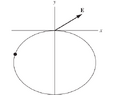
A point charge is placed somewhere on the curve shown in
Figure. This point charge creates an electric field at the origin.
Let ##E_y## be the vertical component of this field. What shape
(up to a scaling factor) should the curve take so that ##E_y## is inde-
pendent of the position of the point charge on the curve?
(b) You have a moldable material with uniform volume charge
density. What shape should the material take if you want to
create the largest possible electric field at a given point in
space? Be sure to explain your reasoning clearly.
Relevant Equations
Result for part a is the polar curve ##r^2 = C \sin \theta##
For part a) we have $$ E = \frac{Qy}{4 \pi \epsilon_0 (x^2 + y^2)^{3/2} } = \text{constant} $$
I am stuck on part b). What should the shape of the volume?...
 

Attachments
  • Selection_246.png
    Selection_246.png
    2.4 KB · Views: 85
Physics news on Phys.org
The problem I have with the argument of trying to use the first solution is that the first problem uses a fixed point charge. I am not too sure if we can turn a linear charge distribution into the point charge...i.e. I am not comfortable to say if we have a curve embedded in a uniformly charged volume will have the same amount of charge along the curve. In other words, maybe we could say find a curve with uniform charge density that yields the same y component electric field. This curve is not the same as the curve in the first solution.
 
Rob2024 said:
The problem I have with the argument of trying to use the first solution is that the first problem uses a fixed point charge.
No, it compares positions where a point charge may be placed. You need to do likewise in part b, as I hinted in post #4.
Please try to answer the question I posed there.
 
#5 has the answer to your question. I understand you are alluding to use the solution from part a) but I am not too sure if that's correct since part a)'s solution uses the condition ##Q## is constant. Thanks for the help. I'll think about this some more.
 
Rob2024 said:
#5 has the answer to your question.
It certainly does not have the answer I am looking for.
Given one shape for the body, you might try to increase the field by shifting little bits at the surface around (in a way that does not alter the direction of the field, by combining symmetric pairs of moves, say). If the shape is already optimum, what will you discover when trying this?