stephen8686
- 42
- 5
This problem is from David Morin's classical mechanics textbook:
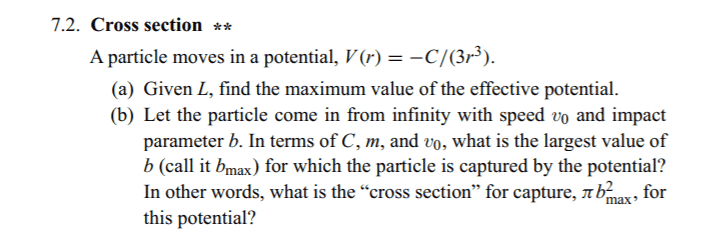
I am having trouble with Part b. Here is the textbook's answer:

I do not understand why large particle energies lead to capture. I would think that smaller energies would lead to capture because the particle wouldn't have enough energy to escape the gravitational potential, whereas large energy particles could woosh past. If someone could explain why my intuition is wrong, that would be very helpful.
I am having trouble with Part b. Here is the textbook's answer:
I do not understand why large particle energies lead to capture. I would think that smaller energies would lead to capture because the particle wouldn't have enough energy to escape the gravitational potential, whereas large energy particles could woosh past. If someone could explain why my intuition is wrong, that would be very helpful.