Maxwell kinetic energy distribution

Click For Summary
SUMMARY

The discussion focuses on calculating the fraction of molecules with kinetic energy (KE) between two values, K1 and K2, using the Maxwell kinetic energy distribution function. To achieve this, one must first convert the speed distribution into a number density function by multiplying it by the total number of particles. The relationship between kinetic energy and speed is given by the equation KE = ½mv², allowing for the determination of speed limits v1 and v2 corresponding to K1 and K2. Integration of the density function between these speed limits yields the desired fraction of molecules.

PREREQUISITES
  • Understanding of Maxwell-Boltzmann distribution
  • Familiarity with kinetic energy equations
  • Knowledge of integration techniques in calculus
  • Basic concepts of statistical mechanics
NEXT STEPS
  • Study the derivation of the Maxwell-Boltzmann speed distribution
  • Learn about integrating probability density functions
  • Explore applications of kinetic energy distribution in statistical mechanics
  • Review examples of kinetic energy calculations in gas systems
USEFUL FOR

Students and researchers in physics, particularly those studying thermodynamics and statistical mechanics, as well as anyone interested in molecular behavior in gases.

TeslaPow
Messages
40
Reaction score
1
Hello.

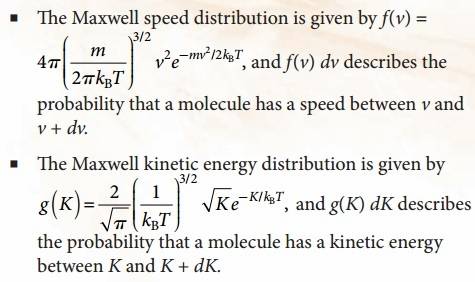
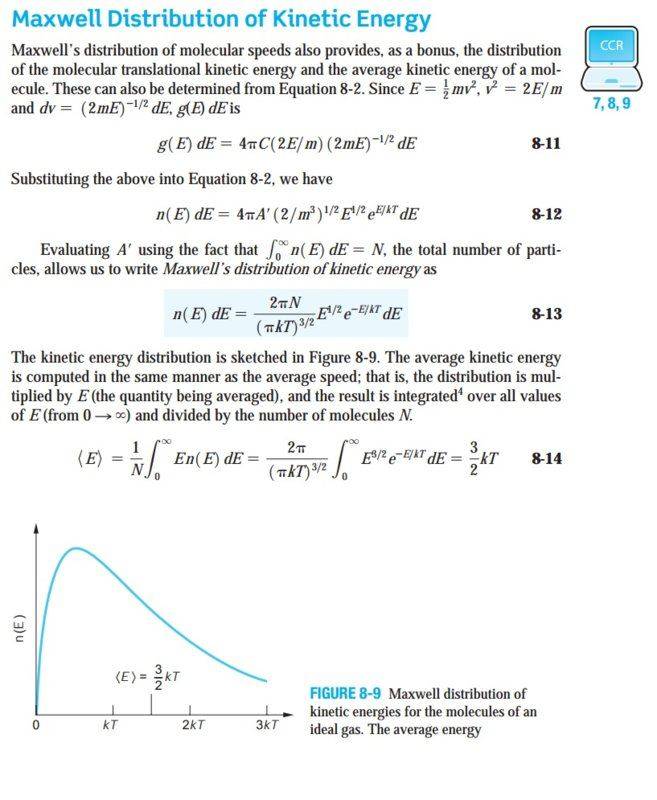
I need some guidance on how to find the fraction of molecules with KE between K1 and K2 from the Maxwell kinetic energy distribution function.
maxwell-kinetic.jpg


Here's an link to an earlier post where the speed distribution was integrated, how will I proceed with the kinetic energy distribution?

https://www.physicsforums.com/threads/maxwell-boltzmann-distribution.757539/#post-4772356
maxwell_kinetic.jpg
 

Attachments

  • maxwell-kinetic.jpg
    maxwell-kinetic.jpg
    22.7 KB · Views: 213
Physics news on Phys.org
Take your first equation from your first insert, the speed distribution which is a probability density function.
Now multiply by your total number of particles to make it a number density function. Remembering that ##KE=\tfrac{1}{2}m v^2## you have ##v_{1,2}=\sqrt{\frac{2K_{1,2}}{m}}## to get your range of speeds ##v_1## and ##v_2##. Integrate the density function between these two values.
 

Similar threads

  • · Replies 12 ·
Replies
12
Views
3K
  • · Replies 8 ·
Replies
8
Views
1K
  • · Replies 18 ·
Replies
18
Views
3K
  • · Replies 4 ·
Replies
4
Views
3K
  • · Replies 38 ·
2
Replies
38
Views
5K
  • · Replies 18 ·
Replies
18
Views
3K
  • · Replies 10 ·
Replies
10
Views
3K
  • · Replies 2 ·
Replies
2
Views
2K
  • · Replies 4 ·
Replies
4
Views
3K
  • · Replies 10 ·
Replies
10
Views
2K