Mean and Gaussian curvature for a Gaussian 'hill' seem wrong

Click For Summary
SUMMARY

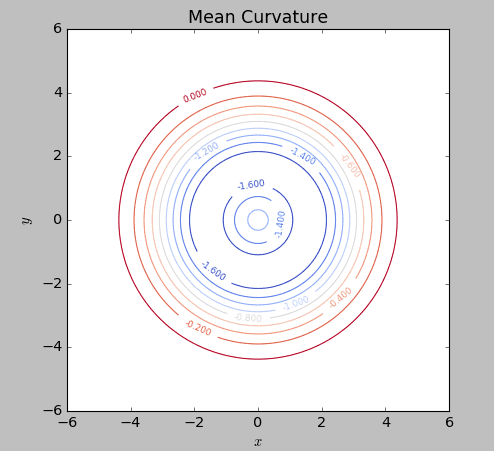
The forum discussion centers on the calculation of Gaussian and Mean curvature for a 3D Gaussian surface parameterized by the Monge patch representation, specifically the function f(x,y) = Ae^-(ax^2+by^2). Users express concerns about the accuracy of their contour plots, particularly regarding the signs of the curvature values. The calculations yield Gaussian curvature K(0,5) = -0.07, indicating negative curvature, which contradicts the positive values observed in the contour graphs. Participants suggest verifying the calculation methods and adjusting the number of contour lines displayed to ensure accurate representation.

PREREQUISITES
  • Differential geometry concepts, specifically Gaussian and Mean curvature
  • Understanding of Monge patch representation in 3D surfaces
  • Proficiency in calculus for deriving second derivatives (f_{xx}, f_{yy}, f_{xy})
  • Experience with contour plotting in mathematical software
NEXT STEPS
  • Review the derivation of Gaussian curvature formulas for 3D surfaces
  • Learn about contour plotting techniques in software like MATLAB or Python's Matplotlib
  • Investigate the relationship between curvature signs and surface shapes in differential geometry
  • Explore optimization techniques for simplifying complex curvature formulas
USEFUL FOR

Mathematicians, physicists, and engineers working with differential geometry, particularly those involved in surface modeling and curvature analysis.

Zaent
Messages
15
Reaction score
2
I'm hoping someone can help check whether my final contour plots look plausible based on the surface.

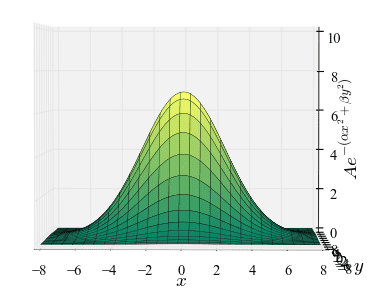
I haven't done too much differential geometry but I've needed to work with Gaussian/Mean curvature for a simple 3D gaussian surface. Here's an example:
upload_2017-4-15_4-20-3.png

(A = 7, a=b=1/(3.5)^2)

It's parameterised using Monge patch representation; the z axis is f(x,y) = Ae^-(ax^2+by^2).

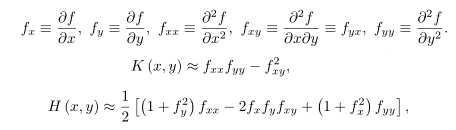
The Gaussian curvature K and Mean curvature H can be approximated via the following:
upload_2017-4-15_4-7-15.png


A little bit of calculation later, I end up with:
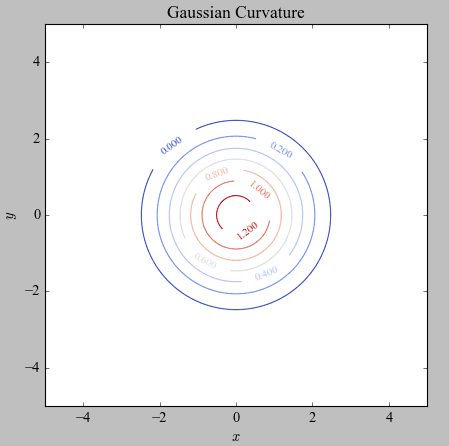
upload_2017-4-15_4-12-46.png


and

upload_2017-4-15_4-10-9.png
These don't look right to me, considering on my example surface there's clearly curvature beyond x=y~4 range. Also, should the Gaussian and Mean contours look more similar? If it seems like my method is sound yet these still look wrong then the error must be in my calculation code. I haven't been able to spot a mistake in it, though.

Many thanks.
 

Attachments

  • upload_2017-4-15_4-1-21.png
    upload_2017-4-15_4-1-21.png
    6.8 KB · Views: 647
  • upload_2017-4-15_4-9-53.png
    upload_2017-4-15_4-9-53.png
    14.4 KB · Views: 630
Physics news on Phys.org
I get K(0,5)=-0.07, so it looks to me like the calculations behind the contour graph of Gaussian Curvature are wrong.

Also, it looks from the first contour graph as though you are getting positive curvatures. They should be negative, as one can see from the shape of the 3D graph.

What formulas did you get for ##f_{xx},\ f_{yy},\ f_{xy}##?
 
  • Like
Likes   Reactions: Zaent
andrewkirk said:
I get K(0,5)=-0.07, so it looks to me like the calculations behind the contour graph of Gaussian Curvature are wrong.

Also, it looks from the first contour graph as though you are getting positive curvatures. They should be negative, as one can see from the shape of the 3D graph.

What formulas did you get for ##f_{xx},\ f_{yy},\ f_{xy}##?
Thank you for taking the time.

Here's what I have for the Gaussian curvature and how I got it:

upload_2017-4-15_13-48-24.png


My method for Mean curvature is similar.

Should all the Gaussian curvatures be negative? I had in my head that it'd be negative at the bottom and positive at the top, based on a few other surfaces I googled for comparison.
 

Attachments

  • upload_2017-4-15_13-43-42.png
    upload_2017-4-15_13-43-42.png
    14 KB · Views: 648
  • upload_2017-4-15_13-45-50.png
    upload_2017-4-15_13-45-50.png
    15.7 KB · Views: 625
Zaent said:
Thank you for taking the time.

Here's what I have for the Gaussian curvature and how I got it:
Your formula for K matches mine. Check the calculations you did with that formula. The values I get for y=0, x=(-6):6 are

-0.01784834 -0.06794136 -0.15450102 -0.14104856 0.23583912 0.92825319 1.30612245
0.92825319 0.23583912 -0.14104856 -0.15450102 -0.06794136 -0.01784834

These are different from the numbers on the contour graph.
Should all the Gaussian curvatures be negative? I had in my head that it'd be negative at the bottom and positive at the top, based on a few other surfaces I googled for comparison.
What you had in your head is right, and is what I meant. It does not match the contour graph, which seems to show only positive values.
 
  • Like
Likes   Reactions: Zaent
andrewkirk said:
Your formula for K matches mine. Check the calculations you did with that formula. The values I get for y=0, x=(-6):6 are

-0.01784834 -0.06794136 -0.15450102 -0.14104856 0.23583912 0.92825319 1.30612245
0.92825319 0.23583912 -0.14104856 -0.15450102 -0.06794136 -0.01784834

These are different from the numbers on the contour graph.
What you had in your head is right, and is what I meant. It does not match the contour graph, which seems to show only positive values.

I did this and got the exact same values, so then I checked my contour and changed how many lines it was showing. Duh. Here's what I have now:

upload_2017-4-16_0-40-9.png


I figure this must be right and I just wasn't showing enough lines. One thing that worries me is the mean curvature, should those all be negative? Here's the formula I get for that:

upload_2017-4-16_0-43-30.png


Thank you again, you're a saint.
 
Zaent said:
One thing that worries me is the mean curvature, should those all be negative?
The formula is a little too busy to check. I suggest you factorise it, to get all the common factors out of the way - the exponent and the constant A for a start. Also, it's better to write short formulas for ##f_x,f_{xx},f_{xy}## etc and then write the formula for ##H## in terms of those, to prevent the formula getting too big. Then you can check it for correctness.

FWIW I got the following values for H for y=0 and x= -6:6

0.09410179 0.05881300 -0.03535662 -0.12436133 -0.23370455 -0.50643935 -1.14285714
-0.50643935 -0.23370455 -0.12436133 -0.03535662 0.05881300 0.09410179

Omitting the denominator, which your formula above does, gives:

0.1132960 0.1136231 -0.1425589 -0.8866893 -1.6761835 -1.5515235 -1.1428571
-1.5515235 -1.6761835 -0.8866893 -0.1425589 0.1136231 0.1132960

The signs change, from + to - and back to +.
 
  • Like
Likes   Reactions: Zaent
andrewkirk said:
The formula is a little too busy to check. I suggest you factorise it, to get all the common factors out of the way - the exponent and the constant A for a start. Also, it's better to write short formulas for ##f_x,f_{xx},f_{xy}## etc and then write the formula for ##H## in terms of those, to prevent the formula getting too big. Then you can check it for correctness.

FWIW I got the following values for H for y=0 and x= -6:6

0.09410179 0.05881300 -0.03535662 -0.12436133 -0.23370455 -0.50643935 -1.14285714
-0.50643935 -0.23370455 -0.12436133 -0.03535662 0.05881300 0.09410179

Omitting the denominator, which your formula above does, gives:

0.1132960 0.1136231 -0.1425589 -0.8866893 -1.6761835 -1.5515235 -1.1428571
-1.5515235 -1.6761835 -0.8866893 -0.1425589 0.1136231 0.1132960

The signs change, from + to - and back to +.

I have the same values. Number of contour lines was the problem again. I appreciate all the help!
 

Similar threads

  • · Replies 2 ·
Replies
2
Views
3K
  • · Replies 8 ·
Replies
8
Views
2K
  • · Replies 1 ·
Replies
1
Views
4K
  • · Replies 1 ·
Replies
1
Views
2K
  • · Replies 12 ·
Replies
12
Views
2K
  • · Replies 5 ·
Replies
5
Views
3K
  • · Replies 30 ·
2
Replies
30
Views
2K
  • · Replies 4 ·
Replies
4
Views
2K
  • · Replies 7 ·
Replies
7
Views
10K
Replies
4
Views
1K