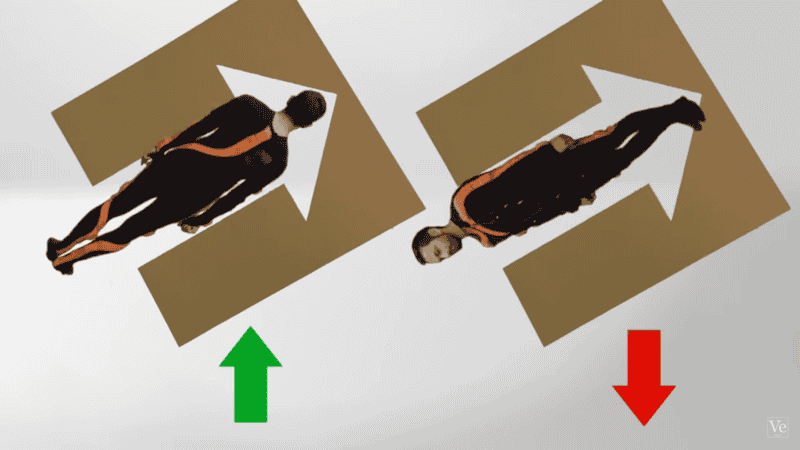
Measuring electron spin and measuring entangled electron spin

Join the discussion
Ask a follow-up here, or get your own question answered by working scientists, mathematicians and engineers — people, not an autocomplete.
Real named experts · corrections over time · the nuance an AI answer skips
12 replies · 2K views
Athraxin
Messages
20
Reaction score
2
Hi people,

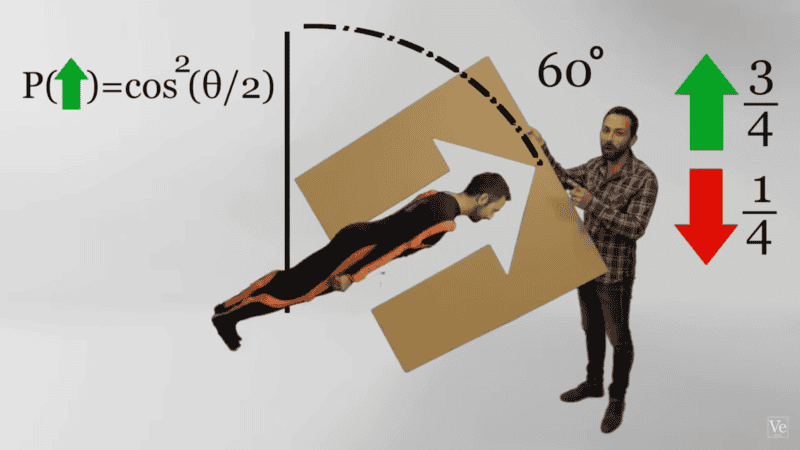
Lets assume, we have a stern gerlach setup and we are going to measure an atom's last orbit electron's spin with 60 degree from vertical axis. Therefore, in this case, our outcomes would be 3/4 for spin up, 1/4 for spin down.

Let's assume, we have the same setup but we are going to measure the spin of the last orbital electron of one of the entangled atoms with the same axis. In this case what would be the results for this action?
Entangled state:

1692444550200.png

Would it change the results or wouldn't it?
1692441680590.png

1692441730989.png

[1] - Veritasium.
 
Last edited:
Physics news on Phys.org
vanhees71 said:
I'd need more details about which experiment you have concretely in mind.
Suppose, we have a stern-gerlach setup, we are going to measure only one silver atom, (it is entangled with another silver atom but that partner is not in this setup we have only one of the entangled atoms in this setup), our magnetic measurer has shifted 60 degree from vertical axis by us. What would be the results of obtaining spin up and spin down for this atom's last orbital electron?
Our entangled state:
1692444326417.png

1692443178652.png
 
Last edited:
If you measure only the 1st atom, you can use its reduced state to describe its preparation, and this state is
$$\hat{\rho}_1=\mathrm{Tr}_2 \hat{\rho}_{12}=\frac{1}{2} \hat{1},$$
i.e., you simply have an unpolarized atom, and thus you'll find with probality 1/2 either the one or the other possible result ##\pm \hbar/2##, no matter in which direction you choose your measured spin component, i.e., the direction of the magnetic field.
 
Reply
  • Like
Likes   Reactions: Athraxin
vanhees71 said:
If you measure only the 1st atom, you can use its reduced state to describe its preparation, and this state is
$$\hat{\rho}_1=\mathrm{Tr}_2 \hat{\rho}_{12}=\frac{1}{2} \hat{1},$$
i.e., you simply have an unpolarized atom, and thus you'll find with probality 1/2 either the one or the other possible result ##\pm \hbar/2##, no matter in which direction you choose your measured spin component, i.e., the direction of the magnetic field.
So you say measuring doesn't alter the state for entangled state and we get %50 spin up and down. Thanks for your answer sir.
 
vanhees71 said:
That's because your initial state can be written in any other spin basis, and it'll always look the same, because it's the unique state (up to irrelevant phase factors) of total spin ##S=1## and ##\sigma=0##.
So you mean, for a single superposition state (
1692451584355.png
), this can be anything because we can alter probabilities (c1 and c2 complex numbers) with observing at different angles.

But for entangled state this is initially determined (
1692451628792.png
) and this is a unique state therefore we can only measure the outcomes as 1/2 and we cannot change its state with just observing.
 
Let ##|\sigma_{\vec{n}} \rangle## with ##\sigma_{\vec{n}} \in \{\hbar/2,-\hbar/2\}## be the eigenvectors of the spin-component-operator in direction ##\vec{n}##. Then your state is
$$|\Psi \rangle=\frac{1}{\sqrt{2}} (|\hbar/2_{\vec{n}} \rangle |-\hbar/2_{\vec{n}} \rangle + |-\hbar/2_{\vec{n}} \rangle |\hbar/2_{\vec{n}} \rangle),$$
for any direction ##\vec{n}##, because the state is simply the state of total spin ##S=1## and ##\Sigma=0##.

I don't know, what you mean by "changing its state". Is it about a projection measurement (sometimes called the "collapse of the state")? Then after measuring atom 1's spin component in the direction ##\vec{n}## having value ##+\hbar/2##, then the other atom must be found to have ##-\hbar/2## for the spin component in the same direction ##\vec{n}##.
 
vanhees71 said:
Let ##|\sigma_{\vec{n}} \rangle## with ##\sigma_{\vec{n}} \in \{\hbar/2,-\hbar/2\}## be the eigenvectors of the spin-component-operator in direction ##\vec{n}##. Then your state is
$$|\Psi \rangle=\frac{1}{\sqrt{2}} (|\hbar/2_{\vec{n}} \rangle |-\hbar/2_{\vec{n}} \rangle + |-\hbar/2_{\vec{n}} \rangle |\hbar/2_{\vec{n}} \rangle),$$
for any direction ##\vec{n}##, because the state is simply the state of total spin ##S=1## and ##\Sigma=0##.

I don't know, what you mean by "changing its state". Is it about a projection measurement (sometimes called the "collapse of the state")? Then after measuring atom 1's spin component in the direction ##\vec{n}## having value ##+\hbar/2##, then the other atom must be found to have ##-\hbar/2## for the spin component in the same direction ##\vec{n}##.
I meant altering the state by observing it (as in light polarization).
 
PeroK said:
To calculate the answer to your question you could transform that state into the "60 degree" basis. Is that within your capability?
If I had this capability, I wouldn't open this thread. :smile:
If you don't mean that?
1692453374289.png
 
Athraxin said:
If I had this capability, I wouldn't open this thread. :smile:
If you don't mean that? View attachment 330767
Definitely not. Here's a symmetry argument that requires no calculations. Your entangled state is symmetric in both particles and in the spin state expressed in the z-basis. Therefore, it must have a symmetric spin state in any other directional basis.
 
Reply
  • Like
Likes   Reactions: vanhees71
PeroK said:
Definitely not. Here's a symmetry argument that requires no calculations. Your entangled state is symmetric in both particles and in the spin state expressed in the z-basis. Therefore, it must have a symmetric spin state in any other directional basis.
Ok. I got it.