Mesh Equations and Polarity in Coupled Circuits

  • Context: Engineering 
  • Thread starter Thread starter ranju
  • Start date Start date
  • Tags Tags
    Circuits Coupled
Click For Summary

Discussion Overview

The discussion revolves around writing mesh equations for coupled circuits involving inductors and determining the polarity of voltages across these inductors. Participants explore the conventions for mutual inductance and how to apply them in mesh analysis.

Discussion Character

  • Homework-related
  • Technical explanation
  • Debate/contested

Main Points Raised

  • One participant expresses uncertainty about determining the polarity of the voltage across an inductor when writing mesh equations.
  • Another participant suggests using the assumed directions of loop currents and the dot notation convention to establish the polarities of voltages induced by mutual inductance.
  • There is a proposed convention regarding the reference polarity of mutual voltage based on current entering or leaving the dotted terminal of coils, which some participants confirm.
  • One participant questions how to proceed with determining the polarity of voltages across multiple inductors, suggesting that the current leaving one coil affects the polarities of others.
  • A later reply advises that the overall polarity does not need to be decided beforehand, suggesting that the mathematical analysis will clarify the signs of the voltages.
  • Another participant introduces the idea of inserting voltage sources in series with inductors to account for mutual coupling effects, explaining how to determine the contributions to the voltage based on current flow through the inductors.
  • There is a discussion about the orientation of voltage sources and their relationship to the current direction at the dotted terminal, with some participants expressing confusion about the expected current flow.

Areas of Agreement / Disagreement

Participants do not reach a consensus on the best approach to determine the polarities of voltages across the inductors, and multiple viewpoints regarding the conventions and methods remain present throughout the discussion.

Contextual Notes

Participants express uncertainty regarding the assumptions made about current directions and the implications for voltage polarity. The discussion highlights the complexity of applying mutual inductance concepts in mesh analysis without resolving these uncertainties.

ranju
Messages
221
Reaction score
3

Homework Statement


In the given attachment (supply has voltage v(t) , ) we have to write mesh equations .I am not getting how to decide the polarity of voltage across inductor ?

Homework Equations

The Attempt at a Solution


There's nothing much to do.. The only thing I am doubtful about is the polarity.
 

Attachments

  • IMG_20141001_184550.jpg
    IMG_20141001_184550.jpg
    43.1 KB · Views: 515
Last edited by a moderator:
Physics news on Phys.org
You're writing mesh equations so you have assumed the directions of loop currents. Use those directions along with the dot notation convention to determine the polarities of the voltages induced via mutual inductance.
 
Is the convention like this ?? : If a current enters (leaves) the dotted terminal of one coil, the reference polarity of the mutual voltage in the second coil is positive (negative) at the dotted terminal of the second coil.
 
ranju said:
Is the convention like this ?? : If a current enters (leaves) the dotted terminal of one coil, the reference polarity of the mutual voltage in the second coil is positive (negative) at the dotted terminal of the second coil.
Yes, that's it.
 
So how we will proceed.. I mean.. we should just consider one coil as the reference i.e. as current in L1 is leaving the coil then the polarity of voltages of L2 & L3 will be negative at the dotted terminal..?? then with which coil reference we will decide polarity of L1..??
 
ranju said:
So how we will proceed.. I mean.. we should just consider one coil as the reference i.e. as current in L1 is leaving the coil then the polarity of voltages of L2 & L3 will be negative at the dotted terminal..?? then with which coil reference we will decide polarity of L1..??
You don't have to decide the overall polarity of net potentials beforehand; let the math take care of sorting that out for you. It's like mesh currents, you make an assumption about directions and then do the math. Some will turn out positive and others negative, the math sorting it out.

For mutual inductors you may find it handy to insert a voltage source in series with each inductor. Orient them so that they would produce a current out the dot on their inductor. These sources are placeholders for where you'll gather together the induced voltages from the other inductors. So you'll see that the original inductors remain in the circuit and are treated as typical isolated components and the new voltage sources take on the coupling effects.
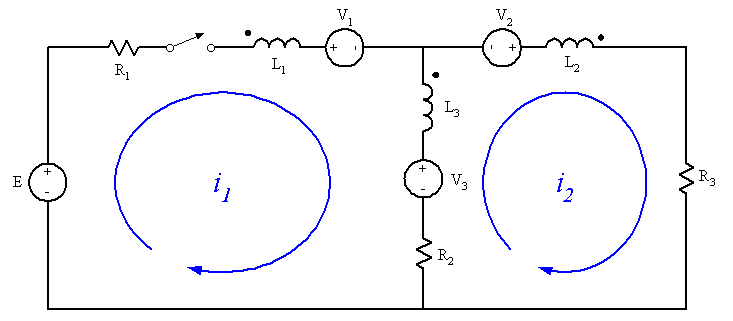
Fig1.gif


Now you can write mesh (or nodal) equations using these components easily enough. To work out the "value" of a given voltage source, look at the currents flowing through the other coupled inductors. If a current flows into a dot then add a positive term to the voltage for that inductor. If the current flows out of the dot then add a negative term. The terms are composed of the mutual inductance between the two inductors in question multiplied by the time derivative of the current in question (or if you're using the Laplace notation,##sM_{mn} I_n##, with the "s" operator implying the derivative).

For a concrete example, suppose the mutual inductances between the inductors in your circuit are ##M_{12},M_{23}, M_{13}##. For V3 you need to consider terms due to the currents flowing through ##L_1## and ##L_2##. In the figure, ##i_1## is flowing into the dot on ##L_1## so it's contributing term will be positive: ##+s M_{13} i_1##. On the other hand, ##i_2## flows out of the dot on ##L_2##, so it contributes a negative term: ##-s M_{23} i_2##. Thus:
$$V_3 = sM_{13} i_1 - sM_{23} i_2$$
Do the same for the other sources. Take note that the current flowing through ##L_3## is ##i_1 - i_2##, so the terms contributed to ##V_1## and ##V_2## have that as their current!
 
gneill said:
Orient them so that they would produce a current out the dot on their inductor.
but according to the polarity of voltage sources it seems as is current is entering the dot.!
 
ranju said:
but according to the polarity of voltage sources it seems as is current is entering the dot.!
I'm not sure why you'd say that. Take a look at, say, V2 paired with L2:

Fig2.gif

V2's potential would like to drive current in the direction through L2 and out of its dot.
 

Similar threads

  • · Replies 1 ·
Replies
1
Views
2K
  • · Replies 34 ·
2
Replies
34
Views
7K
  • · Replies 7 ·
Replies
7
Views
2K
  • · Replies 8 ·
Replies
8
Views
2K
  • · Replies 7 ·
Replies
7
Views
3K
  • · Replies 1 ·
Replies
1
Views
2K
  • · Replies 5 ·
Replies
5
Views
2K
  • · Replies 8 ·
Replies
8
Views
2K
  • · Replies 4 ·
Replies
4
Views
7K
Replies
4
Views
3K