Michelson Interferometer ring contraction

Click For Summary
SUMMARY

The discussion focuses on the physical phenomenon of ring contraction in a Michelson Interferometer when the separation between mirrors is reduced. The equation mλ = 2Lcosθ establishes that as the distance L decreases, cosθ increases, leading to the contraction of the fringes. It is confirmed that the direction of movement of the mirrors does not affect this contraction, and a movable marker can be used to visually demonstrate the radial inward movement of the fringes as the distance d decreases. Ultimately, when the mirrors coincide, only a bright area appears on the screen, indicating complete contraction of the fringes.

PREREQUISITES
  • Understanding of the Michelson Interferometer setup
  • Familiarity with the equation mλ = 2Lcosθ
  • Basic knowledge of wave interference and fringe patterns
  • Concept of angular relationships in right-angled triangles
NEXT STEPS
  • Study the principles of wave interference in detail
  • Learn about the mathematical derivation of fringe patterns in interferometry
  • Explore practical applications of the Michelson Interferometer in measuring distances
  • Investigate the effects of mirror alignment on interference patterns
USEFUL FOR

Physics students, optical engineers, and researchers interested in wave optics and interferometry will benefit from this discussion.

epsilon
Messages
29
Reaction score
1
I have been trying for hours to understand what is physically causing the interferometric rings to contract when the separation of the mirrors is reduced.
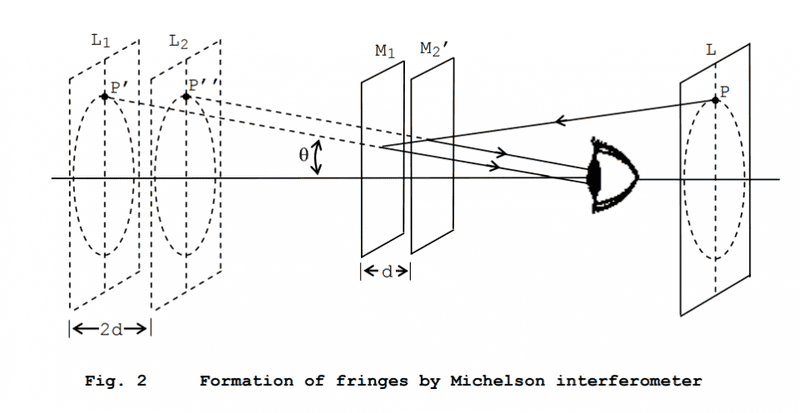
df178ac5183850e78f12a22a2ac873d2.png


From the equation: m\lambda = 2Lcos\theta, where m is the number of fringes, if we consider just one fringe at a fixed wavelength, m\lambda is constant and hence 2Lcos\theta is also constant.

Hence reducing L causes cos\theta to increase, which is analogous to reducing \theta. [Is this where I'm going wrong?]

Question 1: When reducing d in the image above, does it matter if we are moving L_1 towards L_2 or vice versa? (Is it directionally dependent?)

Question 2: The image suggests that \theta is only linked to L_1. If I move L_1 towards L_2, the adjacent side of the right-angled triangle is getting shorter, and hence \theta must be increasing. But this goes against what happens when it is considered mathematically.

How can we tell PHYSICALLY whether the rings are contracting or expanding? Thank you.
 
Science news on Phys.org
epsilon said:
Hence reducing L causes cos\theta to increase, which is analogous to reducing \theta. [Is this where I'm going wrong?]
That's correct, and should confirm that the fringes contract when the mirror separation is reduced.
epsilon said:
Question 1: When reducing d in the image above, does it matter if we are moving L1L_1 towards L2L_2 or vice versa? (Is it directionally dependent?)

It doesn't matter.
epsilon said:
Question 2: The image suggests that θ\theta is only linked to L1L_1. If I move L1L_1 towards L2L_2, the adjacent side of the right-angled triangle is getting shorter, and hence θ\theta must be increasing. But this goes against what happens when it is considered mathematically.

I don't get your point.
epsilon said:
How can we tell PHYSICALLY whether the rings are contracting or expanding? Thank you.
I think you can place a movable marker on a particular fringe, when you decrease ##d##, this marker should go radially inward. That's when you would say the fringes are contracting.
Btw, notice that the zeroth order is located at infinity. This means, if you decrease ##d##, all fringes will actually contract such that in the end there is only bright area on the screen when ##d=0##, i.e. when the mirrors coincide.
 
  • Like
Likes   Reactions: epsilon
blue_leaf77 said:
That's correct, and should confirm that the fringes contract when the mirror separation is reduced.

It doesn't matter.

I don't get your point.

I think you can place a movable marker on a particular fringe, when you decrease ##d##, this marker should go radially inward. That's when you would say the fringes are contracting.
Btw, notice that the zeroth order is located at infinity. This means, if you decrease ##d##, all fringes will actually contract such that in the end there is only bright area on the screen when ##d=0##, i.e. when the mirrors coincide.

Thank you, that was quite helpful (still slight uncertainty but better understanding now than before!)
 

Similar threads

  • · Replies 9 ·
Replies
9
Views
3K
Replies
0
Views
1K
Replies
2
Views
2K
  • · Replies 10 ·
Replies
10
Views
3K
Replies
8
Views
6K
  • · Replies 6 ·
Replies
6
Views
4K
Replies
1
Views
2K
  • · Replies 4 ·
Replies
4
Views
3K
  • · Replies 1 ·
Replies
1
Views
3K
  • · Replies 1 ·
Replies
1
Views
3K