Missing technique used to find acceleration of a 4-bar mechanism?

Click For Summary

Homework Help Overview

The discussion revolves around a technique used to find the normal acceleration of a link in a 4-bar mechanism. The original poster is seeking clarification on the method, which involves drawing circles based on the link's length and velocity vector to determine acceleration.

Discussion Character

  • Exploratory, Conceptual clarification, Mathematical reasoning

Approaches and Questions Raised

  • The original poster describes a method involving circles to find normal acceleration and asks for the name of this technique and examples. Participants inquire about the positioning of the circles and provide details on the setup of the mechanism.

Discussion Status

Participants are actively engaging with the original poster's inquiry, providing clarifications about the geometric setup and discussing the application of Pythagorean theorem in this context. Some guidance has been offered regarding the mathematical relationships involved.

Contextual Notes

The original poster mentions a lack of understanding of the technique's name and seeks further examples, indicating a potential gap in foundational knowledge about the method being discussed.

MechE
Messages
5
Reaction score
0
Hi there!
There is a technique that is being used by my lecturer for mechanisms course at uni and i could not understand how this technique is manipulated.I wish i would know this methods name but no chance!.
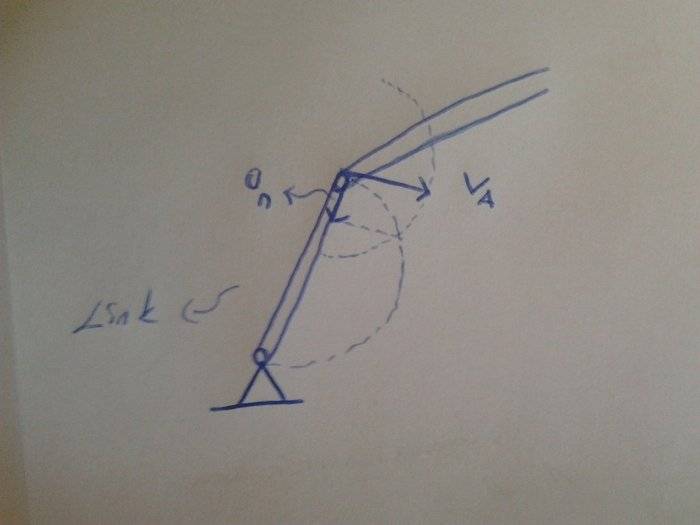
This technique is being used to find normal acceleration of link in 4-bar mechanism.Manipulation:If you know the velocity of a link then draw a semi circle whose diameter is link's length and draw another circle whose radius is velocity vector and intersect these two circles then you obtain the normal acceleration of link.
What is the name of this method?
How can i find more examples on this method?
Thank you very much!
21418hl.jpg
 
Last edited:
Physics news on Phys.org
Where is the second circle centred in relation to the first?
 
haruspex said:
Where is the second circle centred in relation to the first?
First circle centered at midpoint of link
Second circle is centered at the rotating tip of link.
(Assume link is grounded at one point.And second point is rotating at a constant angular velocity-it is a 4-bar mechanism)
I will upload a picture of it.
 
MechE said:
First circle centered at midpoint of link
Second circle is centered at the rotating tip of link.
(Assume link is grounded at one point.And second point is rotating at a constant angular velocity-it is a 4-bar mechanism)
I will upload a picture of it.
Very cute.
It's just an application of Pythagoras. Let the bar be AB, length 2r. Let C be the centre of the bar, P be the point where the arcs intersect and N where the perpendicular from P to the bar meets the bar. Then v = BP, CB=CP = r, BN = a. Applying Pythagoras to CNP, (r-a)2+PN2=r2. Applying it to BNP, a2+PN2=v2. Subtract one equation from the other and you end up with a = v2/2r.
When using this drawing technique, you have to scale velocity to distance in such a way as to ensure the curves intersect. That same scaling applies to the ratio of acceleration to velocity, enabling you to interpret the result.
 
haruspex said:
Very cute.
It's just an application of Pythagoras. Let the bar be AB, length 2r. Let C be the centre of the bar, P be the point where the arcs intersect and N where the perpendicular from P to the bar meets the bar. Then v = BP, CB=CP = r, BN = a. Applying Pythagoras to CNP, (r-a)2+PN2=r2. Applying it to BNP, a2+PN2=v2. Subtract one equation from the other and you end up with a = v2/2r.
When using this drawing technique, you have to scale velocity to distance in such a way as to ensure the curves intersect. That same scaling applies to the ratio of acceleration to velocity, enabling you to interpret the result.
Thank you for explanation.This was what i was looking for.
 

Similar threads

  • · Replies 1 ·
Replies
1
Views
7K
  • · Replies 5 ·
Replies
5
Views
4K
Replies
1
Views
2K
  • · Replies 6 ·
Replies
6
Views
3K
  • · Replies 1 ·
Replies
1
Views
4K
Replies
1
Views
5K
  • · Replies 1 ·
Replies
1
Views
2K
  • · Replies 15 ·
Replies
15
Views
3K
Replies
2
Views
6K
  • · Replies 6 ·
Replies
6
Views
7K