Mixture problem. How to solve for C?

  • Thread starter Thread starter Jeff12341234
  • Start date Start date
  • Tags Tags
    Mixture
Click For Summary
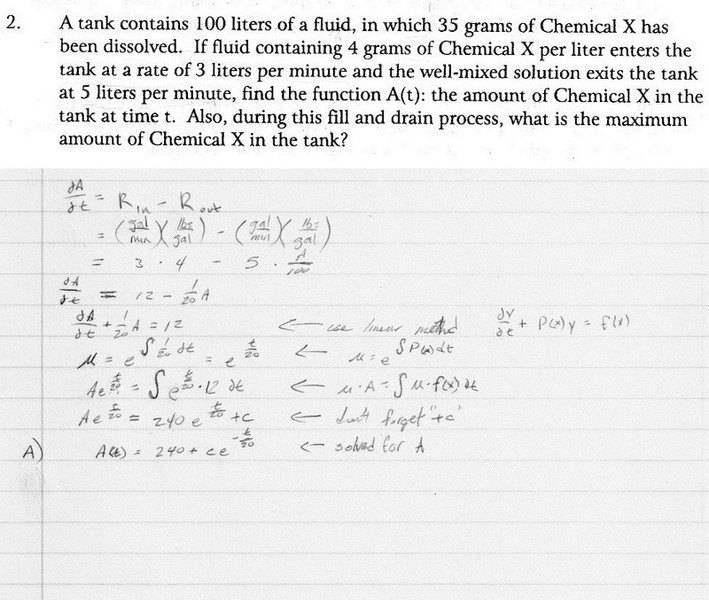
To solve for concentration C in a mixture problem, two differential equations are necessary: one for volume and another for the chemical concentration. The volume equation is dV/dt = fin - fout, while the concentration equation is d(VC)/dt = fin*C_in - fout*C. By multiplying the volume equation by C and subtracting it from the concentration equation, the relationship V*dC/dt = fin*(C_in - C) is derived. This leads to the integral form dC/(C_in - C) = fin*dt/(V_0 + (fin - fout)t). With the initial condition A(0) = 35, C can be solved effectively.
Jeff12341234
Messages
179
Reaction score
0
I need to solve for C. I know it's probably simple but i don't remember how to. This is what I have so far:
FgCaDxf.jpg
 
Physics news on Phys.org
Because the volume flow rate entering is different from the volume flow rate leaving, you need to write down two differential equations, rather than 1:

Volume Input - Volume Output = accumulation for the volume of fluid in the tank

Chemical X Input - chemical X Output = accumulation for chemical X in the tank

If V(t) is the volume of fluid in the tank at time t, fin is the volumetric flow rate of fluid in, and f_out is the volumetric flow rate of fluid out, what is the differential equation for V?

If C(t) is the concentration of chemical X within the tank at time t, and C_in is the concentration of chemical X in the feed to the tank, what is the differential equation for the rate of change of total chemical X in the tank?

The next step is to multiply the differential equation for V by C, and subtract the resulting relationship from the mass balance on chemical X.
 
I don't follow.. The way I did it is the way the professor instructed us and the steps match the steps in his example. To solve for C, I now realize from an example in the book that A(0)=35. With that information, I can solve for C.

WYp5JqT.png
 
OK. I see what you did, and, of course, it is right. But, here's my alternate version to consider:

\frac{dV}{dt}=f_{in}-f_{out}
\frac{d(VC)}{dt}=f_{in}C_{in}-f_{out}C
Multiply the first equation by C and subtract it from the second equation:

V\frac{dC}{dt}=f_{in}(C_{in}-C)

where V=V_0+(f_{in}-f_{out})t
So,

\frac{dC}{(C_{in}-C)}=f_{in}\frac{dt}{V_0+(f_{in}-f_{out})t}
 
Question: A clock's minute hand has length 4 and its hour hand has length 3. What is the distance between the tips at the moment when it is increasing most rapidly?(Putnam Exam Question) Answer: Making assumption that both the hands moves at constant angular velocities, the answer is ## \sqrt{7} .## But don't you think this assumption is somewhat doubtful and wrong?

Similar threads

  • · Replies 5 ·
Replies
5
Views
2K
  • · Replies 4 ·
Replies
4
Views
450
  • · Replies 2 ·
Replies
2
Views
3K
Replies
21
Views
3K
  • · Replies 0 ·
Replies
0
Views
1K
Replies
4
Views
1K
Replies
6
Views
1K
  • · Replies 5 ·
Replies
5
Views
2K
  • · Replies 3 ·
Replies
3
Views
2K
  • · Replies 9 ·
Replies
9
Views
2K