Mode of operation for transistor

  • Thread starter Thread starter magnifik
  • Start date Start date
  • Tags Tags
    Mode Transistor
Click For Summary

Discussion Overview

The discussion revolves around determining the mode of operation for a transistor circuit, specifically whether it is in active or saturation mode. Participants explore the relationships between voltages and currents in the circuit, applying Kirchhoff's Voltage Law (KVL) and discussing the implications of various resistor values.

Discussion Character

  • Technical explanation
  • Mathematical reasoning
  • Debate/contested

Main Points Raised

  • One participant expresses uncertainty about the node between two resistors and whether it corresponds to the base or collector of the transistor.
  • Another participant clarifies that the base is indeed the node between the two resistors.
  • There is a discussion about the collector voltage (Vc) and its relation to the resistors, with questions about whether Vc is the voltage across the 300-ohm resistor.
  • One participant calculates the base voltage (Vb) and collector voltage (Vc) using given values, leading to a conclusion that the transistor is not in active mode based on the calculated Vec.
  • Another participant agrees with the assessment that the transistor is not in active mode and suggests re-solving for saturation mode.
  • A later reply proposes a method to solve for the emitter current (Ie) and subsequently the collector current (Ic) and base current (Ib) to confirm the saturation mode assumption.

Areas of Agreement / Disagreement

Participants generally agree on the calculations and the need to re-evaluate the mode of operation, but there remains uncertainty about the specific roles of the voltages and currents in the circuit, as well as the implications of the resistor values.

Contextual Notes

There are unresolved assumptions regarding the definitions of voltages and currents in the circuit, particularly in relation to the active and saturation modes of operation.

Who May Find This Useful

Readers interested in transistor operation, circuit analysis, and the application of Kirchhoff's laws may find this discussion relevant.

magnifik
Messages
350
Reaction score
0
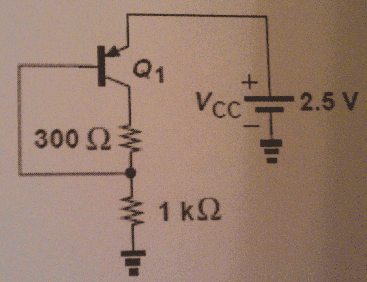
I am trying to determine the mode of operation for the following circuit and find the voltages and currents:
zsmgkh.png


I am given that β = 50

I know that VEC > VEC,sat for a transistor in active mode
I applied KVL on the right loop and got:
VCC = 300Ic + 1000Ic + VEC
VEC = VCC - 1300Ic

i'm not sure if the above is right or where to go from here. what is throwing me off is the 300 Ω resistor connected to the 1kΩ resistor. is the node between the two B or C? or are B and C equal in this case?

thanks in advance.
 
Physics news on Phys.org
Assuming the transistor is on, what must be the base voltage without writing down any equations at all?
 
rude man said:
Assuming the transistor is on, what must be the base voltage without writing down any equations at all?

VBE = VBE,on = 0.7 V (as defined in the text)
 
That's the voltage between the base and the emitter. So what's the voltage at the base?
 
rude man said:
That's the voltage between the base and the emitter. So what's the voltage at the base?


i'm unsure. is it the voltage at that node between the two resistors?
 
Why yes, the base is the node between the two resistors.
 
what confuses me about this is the position of Vc. normally, it is the voltage across the bottom resistor, but since there are two resistors with a node in between, is Vc the voltage across the 300-ohm resistor? or does Ic occur in both the 300-ohm and 1k-ohm resistor
 
Vc is the collector voltage to ground. "c" stands for "collector".

The base voltage is Vb = Vcc - Vbe = Vcc - 0.7V.

Ic is the current flowing out of the collector.
 
Vcc = Vbe,on + Vb
--> Vb = 2.5 - 0.7 = 1.8

Vb/1000 + (Vb-Vc)/300 = 0
1.8/1000 + 1.8-Vc/300 = 0
--> Vc = 2.34

Ic = 1.8/1000 = 1.8 mA

2.5 = Vec + 300Ic + 1000Ic
--> Vec = .16

since Vec = 0.2 in this problem and Vec is less than this, the transistor is not in active mode so i re-solve for saturation mode?
 
  • #10
magnifik said:
Vcc = Vbe,on + Vb
--> Vb = 2.5 - 0.7 = 1.8

Vb/1000 + (Vb-Vc)/300 = 0
1.8/1000 + 1.8-Vc/300 = 0
--> Vc = 2.34

Ic = 1.8/1000 = 1.8 mA

2.5 = Vec + 300Ic + 1000Ic
--> Vec = .16

since Vec = 0.2 in this problem and Vec is less than this, the transistor is not in active mode so i re-solve for saturation mode?

Yes that's exactly right, sorry for the delay in answering.

So now what do you do? (Hint - the base current is no longer assumable to be ic/50).
 
  • #11
i solve for Ie then do the KVL for the CE loop. then solve for Ic from that equation. then get Ib from the relationship Ib = Ie - Ie. if Ib and Ic are both positive then the saturation mode assumption is correct.

thanks for pointing me in the right direction!
 
  • #12
Yer' welcome! Post your results if you care to.
 

Similar threads

  • · Replies 17 ·
Replies
17
Views
3K
Replies
4
Views
3K
Replies
3
Views
2K
  • · Replies 2 ·
Replies
2
Views
4K
  • · Replies 1 ·
Replies
1
Views
3K
Replies
80
Views
5K
  • · Replies 10 ·
Replies
10
Views
3K
Replies
68
Views
7K
  • · Replies 13 ·
Replies
13
Views
3K