Modeling a ball thrown vertically including drag from air resistance

Click For Summary

Discussion Overview

The discussion revolves around modeling the motion of a ball thrown vertically with an initial velocity \( v_0 \), taking into account the effects of air resistance represented by a drag constant \( D \). Participants explore the formulation of a differential equation to describe this motion and discuss methods for solving it, including simplifications and alternative approaches.

Discussion Character

  • Technical explanation
  • Mathematical reasoning
  • Exploratory

Main Points Raised

  • One participant presents a differential equation for the ball's motion and seeks confirmation of its correctness and alternative solving methods.
  • Another participant suggests that the equation can be simplified by canceling terms and introduces parameters \( \alpha \) and \( \beta \) to aid in the solution.
  • A participant expresses confidence in the graphical behavior of the solution as \( D \) approaches zero, despite not deriving it mathematically.
  • One participant provides a simplified expression for velocity, \( v \), in terms of \( v_0 \), \( g \), and \( \alpha \), suggesting it may be easier to work with.
  • Another participant acknowledges the improvement in the expression and suggests verifying for potential mistakes in the simplification process.
  • A later reply proposes a substitution method involving \( u = Dv \) and \( a = \sqrt{mg} \) as another approach to solving the problem.

Areas of Agreement / Disagreement

Participants express varying degrees of confidence in their formulations and simplifications, but no consensus is reached on a definitive solution or method. Multiple approaches and perspectives remain present in the discussion.

Contextual Notes

Some participants note the potential for simplification and alternative methods, but the discussion includes unresolved mathematical steps and assumptions regarding the behavior of the model under different conditions.

MigMRF
Messages
15
Reaction score
0
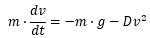
So I'm trying to figure out how to model a ball getting thrown vertically with the starting velocity v_0. So I've come up with a differential equation which I'm pretty sure is correct:
1576515377922.png

Where D is a constant. So far so good. My problem is solving this. This is my attempt:
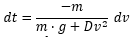
1576515472543.png

1576515451893.png

And when i do this and isolate v(t) i get this:
1576515564441.png

First of all, can anyone confirm this? It should only be used between t=0 and when the graph cross the x-axis. Secondly: Is there another waay to solve this.
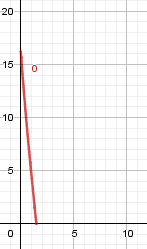
BTW. if anyone were curios the fuction looks like this (for m=0.05 D=0.00085 g=9.82 v_0=16)
1576515835423.png
 
Last edited by a moderator:
Physics news on Phys.org
MigMRF said:
So I'm trying to figure out how to model a ball getting thrown vertically with the starting velocity v_0. So I've come up with a differential equation which I'm pretty sure is correct:
View attachment 254204
Where D is a constant. So far so good. My problem is solving this. This is my attempt:
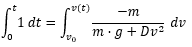
View attachment 254206
View attachment 254205
And when i do this and isolate v(t) i get this:
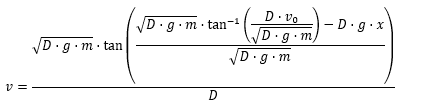
View attachment 254207
First of all, can anyone confirm this?

That looks right (although it has ##x## instead of ##t## in there), but it can be significantly simplified by cancelling terms. Try using the parameter ##\alpha = \sqrt{\frac{D}{mg}}##.

PS You could also then try ##\beta = \tan(g\alpha t)##. That will sort out the inverse tangents.

PPS can you show that your solution tends to ##v = v_0 - gt## as ##D \rightarrow 0##?
 
Last edited:
PeroK said:
That looks right (although it has ##x## instead of ##t## in there), but it can be significantly simplified by cancelling terms. Try using the parameter ##\alpha = \sqrt{\frac{D}{mg}}##.

PS You could also then try ##\beta = \tan(g\alpha t)##. That will sort out the inverse tangents.

PPS can you show that your solution tends to ##v = v_0 - gt## as ##D \rightarrow 0##?
Well not from the math, but it pretty sure it does looking at it from a graphical point of view.
1576522748945.png

In this example I've plottet the same things as before but with an v_0-g*t graph and they are pretty close. When you increase the mass they get closer and closer (drag goes down) while an increase in drag makes them go apart (with drag getting v=0 before nondrag ofc)
 
I simplified things down to:
$$v = \frac{v_0 - \frac g \alpha \tan(\alpha t)}{1 + \frac{v_0 \alpha}{ g} \tan(\alpha t)}$$
Where ##\alpha = \sqrt{\frac{Dg}{m}}##

Which might be a bit easier to work with.
 
  • Like
Likes   Reactions: MigMRF
PeroK said:
I simplified things down to:
$$v = \frac{v_0 - \frac g \alpha \tan(\alpha t)}{1 + \frac{v_0 \alpha}{ g} \tan(\alpha t)}$$
Where ##\alpha = \sqrt{\frac{Dg}{m}}##

Which might be a bit easier to work with.
Thanks! It looks better this way, that's for sure :)
 
MigMRF said:
Thanks! It looks better this way, that's for sure :)

It's not hard to get from your function to that. It might be worth it to check I haven't made any mistakes.
 
I will put it back up that you could also do a u sub where ##u=Dv## and ##a=\sqrt{mg}##. Then use an inverse trig table.
 

Similar threads

  • · Replies 7 ·
Replies
7
Views
7K
  • · Replies 11 ·
Replies
11
Views
2K
  • · Replies 13 ·
Replies
13
Views
4K
  • · Replies 11 ·
Replies
11
Views
3K
  • · Replies 1 ·
Replies
1
Views
2K
  • · Replies 2 ·
Replies
2
Views
2K
  • · Replies 8 ·
Replies
8
Views
18K
Replies
6
Views
3K
  • · Replies 4 ·
Replies
4
Views
2K
  • · Replies 12 ·
Replies
12
Views
3K