Moment of Inertia for a hollow Sphere

Click For Summary

Discussion Overview

The discussion revolves around the derivation of the moment of inertia for a hollow sphere, exploring the mathematical steps involved and addressing confusions regarding the notation and integration process. Participants engage in clarifying the derivation and discussing different approaches to calculating moment of inertia.

Discussion Character

  • Technical explanation
  • Debate/contested
  • Mathematical reasoning

Main Points Raised

  • One participant expresses confusion about the use of the lowercase "r" in the derivation, suggesting it was used to cancel out one of the "R's".
  • Another participant claims that the "r" is a misprint and should be read as "R".
  • A follow-up question is raised regarding why "R" is used in the expression derived from the differential area dA, considering that the radius is changing.
  • Clarification is provided that the circumference is given by 2πRsinφ and the thickness is Rdφ.
  • Another participant proposes an alternative method for calculating the moment of inertia of a hollow sphere by subtracting the moment of inertia of a smaller solid sphere from that of a larger solid sphere, using cylindrical coordinates for the integration.

Areas of Agreement / Disagreement

Participants generally agree on the confusion regarding the notation, with some suggesting it is a misprint. However, the discussion includes multiple approaches to calculating the moment of inertia, indicating that no consensus exists on the best method.

Contextual Notes

There are unresolved questions about the notation and the implications of changing radii in the derivation. The integration limits and specific steps in the alternative method proposed are not fully detailed.

Xyius
Messages
501
Reaction score
4
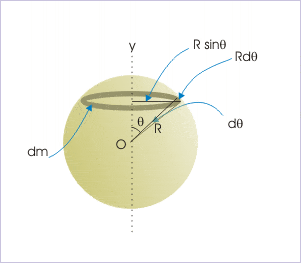
I am confused about one thing on this derivation. Okay so the guide I am following goes like this..

-------------------------------------
mi10b.gif


\sigma=\frac{M}{A}

dm=\sigma dA=(\frac{M}{4\pi R^2})2\pi rsin\phi Rd\phi

dm=\frac{M}{2}sin\phi d\phi​

This is one part that confuses me. It seems as though the lower case "r" was used to cancel out one of the "R's" on the bottom. I can't reason another way how it went away. The rest of the derivation goes like this.. (Just in case anyone needs it)

Here, radius of elemental ring about the axis is R sinθ. Moment of inertia of elemental mass is :
dI=R^2sin^2\phi dm=R^2sin^2\phi (\frac{M}{2}sin\phi d\phi)​

Therefore the total moment of inertia is..

\oint R^2sin^2\phi (\frac{M}{2}sin\phi d\phi)
\frac{MR^2}{2}\oint sin^3\phi d\phi = \frac{MR^2}{2}\oint (1-cos^2\phi )sin\phi d\phi = \frac{MR^2}{2}\oint sin\phi - sin\phi cos^2\phi d\phi = \frac{MR^2}{2}(-cos\phi +\frac{1}{3} cos^3\phi )​

The limits are 0 to \pi hence..
I=\frac{2}{3}MR^2​
 
Physics news on Phys.org
Welcome to PF!

Hi Xyius! Welcome to PF! :wink:
Xyius said:
… It seems as though the lower case "r" was used to cancel out one of the "R's" on the bottom …

It's a misprint … there is no r ! :biggrin:

read it as R. :smile:


tiny-tim said:
It's a misprint … there is no r ! :biggrin:

read it as R. :smile:

Thanks! But since that expression came from the differential dA, why is it "R"?? Because the radius is constantly changing right?
 
Yup! The circumference is 2πRsinφ, and the thickness is Rdφ. :smile:
 
tiny-tim said:
Yup! The circumference is 2πRsinφ, and the thickness is Rdφ. :smile:

Ohh! Makes sense now! Cool thanks a lot! :D
 
The best way to calculate the moment of inertia (MOI) of a hollow sphere is to calculate the MOI of two solid spheres, and subtract the MOI of the smaller sphere from the MOI of the larger sphere.

The best way to calculate the MOI of a solid sphere is to use cylindrical coordinate system, r, θ, z. Using ρ as density, the basic form of the integral is

I = ∫∫∫ρ·r2·r·dr·dθ·dz

where r is the perpendicular distance from the axis of rotation, R is the radius of the sphere, and ρ = M/(4πR3/3). Do the z integration last. You will need to determine and use the appropriate integration limits. Hint: Use Phythagorean theorem.

Bob S
 

Similar threads

Replies
1
Views
360
  • · Replies 17 ·
Replies
17
Views
3K
  • · Replies 10 ·
Replies
10
Views
3K
  • · Replies 1 ·
Replies
1
Views
1K
  • · Replies 9 ·
Replies
9
Views
2K
  • · Replies 2 ·
Replies
2
Views
6K
  • · Replies 12 ·
Replies
12
Views
2K
  • · Replies 1 ·
Replies
1
Views
2K
  • · Replies 7 ·
Replies
7
Views
2K
  • · Replies 2 ·
Replies
2
Views
2K