Momentum at time t and at a time t+dt for a rocket

  • Context: Graduate 
  • Thread starter Thread starter mcastillo356
  • Start date Start date
  • Tags Tags
    Momentum Rocket Time
Click For Summary
SUMMARY

The discussion focuses on the dynamics of variable-mass motion, specifically in the context of rocket propulsion. The equation governing this motion is expressed as Fext + vrel (dm/dt) = m (dv/dt), where Fext represents the net external force, vrel is the relative velocity of the mass being ejected, and m is the mass of the rocket. Participants clarified the use of dm in the equation, noting that it represents mass loss during propulsion, thus dm is negative when considering mass ablation. The discussion also emphasizes that the velocities are relative to any inertial reference frame, with Earth being a common example.

PREREQUISITES
  • Understanding of variable-mass systems in physics
  • Familiarity with Newton's laws of motion
  • Knowledge of momentum conservation principles
  • Basic proficiency in calculus, particularly derivatives
NEXT STEPS
  • Study the derivation of the variable-mass motion equation in detail
  • Explore applications of variable-mass systems in rocketry and aerospace engineering
  • Learn about momentum conservation in non-constant mass systems
  • Investigate the role of relative velocity in physics problems
USEFUL FOR

This discussion is beneficial for physics students, aerospace engineers, and anyone interested in the principles of rocket dynamics and variable-mass motion systems.

mcastillo356
Gold Member
Messages
658
Reaction score
361
Hello, my name is Marcos, I have a bachelor in advertising and public relations, and my hobby is maths and physics
The equation of variable-mass motion is written as ##\mathbf{F}_{ext}+\mathbf{v}_{rel}\dfrac{dm}{dt}=m\dfrac{d\mathbf{v}}{dt}##
There are different derivations for the equation:
Mass accretion:
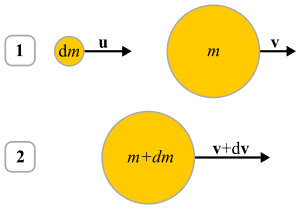
1575939389252.png

Mass ablation/ejection:
1575939579538.png

The initial momentum of the system is ##\mathbf{p}_1=m\mathbf{v}##. Since the mainbody will be losing mass, ##dm## will be negative. At a time ##t+dt## the momentum is ##\mathbf{p}_2=(m+dm)(\mathbf{v}+d\mathbf{v})+\mathbf{u}(-dm)##. Why in the same equation ##dm## is first positive and at the end negative?.
Full text at https://en.wikipedia.org/wiki/Variable-mass_system
Thanks!
 
  • Like
Likes   Reactions: berkeman
Physics news on Phys.org
Since dm is negative, m+dm < m and -dm > 0. dm itself is negative, it does not change sign.

Since dm is the mass gained by the rocket (being negative means the rocket loses mass), the mass of the ejecta is -dm.
 
mcastillo356 said:
Why in the same equation ##dm## is first positive and at the end negative?.

It's not positive and negative in the same equation. ##dm## is whatever it is. Your question is really: "Why in the equation do we use ##+dm## in one place and ##-dm## in another? Or, why do we sometimes add ##dm## and sometimes subtract it?

To answer this, consider this equation, for example:

##a + b = (a + c) + (b - c)##
 
Thank you very much, Orodruin and Perok!. Question solved
 
Hello
The general equation of variable-mass motion is written as ##\mathbf{F}_{ext}+\mathbf{v}_{rel}\dfrac{dm}{dt}=m\dfrac{d\mathbf{v}}{dt}##, where ##\mathbf{F}_{ext}## is the net external force on the body, ##\mathbf{v}_{rel}## is the relative velocity of the escaping or incoming mass with respect to the center of mass of the body, and ##\mathbf{v}## is the velocity of the body
1576037359666.png

Noting that ##\mathbf{u}-\mathbf{v}## is the velocity of ##dm## relative to ##m##, simbolized as ##\mathbf{v}_{rel}##
The question is: velocity of ##dm## and ##m##, is relative to Earth?
Thanks!
 
It is relative to any inertial reference frame. The Earth is a good example, but any other inertial frame will do just as well too.
 
Hello!
Is the geogebra file I've attached the momentum for a rocket in motion at a time ##t## and at a time ##t+dt##?. I've done it inspired by
1576074794630.png

witch shows mass accretion for a variable-mass system.
Thanks!
 

Attachments

Thank you very much, Dale
 
Hello Orodruin
The pdf I attached drawing mass ablation for a variable-mass system like a rocket was not wright. I am student of spanish Uned, I am preparing a specific entrance exam to access maths degree. The image I've drawn is their advice. The system taken in account is the rocket and the fuel yet to burn. Thanks!
1576610090292.png

At time t it's m with velocity vector v, in the left; and in the right, at time t+dt, it's the rocket, with mass m-dm and velocity vector v+dv, and below, dm, with velocity vector u downwards, to preserve momentum
 

Similar threads

  • · Replies 0 ·
Replies
0
Views
2K
  • · Replies 1 ·
Replies
1
Views
2K
  • · Replies 17 ·
Replies
17
Views
2K
  • · Replies 6 ·
Replies
6
Views
2K
  • · Replies 30 ·
2
Replies
30
Views
2K
  • · Replies 41 ·
2
Replies
41
Views
2K
  • · Replies 4 ·
Replies
4
Views
5K
  • · Replies 47 ·
2
Replies
47
Views
4K
  • · Replies 1 ·
Replies
1
Views
3K
  • · Replies 1 ·
Replies
1
Views
2K