jacksonpeeble
Gold Member
- 118
- 2
Momentum "Broken Plate" Problem
By accident, a large plate is dropped and breaks into three pieces. The pieces fly apart parallel to the floor, with v1 = 3.10 m/s and v2 = 1.95 m/s. As the plate falls, its momentum has only a vertical component, and no component parallel to the floor. After the collision, the component of the total momentum parallel to the floor must remain zero, since the net external force acting on the plate has no component parallel to the floor. Using the data shown in the drawing, find the masses of pieces 1 and 2.
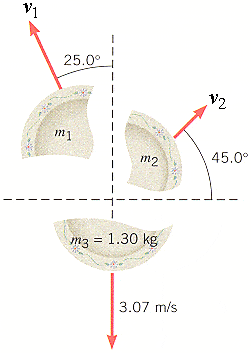
(See below)
This question has been posted multiple times at https://www.physicsforums.com/showthread.php?t=115200, https://www.physicsforums.com/showthread.php?t=50774, and http://answers.yahoo.com/question/index?qid=20061028143914AAiNoia. Therefore, I have a step-by-step process to follow.
I am simply wondering if somebody can take me through the "whys" regarding this problem. As an online AP Physics student, I am having trouble applying some of the concepts in the online and book material. Specifically, could somebody please take me through the existing procedure with a better explanation of what is happening at each step, up to the answer?
Thank you very much for your time in advance!
Homework Statement
By accident, a large plate is dropped and breaks into three pieces. The pieces fly apart parallel to the floor, with v1 = 3.10 m/s and v2 = 1.95 m/s. As the plate falls, its momentum has only a vertical component, and no component parallel to the floor. After the collision, the component of the total momentum parallel to the floor must remain zero, since the net external force acting on the plate has no component parallel to the floor. Using the data shown in the drawing, find the masses of pieces 1 and 2.
Homework Equations
(See below)
The Attempt at a Solution
This question has been posted multiple times at https://www.physicsforums.com/showthread.php?t=115200, https://www.physicsforums.com/showthread.php?t=50774, and http://answers.yahoo.com/question/index?qid=20061028143914AAiNoia. Therefore, I have a step-by-step process to follow.
I am simply wondering if somebody can take me through the "whys" regarding this problem. As an online AP Physics student, I am having trouble applying some of the concepts in the online and book material. Specifically, could somebody please take me through the existing procedure with a better explanation of what is happening at each step, up to the answer?
Thank you very much for your time in advance!
Last edited by a moderator: