Motion in two dimensions: Launching up an incline

Click For Summary
SUMMARY

The discussion focuses on solving a projectile motion problem involving launching an object up an incline. Participants highlight the complexity of deriving the distance to a target along the slope, particularly when dealing with trigonometric substitutions and the initial velocity, denoted as v_0. Key equations discussed include d\sin\theta = d\cos\theta\tan\alpha - \frac{1}{2} g \frac{d^2\cos^2 \theta}{v_0^2 \cos^2\alpha}, which leads to a non-trivial solution for d. The conversation emphasizes the importance of clear communication in problem-solving and the necessity of understanding trigonometric relationships in this context.

PREREQUISITES
  • Understanding of projectile motion principles
  • Familiarity with trigonometric functions and identities
  • Knowledge of algebraic manipulation and solving equations
  • Experience with physics problems involving inclined planes
NEXT STEPS
  • Study the derivation of projectile motion equations on inclined planes
  • Learn about trigonometric identities and their applications in physics
  • Practice solving problems involving initial velocity and angles in projectile motion
  • Explore resources on algebraic techniques for solving quadratic equations
USEFUL FOR

Students and educators in physics, particularly those focusing on mechanics and projectile motion, as well as anyone looking to improve their problem-solving skills in trigonometry and algebra.

simphys
Messages
327
Reaction score
46
Homework Statement
You fire a ball with an initial speed at an angle Φ above the surface of an incline, which is itself inclined at an angle θ above the horizontal (see the above image). (a) Find the distance measured along the incline, from the launch point to the point when the ball strikes the incline. (b) What angle Φ gives the maximum range, measured along the incline? Ignore air resistance.
Relevant Equations
I tried to do this one using

x = y / tan(phi + thetha)
y = v_0sin(phi + theta)t - (gt^2) / 2
x = v_0cos(phi+theta)t => t = x / (v_0cos(phi+theta))
1644446952259.png

But it seems to get too complex and am not sure whether it is correct.. my solution got a bit messy + incorrect

Thanks in advance!
 
Last edited:
Physics news on Phys.org
simphys said:
so haven't uploaded it, hope you don't mind.
We don't mind, but then we can't help either. We can't guess what is your problem ...

##\ ##
 
  • Like
Likes   Reactions: simphys
BvU said:
We don't mind, but then we can't help either. We can't guess what is your problem ...

##\ ##
yeah I was literally about to upload it apologies :)
 
  • Informative
Likes   Reactions: simphys
BvU said:
Check out your predecessor...
wooowww thanks!
One question
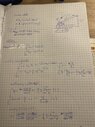
I rewrote it a bit clearer, so from this step at the end of the page it’s all about what is said in the thread of the predecessor? The above is done how it ‘should’ be then
 

Attachments

  • 64FC3AC1-3EBF-4816-BAED-9D9442E949AE.jpeg
    64FC3AC1-3EBF-4816-BAED-9D9442E949AE.jpeg
    60.1 KB · Views: 139
Or check out this Insight, Example 3 (Incline landing).
 
  • Like
  • Informative
Likes   Reactions: BvU and simphys
kuruman said:
Or check out this Insight, Example 3 (Incline landing).
Toughh i guess I am having problems with the final algebra every x (trig subs actually)
 
I gave you a link to a thread with a slightly different problem statement (target given, angle to be found).
Your problem statement gives angles and asks for a distance to target along the slope.
My guess is you're off track because you end up with an equation in ##x## that does no longer depend on ##v_0##. That is very strange...

##\ ##
 
  • Like
Likes   Reactions: simphys
  • Like
Likes   Reactions: simphys
  • #10
BvU said:
A real spoiler !
It even tells us where the exercise comes from !
Sadly, only b solved which is the the derivate of a which isn't dolved there, unfortunately:(
BvU said:
I gave you a link to a thread with a slightly different problem statement (target given, angle to be found).
Your problem statement gives angles and asks for a distance to target along the slope.
My guess is you're off track because you end up with an equation in ##x## that does no longer depend on ##v_0##. That is very strange...

##\ ##
or just too complicated because i do have v_0^2 but I forgot to invlude it in the denominator of the quadratic term for y
 
  • #11
OKAY! I found this.. The exact same way as i have done!
https://www.toppr.com/ask/question/a-projectile-is-fired-up-an-incline-incline-angle-phi-with-an-initial-speed-vi/
 
  • #12
BUT... the step he immediately calculates d is where I am lost...
 
  • #13
it’s amazing how many ways yoj can solve such a problem tough lol
 
  • #14
simphys said:
Sadly, only b solved
Oh, really ?

simphys said:
BUT... the step he immediately calculates d is where I am lost...
it says (in your notation) $$d\sin\theta = d\cos\theta\tan\alpha - {1\over 2} g \ {d^2\cos^2 \theta\over v_0^2 \cos^2\alpha }$$so of the form ##d(d-z)=0## with non-trivial solution ##d=z##.

##\ ##
 
  • Like
Likes   Reactions: simphys
  • #15
BvU said:
Oh, really ?


it says (in your notation) $$d\sin\theta = d\cos\theta\tan\alpha - {1\over 2} g \ {d^2\cos^2 \theta\over v_0^2 \cos^2\alpha }$$so of the form ##d(d-z)=0## with non-trivial solution ##d=z##.

##\ ##
yes, the next step was the problem haha, that was the easy step, but then the reformation was not really clear
 
  • #16
$$d\sin\theta = d\cos\theta\tan\alpha - {1\over 2} g \ {d^2\cos^2 \theta\over v_0^2 \cos^2\alpha }$$
$$0 = d(\cos\theta\tan\alpha - \sin\theta) - {1\over 2} g \ {d^2\cos^2 \theta\over v_0^2 \cos^2\alpha }$$
So d= 0 or $$(\cos\theta\tan\alpha - \sin\theta) - d \; {g\cos^2 \theta\over 2 v_0^2 \cos^2\alpha }=0$$meaning ##d = ...##
 
  • #17
BvU said:
$$d\sin\theta = d\cos\theta\tan\alpha - {1\over 2} g \ {d^2\cos^2 \theta\over v_0^2 \cos^2\alpha }$$
$$0 = d(\cos\theta\tan\alpha - \sin\theta) - {1\over 2} g \ {d^2\cos^2 \theta\over v_0^2 \cos^2\alpha }$$
So d= 0 or $$(\cos\theta\tan\alpha - \sin\theta) - d \; {g\cos^2 \theta\over 2 v_0^2 \cos^2\alpha }=0$$meaning ##d = ...##
Thank you ,I meant this one :) :

d=g*cos(2ϕ)2*v_i2*cos(θ)[sinθ_icosϕ−sinϕcosθ_i]​

that basically the d =... that you said, I just can't see the damn realtion of it for some reasons from ttrig
 
  • #18
simphys said:
yes, the next step was the problem haha,
So next (:smile:) time don't write 'the next step' but write out the step in question !

simphys said:
Thank you ,I meant this one :) :

d=g*cos(2ϕ)2*v_i2*cos(θ)[sinθ_icosϕ−sinϕcosθ_i]​

I don't see this appearing anywhere -- wrong dimensions

##\ ##
 
  • #19
BvU said:
So next (:smile:) time don't write 'the next step' but write out the step in question !I don't see this appearing anywhere -- wrong dimensions

##\ ##
yeah you are totally right, I am very very sorry for wasting your time :( my apologies!
and so if you look at this: https://www.toppr.com/ask/question/a-projectile-is-fired-up-an-incline-incline-angle-phi-with-an-initial-speed-vi/
solving for d yields -> that is the solution but after the last step you did, I cannot translate it in such a way if you know what I mean. (but that is than straight up trigonometry thenn??)
 
  • #20
would you want me to post a pic of what I mean ?
 
  • #21
or... you know what.. let me not bother you with this exercise, I immensly appreciate the help! Thank you, I think that it is just trigonometry anyways at this point. If I struggle with it ill just do a bit more practice on it and that's it lol
 

Similar threads

Replies
24
Views
3K
  • · Replies 20 ·
Replies
20
Views
11K
  • · Replies 7 ·
Replies
7
Views
1K
  • · Replies 20 ·
Replies
20
Views
1K
Replies
7
Views
2K
  • · Replies 7 ·
Replies
7
Views
3K
  • · Replies 15 ·
Replies
15
Views
4K
Replies
21
Views
3K
  • · Replies 12 ·
Replies
12
Views
2K
  • · Replies 2 ·
Replies
2
Views
1K