Saptarshi Sarkar
- 98
- 13
I was thinking about a situation related to Galilean relativity but couldn't come up with a solution to the problem. I would be very grateful if someone can explain it to me.
So, I was thinking of a situation where I am in the reference frame of a block moving at velocity u along the x-axis and a helix moving towards me (towards x axis) with velocity v and also rotating.
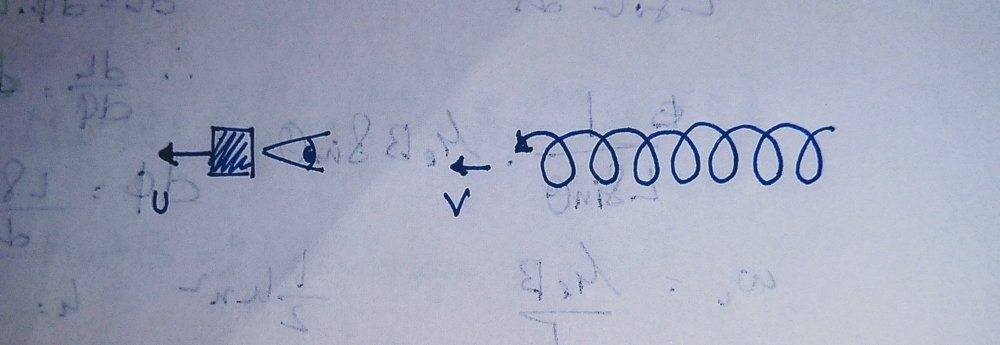
Now, if u<v, from my reference frame, it would seem as the helix is moving towards me with velocity v-u (u,v<<c) and also the helix would seem to be rotating anti-clockwise. If u>v, from my reference frame it would seem that that helix is moving away from me with velocity u-v and the helix would still seem to rotate anti-clockwise.
Now, I consider a different situation of an infinite threaded bolt and a nut (powered by some system attached to the nut to continuously spin it) spinning on it which can only move forward or backward by spinning anti-clockwise (respect to my frame) or clockwise respectively.
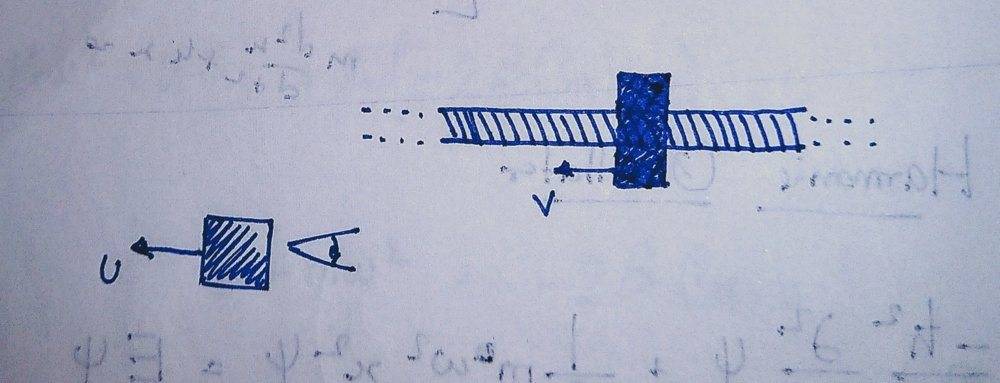
Here, if u<v, I see the nut moving towards me with velocity v-u (I am not viewing the nut head on, but I am very far away from the nut) and spinning anti-clockwise. If u>v, I see the nut moving away from me with velocity u-v but still moving anti-clockwise (?). But how can this be true? The nut won't be able to move back if it spins anti-clockwise?! What would I really observe?
So, I was thinking of a situation where I am in the reference frame of a block moving at velocity u along the x-axis and a helix moving towards me (towards x axis) with velocity v and also rotating.
Now, if u<v, from my reference frame, it would seem as the helix is moving towards me with velocity v-u (u,v<<c) and also the helix would seem to be rotating anti-clockwise. If u>v, from my reference frame it would seem that that helix is moving away from me with velocity u-v and the helix would still seem to rotate anti-clockwise.
Now, I consider a different situation of an infinite threaded bolt and a nut (powered by some system attached to the nut to continuously spin it) spinning on it which can only move forward or backward by spinning anti-clockwise (respect to my frame) or clockwise respectively.
Here, if u<v, I see the nut moving towards me with velocity v-u (I am not viewing the nut head on, but I am very far away from the nut) and spinning anti-clockwise. If u>v, I see the nut moving away from me with velocity u-v but still moving anti-clockwise (?). But how can this be true? The nut won't be able to move back if it spins anti-clockwise?! What would I really observe?