Multiloop Circuit Total Resistance

Click For Summary

Homework Help Overview

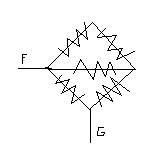
The discussion revolves around a multiloop circuit problem where participants are tasked with finding the total resistance between two points, F and G, in a circuit with multiple resistors, each valued at 5 ohms.

Discussion Character

  • Exploratory, Problem interpretation, Assumption checking

Approaches and Questions Raised

  • The original poster attempts to calculate the total resistance by analyzing current through different loops and resistors, leading to an incorrect conclusion about total current. Other participants suggest methods for combining resistors in series and parallel to simplify the circuit.

Discussion Status

Some participants have offered guidance on how to approach the problem by suggesting resistor combinations. The original poster expresses some confusion but indicates a resolution has been reached. Another participant raises a question about adding an additional resistor, suggesting ongoing exploration of the topic.

Contextual Notes

There is mention of potential confusion with Kirchhoff's laws and the original poster's adjustments to their calculations, indicating a learning process in understanding circuit analysis.

stufaro
Messages
3
Reaction score
0
Hey guys, I have a quick multiloop circuit question:

You're given this circuit with each of the resistors being 5 ohms and are asked to find the total resistance between points F and G.
o5q1pi.jpg


I imagined a 15V battery between those two points so I could get currents.

- Through the top loop from F to G I get 1A.
- Through the middle resistor and down through the bottom right resistor again I get 1.5A.
- Through the bottom left resistor I get 2A.

I (wrongly) conclude that the total current is 5.5A, then 15/5.5 = 2.72... -- not the right answer.

Any help would be much appreciated.

Much obliged,
Steve.
 
Physics news on Phys.org
And by 2A for the bottom resistor I mean 3A. Sorry for the double post.

Thanks again.
- Steve.
 
To help describe I am going to name your resistors beginning at F, R1 R2 R3 R4 moving clockwise. R5 is in the center. Combine R1 and R2 in series to act as one resistor in parallel with R5. Then consider R1,R2,R5 as one resistor in series with R3. Finally R4 in parallel with the value you calculated as equivalent to the other 4 resistors.
 
Thanks, I was getting a little Kirchhoffed out there I think. But problem solved!

Much appreciated!
 
Oh yeah, Jerkhoffs law; I have forgotten it completely ;)
 
hey,
how to find the equivalent resistance if there would have been one more resistance like R5 from the point G .
 

Similar threads

  • · Replies 7 ·
Replies
7
Views
2K
  • · Replies 31 ·
2
Replies
31
Views
5K
Replies
4
Views
2K
Replies
3
Views
2K
  • · Replies 3 ·
Replies
3
Views
2K
  • · Replies 42 ·
2
Replies
42
Views
6K
  • · Replies 6 ·
Replies
6
Views
2K
  • · Replies 3 ·
Replies
3
Views
2K
  • · Replies 14 ·
Replies
14
Views
2K
  • · Replies 60 ·
3
Replies
60
Views
10K