Multivariable integration of a piecewise function

Join the discussion
Ask a follow-up here, or get your own question answered by working scientists, mathematicians and engineers — people, not an autocomplete.
Real named experts · corrections over time · the nuance an AI answer skips
3 replies · 2K views
nomadreid
Gold Member
Messages
1,779
Reaction score
258
Homework Statement
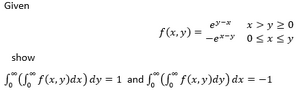
Given f(x,y) = exp(y-x) for x>y>=0, and -exp(x-y) for 0<=x<=y, show that the integral from 0 to infinity of (the integral from 0 to infinity of f(x,y) dx)dy=1, and reversing the order of integration, -1.
Relevant Equations
Integrating with respect to one variable, one keeps the other variable as a constant. The integral to infinity is the limit of the integral to an index. Integrating a piecewise function, one integrates each piece.
The problem, neater:
1731590735782.png

Attempt at a solution:
1731590836259.png

1731590877990.png
 

Attachments

  • 1731590152038.png
    1731590152038.png
    2.1 KB · Views: 85
Physics news on Phys.org
Write [tex] \int_0^\infty \left( \int_0^\infty f(x,y)\,dx\right)\,dy = \lim_{Y \to \infty} \int_0^Y \left( \int_0^y f(x,y)\,dx + \lim_{X \to \infty} \int_y^X f(x,y)\,dx \right)\,dy.[/tex] In the first integral on the right, we have [itex]0 \leq x \leq y[/itex]; in the second we have [itex]0 \leq y \leq x[/itex]. Take the inner limit first, and simplify the result before doing the outer integral.
 
Reply
  • Like
Likes   Reactions: nomadreid
Thanks, pasmith. I will try that.
 
Super! I tried it, and not only did it work, but even more important, while doing it I thus understood the reasoning. Thanks again, pasmith!😊