Mutual inductance of a coil inside a solenoid

Click For Summary
SUMMARY

The discussion focuses on the derivation of the mutual inductance formula for a coil inside a solenoid, specifically addressing the behavior of the magnetic field (B) when an alternating current (I1) is applied. Participants clarify that while B varies with time due to the alternating current, it can be treated as uniform over the surface area (A2) at any specific instant, allowing it to be factored out of the integral during calculations. This understanding is crucial for accurately calculating the magnetic flux and mutual inductance in this scenario.

PREREQUISITES
  • Understanding of electromagnetic theory, specifically mutual inductance.
  • Familiarity with the concepts of magnetic flux and its calculation.
  • Knowledge of alternating current (AC) behavior and its effects on magnetic fields.
  • Proficiency in integral calculus as it applies to physics problems.
NEXT STEPS
  • Study the derivation of the mutual inductance formula for coils and solenoids.
  • Learn about the behavior of magnetic fields in alternating current circuits.
  • Explore the concept of magnetic flux and its calculation in varying fields.
  • Investigate practical applications of mutual inductance in electrical engineering.
USEFUL FOR

Electrical engineers, physics students, and anyone involved in the study or application of electromagnetic theory and inductive components in circuits.

Amaelle
Messages
309
Reaction score
54
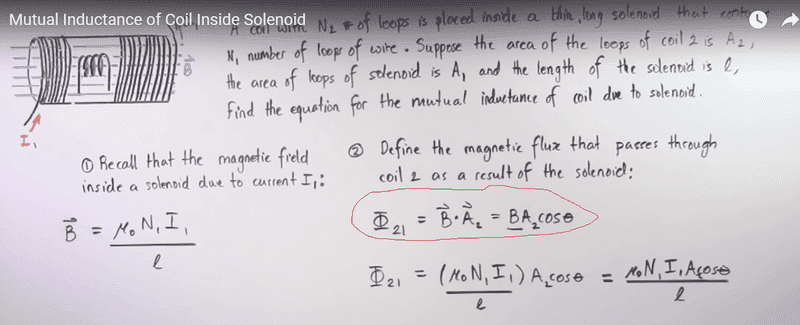
Good day , i have an issue with the derivation of the mutual inductance of coil inside solenoid formula
inductance.png

I1 is an alternating current which means that B is varying, and we know that the Flux 21 is equal to the integral of the dot product of B and A2 but as B is varying we CAN NOT take it out of the integral and use the form used in the pic (the formula encercled in red).
Maybe there is something missing in my logic and any help would be highly appreciated, thanks!
 

Attachments

  • inductance.png
    inductance.png
    67.8 KB · Views: 3,402
Physics news on Phys.org
You can take B out of the integral as long as B doesn’t vary with position.
 
thank you for your prompt answer, but I still have difficulty to grasp this point, isn t B varying with time?? because the current is alternating? thanks!
 
Yes, B varies with time. So the flux varies with time. But the flux at any particular instant of time is a spatial integral of B over the surface A2. At any particular time, B is uniform over the A2.
 
  • Like
Likes   Reactions: Amaelle
Thanks a million ! you nail it !
 

Similar threads

Replies
7
Views
1K
  • · Replies 3 ·
Replies
3
Views
2K
  • · Replies 7 ·
Replies
7
Views
2K
  • · Replies 3 ·
Replies
3
Views
2K
  • · Replies 16 ·
Replies
16
Views
4K
  • · Replies 10 ·
Replies
10
Views
3K
Replies
7
Views
2K
  • · Replies 2 ·
Replies
2
Views
2K
Replies
13
Views
3K
  • · Replies 9 ·
Replies
9
Views
6K