Need help find fourier transform for revision

Click For Summary

Homework Help Overview

The discussion revolves around finding the Fourier transform of the function f(x) = xe^{-x^2}. Participants express challenges with the integral involved and seek guidance on how to approach the problem, particularly in the context of existing knowledge about related transforms.

Discussion Character

  • Exploratory, Mathematical reasoning, Assumption checking

Approaches and Questions Raised

  • Participants discuss substitution methods and integration by parts as potential strategies. There are questions about the correct application of these methods and how they relate to known Fourier transforms. Some participants express confusion about the steps taken by others and seek clarification on specific transformations and limits of integration.

Discussion Status

The conversation is ongoing, with various participants providing insights and suggestions. Some guidance has been offered regarding integration techniques and substitutions, but there remains a lack of consensus on the next steps for all participants. Several interpretations of the problem are being explored.

Contextual Notes

Participants mention constraints such as the absence of the lecturer and the need to work with specific forms of the Fourier transform. There is also a discussion about the implications of different exponential forms and their transformations.

jac7
Messages
20
Reaction score
0
I need to find the Fourier transform to this function
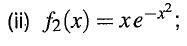
f.jpg
and I'm really stuck, because i tried substituting it into the Fourier transform equations but i started to get a really long integral that got out of hand!
i also know that

f2.jpg
but i don't know how to incorporate it into finding the Fourier transform!

If someone could help me get started or give me some tips on easy steps for find the Fourier transform in general it would be much appreciated as my lecturer is away for easter!

Thanks!
 
Physics news on Phys.org
The Fourier transform of f(x) is, by definition,
[tex]\frac{1}{\sqrt{2\pi}}\int_{-\infty}^\infty} e^{-ix\zeta}f(x)dx[/tex]

Your f(x) is [itex]xe^{-x^2}[/itex] so you want to find
[tex]\frac{1}{\sqrt{2\pi}}\int_{-\infty}^\infty} e^{-ix\zeta}xe^{-x^2}dx[/tex]

If you know how to do it with a "1/2" in the exponent, let [itex]y= x\sqrt{2}[/itex]. Then [itex]-y^2= -2x^2[/itex] so [itex]-x^2= -y^2/2[/itex]. Of course, [itex]dx= dy/\sqrt{2}[/itex], so that [itex]xe^{-x^2}dx= x(e^{-y^2/2})(dy/\sqrt{2}= (x/\sqrt{2}e^{-y^2}dy= ye^{-y^2}dy[/itex].

Now that leaves
[tex]e^{-ix\zeta}= e^{-i(y/\sqrt{2})\zeta}= e^{-i(y)(\zeta/\sqrt{2})}[/tex]

In other words, replace [itex]\zeta[/itex] with [itex]\zeta/\sqrt{2}[/itex] in the Fourier transform.
 
HallsofIvy said:
If you know how to do it with a "1/2" in the exponent, let [itex]y= x\sqrt{2}[/itex]. Then [itex]-y^2= -2x^2[/itex] so [itex]-x^2= -y^2/2[/itex]. Of course, [itex]dx= dy/\sqrt{2}[/itex], so that [itex]xe^{-x^2}dx= x(e^{-y^2/2})(dy/\sqrt{2}= (x/\sqrt{2}e^{-y^2}dy= ye^{-y^2}dy[/itex].

I don't understand what you've done here, when i subbed it in like you did i got
[itex](y/2)\sqrt{2pi}e^{-y^2/2}dy[/itex]
 
Note that if [tex]f(x)=\exp (-x^{2})[/tex] then

[tex] f(\xi )=\int_{\infty}^{\infty}e^{-x^{2}}e^{ix\xi}dx\Rightarrow f'(\xi )=-2\int_{\infty}^{\infty}xe^{-x^{2}}e^{ix\xi}dx[/tex]

Does this help?
 
I'm sorry but i can't see where to go next or how it could help!
i know how you got that and i can see how its the same as my function, but you've already got it into transform form? but i need the transform of xf(x), i know that the transform of xf(x) is if'(xi) is it anything to do with that?
 
hello,

if you know the Fourier transform of [itex]e^{-x^2}[/itex], then do integration by parts and you will get the solution right away.

i used

[tex]dv = x e^{-x^2} dx[/tex]

cheers
 
integration by part of the transform of exp(-x^2) or integration by parts of exp(-x^2)?
 
oh, i meant integration by parts on the whole transform:

[tex]\int{e^{-ikx} x e^{-x^2}}dx[/tex]
 
iv tried this and I've ended up with

[tex]\frac{-i\xi}{2}\int{e^{-x^2}e^{-ix\xi}}dx[/tex]

is this right? what do i do next?
 
  • #10
good!

the integral is just the Fourier transform of [itex]e^{-x^2}[/itex], which is given in the problem. you are already done!

the only thing is that i don't get a negative sign when i do the calculation, maybe you lost one along the way somewhere. of course, so might of I, but I'm just doing this for fun, so i will let you check. :smile:

cheers
 
  • #11
jac7 said:
I'm sorry but i can't see where to go next or how it could help!
i know how you got that and i can see how its the same as my function, but you've already got it into transform form? but i need the transform of xf(x), i know that the transform of xf(x) is if'(xi) is it anything to do with that?
Bang on, with my idea, you have:

[tex] \hat{f}(\xi )=\sqrt{\pi}e^{-\xi^{2}/4}[/tex]

To find the integral you require just differentiate the above.
 
  • #12
eczeno said:
good!

the integral is just the Fourier transform of [itex]e^{-x^2}[/itex], which is given in the problem. you are already done!

the only thing is that i don't get a negative sign when i do the calculation, maybe you lost one along the way somewhere. of course, so might of I, but I'm just doing this for fun, so i will let you check. :smile:

cheers

thankyou!

but I'm given the Fourier transform of [itex]e^{-x^2/2}[/itex] is there a simple way of manipulating it so that its the transform of [itex]e^{-x^2}[/itex] or would i have to work that out?
 
  • #13
hunt_mat said:
Bang on, with my idea, you have:

[tex] \hat{f}(\xi )=\sqrt{\pi}e^{-\xi^{2}/4}[/tex]

To find the integral you require just differentiate the above.

Thank you very much i think I've finally got it!

just a quick question though, when you did the integration for [tex]\hat{f}(\xi )[/tex] what limits did you integrate between? because when i integrate between infinity and -infinity I am not getting the same thing because the exponentials just disappear? am i missing something really obvoius?
 
  • #14
jac7 said:
thankyou!

but I'm given the Fourier transform of [itex]e^{-x^2/2}[/itex] is there a simple way of manipulating it so that its the transform of [itex]e^{-x^2}[/itex] or would i have to work that out?

sure, just do the substitution [itex]u=\frac{x}{\sqrt{2}}[/itex]. i think it will just put a factor of [itex]\sqrt{2}[/itex] out front.
 
Last edited:
  • #15
Thank you so much for your help!
 
  • #16
cheers.
 

Similar threads

  • · Replies 5 ·
Replies
5
Views
2K
  • · Replies 1 ·
Replies
1
Views
2K
  • · Replies 2 ·
Replies
2
Views
2K
Replies
0
Views
1K
  • · Replies 2 ·
Replies
2
Views
3K
  • · Replies 3 ·
Replies
3
Views
2K
  • · Replies 6 ·
Replies
6
Views
4K
Replies
8
Views
2K
  • · Replies 2 ·
Replies
2
Views
2K
  • · Replies 3 ·
Replies
3
Views
3K