Nick O
- 158
- 8
I have a tortoise shell sitting in two parts on my desk (the top and the bottom). I somehow got it in my head that it would be fun to use it as an enclosure for a robot, and I need to know its mass when I choose motors for it.
Now, I don't have any precise mass-measurement tools - all I have is a bathroom scale whose needle won't even deflect for something as light as this shell. So I thought, "hey, I'm an engineering student, I can do this without a scale". I found the volume of the two parts with water and a measuring cup (75 and 20 mL for top and bottom). In theory, I can calculate the mass of the bottom once I have calculated the density of the top.
To calculate the mass of the top part of the shell, I set up the following system:
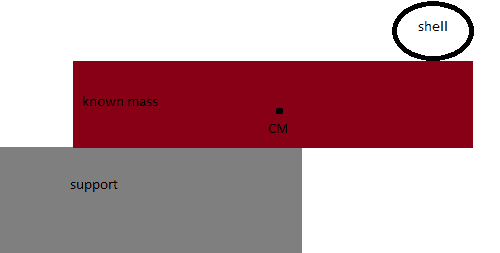
The mass acting as a lever is 1.9 kg. The center of mass is 5.5 in from the left, and the edge of the support is 5.75 in from the left. The shell's point of contact is 9.375 in from the left, and this is where the support just starts to revolve.
On the surface, it appeared straightforward to get a reasonable approximation of the mass. It would start something like this:
M = mass of lever
m = mass of shell
n = normal force on lever from support
g = acceleration due to gravity
CG = center of gravity
positive forces are up
positive torques are counterclockwise
n - Mg - mg = 0
τCG - τsupport - τshell = 0
On first inspection, it looks like two equations and two unknowns, which should be readily solveable. The problem is that I have no idea how to find τsupport, because force is continuously distributed from 0 to 5.75 inches, and probably varies linearly from zero to some maximum value such that the net force is |Mg + mg|. I don't know how to model this in terms of torque.
Does anyone have any suggestions?
Note: I realize that the fulcrum is so close to the center of gravity that a precise measurement will be difficult to find. A rough approximation is fine. More importantly, I want to learn how to solve this sort of problem.
Now, I don't have any precise mass-measurement tools - all I have is a bathroom scale whose needle won't even deflect for something as light as this shell. So I thought, "hey, I'm an engineering student, I can do this without a scale". I found the volume of the two parts with water and a measuring cup (75 and 20 mL for top and bottom). In theory, I can calculate the mass of the bottom once I have calculated the density of the top.
To calculate the mass of the top part of the shell, I set up the following system:
The mass acting as a lever is 1.9 kg. The center of mass is 5.5 in from the left, and the edge of the support is 5.75 in from the left. The shell's point of contact is 9.375 in from the left, and this is where the support just starts to revolve.
On the surface, it appeared straightforward to get a reasonable approximation of the mass. It would start something like this:
M = mass of lever
m = mass of shell
n = normal force on lever from support
g = acceleration due to gravity
CG = center of gravity
positive forces are up
positive torques are counterclockwise
n - Mg - mg = 0
τCG - τsupport - τshell = 0
On first inspection, it looks like two equations and two unknowns, which should be readily solveable. The problem is that I have no idea how to find τsupport, because force is continuously distributed from 0 to 5.75 inches, and probably varies linearly from zero to some maximum value such that the net force is |Mg + mg|. I don't know how to model this in terms of torque.
Does anyone have any suggestions?
Note: I realize that the fulcrum is so close to the center of gravity that a precise measurement will be difficult to find. A rough approximation is fine. More importantly, I want to learn how to solve this sort of problem.