Need help understanding a differentiation

  • Thread starter Thread starter Nat3
  • Start date Start date
  • Tags Tags
    Differentiation
Click For Summary
SUMMARY

The discussion centers on the differentiation process in calculus, specifically the confusion surrounding the application of the product rule. The user identifies a typo in the differentiation notation, correcting \(\frac{dx^2}{dt^2}\) to \(\frac{d^2x}{dt^2}\). The key takeaway is that \(\frac{d^2x}{dt^2}\) is derived using the product rule, as \(\frac{dx}{ds}\) is a function of time \(t\) rather than a constant. This understanding is crucial for accurately performing differentiation in complex equations.

PREREQUISITES
  • Understanding of basic calculus concepts, particularly differentiation
  • Familiarity with the product rule in calculus
  • Knowledge of functions and their derivatives
  • Ability to interpret mathematical notation and symbols
NEXT STEPS
  • Study the product rule in calculus for differentiating products of functions
  • Explore examples of second derivatives and their applications
  • Review common differentiation notations and their meanings
  • Practice solving differential equations involving multiple variables
USEFUL FOR

Students studying calculus, educators teaching differentiation techniques, and anyone seeking to clarify the application of the product rule in mathematical problems.

Nat3
Messages
69
Reaction score
0
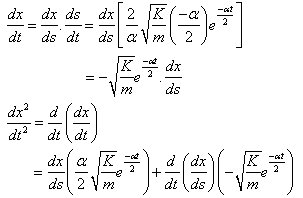
I'm working my way through a solution of a problem and am confused on a step where a differentiation is performed. I'm sure I'm just forgetting some kind of rule, but I've been perusing my textbook and can't seem to figure out what I'm missing. Here's the step I'm talking about:
5nnt.png


Note that there's a typo in the solution: [itex]\frac{dx^2}{dt^2}[/itex] should be [itex]\frac{d^2x}{dt^2}[/itex].

The top part I understand completely, it's the bottom half I'm confused about. It seems to me that:

[itex]\frac{d^2x}{dt^2} = \frac{d}{dt}(\frac{dx}{dt}) = \frac{dx}{ds}(\frac{\alpha}{2}\sqrt{\frac{K}{m}}e^{-\frac{\alpha t}{2}})[/itex]

In other words, I don't understand where the second group of terms (after the + sign) comes from in the last line. Why is it there?
 
Physics news on Phys.org
Nat3 said:
I'm working my way through a solution of a problem and am confused on a step where a differentiation is performed. I'm sure I'm just forgetting some kind of rule, but I've been perusing my textbook and can't seem to figure out what I'm missing. Here's the step I'm talking about:

5nnt.png


Note that there's a typo in the solution: [itex]\frac{dx^2}{dt^2}[/itex] should be [itex]\frac{d^2x}{dt^2}[/itex].

The top part I understand completely, it's the bottom half I'm confused about. It seems to me that:

[itex]\frac{d^2x}{dt^2} = \frac{d}{dt}(\frac{dx}{dt}) = \frac{dx}{ds}(\frac{\alpha}{2}\sqrt{\frac{K}{m}}e^{-\frac{\alpha t}{2}})[/itex]

In other words, I don't understand where the second group of terms (after the + sign) comes from in the last line. Why is it there?

It's because dx/ds is generally a function of t. It's not a constant. You need to use the product rule when you differentiate the result of the top half.
 
  • Like
Likes   Reactions: 1 person

Similar threads

  • · Replies 105 ·
4
Replies
105
Views
11K
Replies
3
Views
2K
  • · Replies 10 ·
Replies
10
Views
2K
Replies
6
Views
3K
  • · Replies 18 ·
Replies
18
Views
3K
  • · Replies 3 ·
Replies
3
Views
2K
Replies
12
Views
2K
  • · Replies 7 ·
Replies
7
Views
2K
Replies
3
Views
2K
  • · Replies 1 ·
Replies
1
Views
2K