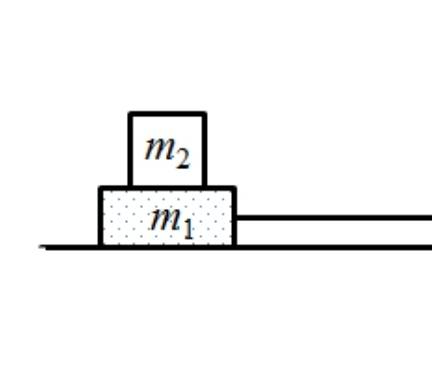
Discussion Overview
The discussion revolves around understanding the relationship between the accelerations of two objects, m1 and m2, when a force is applied to the bottom object (m1) while friction exists between the two objects but not between m1 and the floor. Participants explore how to prove that the accelerations of both objects are equal under certain conditions, using concepts from Newton's laws and friction.
Discussion Character
- Exploratory
- Technical explanation
- Conceptual clarification
- Debate/contested
Main Points Raised
- Some participants suggest using Newton's laws of motion to analyze the system and prove the relationship between the accelerations of the two objects.
- One participant proposes that static friction holds the two objects together for low acceleration, allowing them to accelerate together.
- Another participant emphasizes that static friction is a variable force that adjusts to prevent relative motion until a certain threshold is reached.
- Concerns are raised about the assumption that the frictional force is equal to the applied force, with some arguing that this is not necessarily true.
- One participant attempts to derive the relationship between the accelerations but struggles with the concept of friction and the forces acting on each object.
- Another participant compares static friction to an imaginary string that can only hold the two objects together up to a certain limit before slipping occurs.
Areas of Agreement / Disagreement
Participants express differing views on the nature of static friction and its role in the acceleration of the two objects. There is no consensus on how to prove that the accelerations are equal, and the discussion remains unresolved.
Contextual Notes
Participants note that the properties of friction (both static and kinetic) are not directly derived from Newton's laws, indicating a limitation in the foundational understanding of the problem. The discussion also highlights the complexity of modeling friction in this context.