Discussion Overview
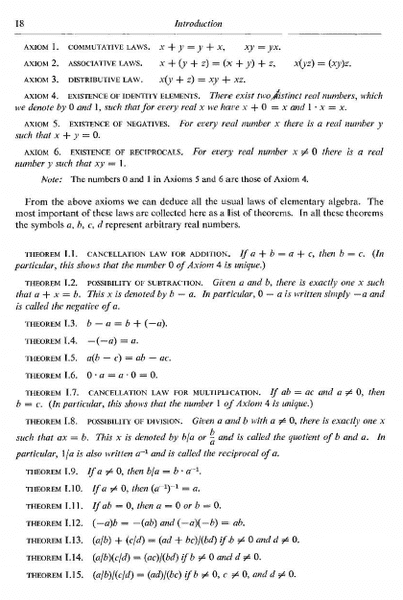
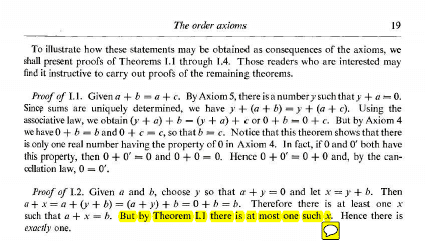
The discussion revolves around understanding the application of theorem I.1 in proving the uniqueness aspect of theorem I.2 from Apostol's 'Calculus'. Participants explore the implications of theorems regarding the existence and uniqueness of solutions in mathematical contexts.
Discussion Character
- Technical explanation
- Conceptual clarification
- Debate/contested
- Mathematical reasoning
Main Points Raised
- One participant seeks clarification on how theorem I.1 supports the assertion of uniqueness in theorem I.2.
- Another participant proposes that if both x and y satisfy theorem I.2, then a + x must equal a + y, leading to a discussion about deducing properties from this equality.
- A participant expresses uncertainty about assuming the existence of x and y, emphasizing that they are trying to prove theorem I.2.
- It is suggested that to prove uniqueness, one can assume the existence of two solutions and show they must be equal, referencing theorem I.1 for support.
- One participant concludes that if a + x = b and a + y = b, then x must equal y, thus establishing uniqueness.
- Another participant shares a general approach to proving uniqueness in mathematics, mentioning the use of contradiction and providing an example from linear algebra.
- There is a discussion about the conditions under which contradiction is necessary in uniqueness proofs, with some participants suggesting that it is not always required.
Areas of Agreement / Disagreement
Participants generally agree on the method of proving uniqueness by assuming the existence of two solutions and showing they are equal. However, there is some disagreement regarding the necessity of contradiction in all cases and the specific application of theorems.
Contextual Notes
Some participants note that the discussion involves assumptions about theorems and the conditions under which they apply, which may not be fully resolved within the thread.