Need help understanding text from 'Calculus' by Apostol

  • Context: Undergrad 
  • Thread starter Thread starter omoplata
  • Start date Start date
  • Tags Tags
    Apostol Calculus Text
Click For Summary

Discussion Overview

The discussion revolves around understanding the application of theorem I.1 in proving the uniqueness aspect of theorem I.2 from Apostol's 'Calculus'. Participants explore the implications of theorems regarding the existence and uniqueness of solutions in mathematical contexts.

Discussion Character

  • Technical explanation
  • Conceptual clarification
  • Debate/contested
  • Mathematical reasoning

Main Points Raised

  • One participant seeks clarification on how theorem I.1 supports the assertion of uniqueness in theorem I.2.
  • Another participant proposes that if both x and y satisfy theorem I.2, then a + x must equal a + y, leading to a discussion about deducing properties from this equality.
  • A participant expresses uncertainty about assuming the existence of x and y, emphasizing that they are trying to prove theorem I.2.
  • It is suggested that to prove uniqueness, one can assume the existence of two solutions and show they must be equal, referencing theorem I.1 for support.
  • One participant concludes that if a + x = b and a + y = b, then x must equal y, thus establishing uniqueness.
  • Another participant shares a general approach to proving uniqueness in mathematics, mentioning the use of contradiction and providing an example from linear algebra.
  • There is a discussion about the conditions under which contradiction is necessary in uniqueness proofs, with some participants suggesting that it is not always required.

Areas of Agreement / Disagreement

Participants generally agree on the method of proving uniqueness by assuming the existence of two solutions and showing they are equal. However, there is some disagreement regarding the necessity of contradiction in all cases and the specific application of theorems.

Contextual Notes

Some participants note that the discussion involves assumptions about theorems and the conditions under which they apply, which may not be fully resolved within the thread.

omoplata
Messages
327
Reaction score
2
Sorry if I'm posting in the wrong place. Since the difficulty I have is with the text of the book, and not the exercises, I posted here.

In proving theorem I.2, how is theorem I.1 used to assert that 'there is at most one such x'? The first image below gives the background text. The text I have trouble with is highlighted in the second image below.
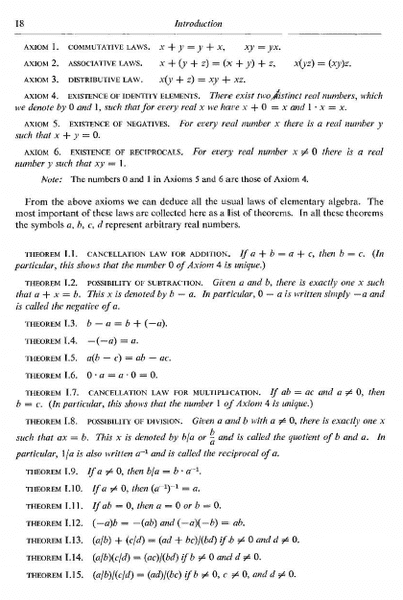
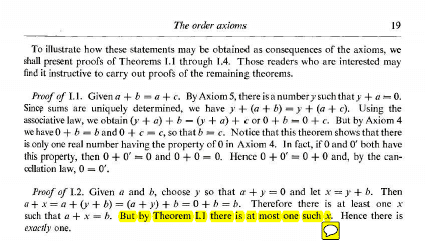
Apostol_pg18.png


Apostol_pg19.png


Thank you.
 
Physics news on Phys.org
Assume that x and y satisfy theorem 1.2.

That means that:
a + x = b
a + y = b

What can you deduce from that about a + x and a + y?
 
  • Like
Likes   Reactions: Astyute Chick
Samy_A said:
Assume that x and y satisfy theorem 1.2.

But I can't assume that. Theorem I.2 is the one I'm trying to prove.
 
omoplata said:
But I can't assume that. Theorem I.2 is the one I'm trying to prove.
You are questioning the part of theorem 1.2 that 'there is at most one such x'.
You prove that by assuming that there are two, and then (hopefully), conclude that they must be equal.
That in itself indeed doesn't prove that "there exists" an x satisfying theorem 1.2, but that if one exists, it is unique.
Do you see how that uniqueness follows from theorem 1.1?
 
  • Like
Likes   Reactions: Astyute Chick
Oh, I see now.

So I have come up to the point saying a + x = b.

But I do not know yet if x is unique. So I assume there is a another y such that a + y = b.

Then, a + x = a + y

From theorem I.1, x = y.

Therefore x is unique.

Thank you!
 
  • Like
Likes   Reactions: Astyute Chick and Samy_A
Samy_A said:
Assume that x and y satisfy theorem 1.2.

That means that:
a + x = b
a + y = b

What can you deduce from that about a + x and a + y?
Had the same problem as omoplata! Thanks for answering :)
 
Maybe this will help for future reference. In mathematics, when we are trying to show uniqueness. We usually do this by assuming that there are two things that have a given property. Then we find a contradiction.

If you have taken linear algebra. A good example would be the uniqueness of the additive identity of a vector space, the 0 vector.

Your post #5, is a great idea to think about when we want to show uniqueness.
 
One more thing. If you are able to show existence and uniqueness, we get an iff statement.
 
MidgetDwarf said:
Maybe this will help for future reference. In mathematics, when we are trying to show uniqueness. We usually do this by assuming that there are two things that have a given property. Then we find a contradiction.

If you have taken linear algebra. A good example would be the uniqueness of the additive identity of a vector space, the 0 vector.

Your post #5, is a great idea to think about when we want to show uniqueness.

Rather assuming that if two things satisfy a given property, then they are equal. Sometimes contradiction can be used, but most of the times it isn't necessary (in your example of the additive identity it isn't necessary: if 0,0' are identities, it follows that 0 + 0' = 0 = 0' + 0 and 0+0' = 0' = 0' + 0, in particular thus 0=0')
 
  • #10
Math_QED said:
Rather assuming that if two things satisfy a given property, then they are equal. Sometimes contradiction can be used, but most of the times it isn't necessary (in your example of the additive identity it isn't necessary: if 0,0' are identities, it follows that 0 + 0' = 0 = 0' + 0 and 0+0' = 0' = 0' + 0, in particular thus 0=0')
That is why i said usually. However, you were correct with the "rather assuming ..." part. I chose the example of the additive identity, because it shows how to start a uniqueness proof. The contradiction part was added, because there are a few theorems and exercises coming up in Apostol that the OP will need to know this idea.
 
  • Like
Likes   Reactions: member 587159

Similar threads

  • · Replies 1 ·
Replies
1
Views
3K
  • · Replies 8 ·
Replies
8
Views
2K
  • · Replies 3 ·
Replies
3
Views
2K
  • · Replies 2 ·
Replies
2
Views
4K
  • · Replies 2 ·
Replies
2
Views
4K
  • · Replies 4 ·
Replies
4
Views
3K
Replies
2
Views
2K
  • · Replies 11 ·
Replies
11
Views
3K
  • · Replies 9 ·
Replies
9
Views
3K
  • · Replies 8 ·
Replies
8
Views
3K