Negative pressure in a cylinder.

Click For Summary
SUMMARY

The discussion revolves around calculating the pressure inside a vacuum created by a piston in a tube with one end open to the atmosphere. The user seeks to determine the force required to pull the piston various distances, using a 1-inch inner diameter tube. Key concepts include the relationship between pressure and volume, specifically Boyle's Law (P1V1 = P2V2), and the calculation of force using the difference in pressure multiplied by the piston area. The user successfully deduces that the pressure behind the piston can be calculated by applying these principles.

PREREQUISITES
  • Understanding of Boyle's Law and its application in closed systems
  • Knowledge of pressure calculations in fluid mechanics
  • Familiarity with basic physics concepts such as force and area
  • Ability to perform unit conversions and calculations involving pascals (Pa) and square meters (m²)
NEXT STEPS
  • Study the applications of Boyle's Law in real-world scenarios
  • Learn about pressure measurement techniques in vacuum systems
  • Explore the relationship between force, pressure, and area in fluid dynamics
  • Investigate different types of pistons and their effects on vacuum pressure
USEFUL FOR

Engineers, physicists, and students involved in fluid mechanics, vacuum technology, and pressure calculations will benefit from this discussion.

willloomy
Messages
4
Reaction score
0
hey everybody, I need to figure out a few things about calculating the pressure inside a vacuum

basically I have a tube and one side of the tube is capped and air tight and the other side is open to the air. In the tube there is an air tight piston like stopper that is pulled through the tube towards open end of the tube, creating a vacuum on the opposite side of the piston.

I need to figure out how much force is needed to pull the piston various distances in the tube.
I have a 1 inch inner diameter tube right now but I would like to be able to test different sized tubes.
hope that wasn't to confusing, hope this picture helps.
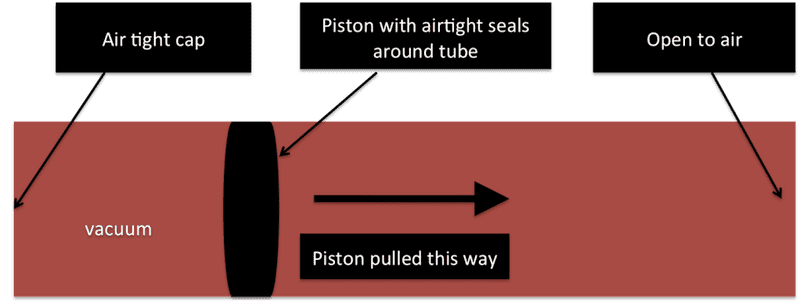
vacuumgun.png
 
Engineering news on Phys.org
A negative pressure would be a negative differential pressure or a gage pressure with respect to an ambient atmosphere.
 
I get that but i still need to know how to figure out what the pressure in the tube is.
I thought I should say that the piston is starts a few inches away from the closed end of the tube and the pressure is equal to the outside pressure.

suppose the piston is 3 inches away from the sealed end of the tube would the pressure decrease by half every 3 inches the piston is pulled towards the front
 
Last edited:
Write what pressures you have on either side of the piston.

Hint 1: Look at what you wrote on the extreme right of your drawing.
Hint 2: There must be a pressure on the left hand side for volume to matter.

Working out the force required is a very simple matter from first principles of pressure and force.
 
i understand that negative pressure is really just the difference in pressures and correct me if i am wrong,but to figure out how much force I need to pull the piston i use
the difference in pressure (Pa) multiplied by the area of the piston (m2)


let's say they are both at 101325 pa to begin with, the area of the piston is 0.0125 m2 and there is 50 mm of tube between the piston and the tight cap. I want to know what happens when the piston is pulled towards the open end decreasing the pressure. i want to know how to figure out what the pressure inside the tube is when i pull the piston.
 
You've answered your original question at the end of the 1st paragraph.

To find the pressure behind the cylinder you need something realating pressure and volume of a gas in a closed space. (ie boyles law)
 
xxChrisxx said:
You've answered your original question at the end of the 1st paragraph.

hahah yeah I did some research and ran some equations and figured it out.

so would the equation p1 v1=p2v2 be used to solve this?
 
Last edited:

Similar threads

  • · Replies 6 ·
Replies
6
Views
3K
  • · Replies 26 ·
Replies
26
Views
2K
  • · Replies 9 ·
Replies
9
Views
2K
  • · Replies 3 ·
Replies
3
Views
1K
  • · Replies 26 ·
Replies
26
Views
3K
  • · Replies 16 ·
Replies
16
Views
6K
  • · Replies 7 ·
Replies
7
Views
3K
  • · Replies 14 ·
Replies
14
Views
2K
  • · Replies 45 ·
2
Replies
45
Views
6K
  • · Replies 24 ·
Replies
24
Views
6K