Net electrostatic force : four particles form a square

Click For Summary

Homework Help Overview

The problem involves four charged particles arranged in a square formation, with specific charges assigned to each particle. The objective is to determine the ratio of charges Q to q when the net electrostatic force on certain particles is zero.

Discussion Character

  • Exploratory, Assumption checking, Mathematical reasoning

Approaches and Questions Raised

  • Participants discuss the conditions under which the forces on the particles would cancel, with one participant suggesting that opposite charges are necessary. Others explore the implications of specific charge values and attempt to derive relationships between Q and q through calculations.

Discussion Status

The discussion is ongoing, with participants sharing their thoughts and calculations. Some guidance has been offered regarding the necessity of showing work and considering force components. Multiple interpretations of the problem are being explored, particularly concerning the relationships between the charges.

Contextual Notes

Participants express uncertainty about the initial conditions and the assumptions regarding the signs and magnitudes of the charges. There is a mention of homework rules that discourage providing complete solutions, emphasizing the need for individual reasoning.

feistytigger
Messages
2
Reaction score
0
I apologize in advance - I am completely clueless about this one. I thought I had it figured out, but it turns out that I think I don't know where to even start.
Four particles form a square. The charges are q1 = q4 = Q and q2 = q3 = q. What is Q/q if the net electrostatic force on particles 1 and 3 is zero?
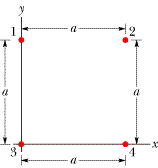
hrw7_21-22.gif

See, I thought it would work out to be 1 since I thought q and Q must be the same for the force to be zero. Apparently I am mistaken. So... show me start to finish pretty please? :biggrin:
 

Attachments

  • hrw7_21-22.gif
    hrw7_21-22.gif
    1.3 KB · Views: 535
Physics news on Phys.org
Your right that Q and q have to have oppisite sighns for the forces to cancel out. But you have to show some work first and eaven the we almost never don't give full answers.
Hint: Just draw out the force components and show when the total on each axis is zero.
 
But I thought this was one of those that you don't really do work - it's logic. Say Q is 2. q has to be -2. Q/q=-1? But that's not right either...

I tried figuring it out this way:
The distance from particle 1 to 4 is sqrt(2a^2), so the force there is k(2Q/(sqrt(2a^2)^2) which simplifies to k(Q/a).
The combined forces of 2 and 3 will pull 1 in at a 45 degree angle to 2 or 3, which is the same direction 4 is pushing away at.
So, for 1: F=k(Q*q/a^2), except we have to take the 45 degrees into account, so F=k(2*Q*q*cos(45)/a^2).
Set them equal, and we have:
k(Q/a)=k(2*Q*q*cos(45)/a^2)
Q=2*Q*q*cos(45)/a
q=a/2cos(45)

Then for particle 3:
F=k(2q/(sqrt(2a^2)^2)=k(q/a)
F=k(2*Q*q*cos(45)/a^2)
k(q/a)=k(2*Q*q*cos(45)/a^2)
Q=a/2cos(45)

Q=a/2cos(45)=q, so Q/q is 1. ?
 
feistytigger said:
The distance from particle 1 to 4 is sqrt(2a^2), so the force there is
k(2Q/(sqrt(2a^2)^2)

It should be:
k(Q^2/(sqrt(2a^2)^2).
 

Similar threads

  • · Replies 10 ·
Replies
10
Views
2K
  • · Replies 6 ·
Replies
6
Views
1K
Replies
2
Views
4K
  • · Replies 14 ·
Replies
14
Views
2K
Replies
23
Views
1K
  • · Replies 12 ·
Replies
12
Views
2K
  • · Replies 14 ·
Replies
14
Views
2K
  • · Replies 9 ·
Replies
9
Views
3K
  • · Replies 5 ·
Replies
5
Views
5K
  • · Replies 5 ·
Replies
5
Views
2K