High School What is the Net Force on a Banked Curve?

Click For Summary
The discussion centers on the differing interpretations of net forces on a car navigating a banked curve. While some sources claim there is a net force greater than zero in the X direction, the professor asserts that both the X and Y net forces are zero when considering the car's accelerated reference frame, where centrifugal force balances out other forces. This discrepancy arises from the choice of reference frame; in an inertial frame, a net force exists, while in the car's frame, the centrifugal force is considered. An analogy involving a rock tied to a string illustrates this concept, where the observer sees tension and gravity, while the rock experiences a centrifugal force equal to the tension. Ultimately, understanding the reference frame is crucial to resolving the confusion about net forces in these scenarios.
Abu
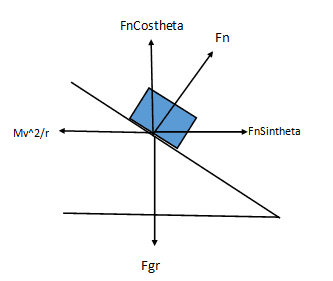
I understand why when deriving the formulas for cars on banked curves, the net force in the Y direction is zero. However, when I google how to derive them, people say that there is a net force greater than zero in the X direction. This is not what my professor says in his explanations however: he says that the net force in the X direction is also zero, and that this is because there is a centrifugal force equal to mv^2/r pointed to the left that cancels Fnsintheta..

I will attach the following diagram to better explain my question. Note the mv^2/r that is pointing to the left, where typically other diagrams do not include that.
question1.PNG


All in all, why is the net force in the X direction for my professors explanation equal to zero, where other explanations say it is not?
 
Physics news on Phys.org
This depends on which reference frame you consider. If you consider the ground inertial frame, there is a net force. If you consider the car's accelerated reference frame there is an additional inertial force, the centrifugal force.
 
Orodruin said:
This depends on which reference frame you consider. If you consider the ground inertial frame, there is a net force. If you consider the car's accelerated reference frame there is an additional inertial force, the centrifugal force.

Oh okay, so let's say there is a string tied to rock spinning in a vertical motion. If I am looking at the scenario as an outside observer, the forces include the tension that acts as the centripetal force and the force of gravity (depending on where the rock is in its rotating motion), there is no centrifugal force that needs to be included. But if I am looking it at as if I am the rock, then there is a centrifugal force that will be equal to the tension? Am I correct in this regard?
 
In essence, yes.
 
Topic about reference frames, center of rotation, postion of origin etc Comoving ref. frame is frame that is attached to moving object, does that mean, in that frame translation and rotation of object is zero, because origin and axes(x,y,z) are fixed to object? Is it same if you place origin of frame at object center of mass or at object tail? What type of comoving frame exist? What is lab frame? If we talk about center of rotation do we always need to specified from what frame we observe?

Similar threads

  • · Replies 3 ·
Replies
3
Views
2K
  • · Replies 8 ·
Replies
8
Views
3K
  • · Replies 9 ·
Replies
9
Views
2K
  • · Replies 9 ·
Replies
9
Views
2K
Replies
31
Views
1K
  • · Replies 14 ·
Replies
14
Views
1K
  • · Replies 24 ·
Replies
24
Views
1K
  • · Replies 9 ·
Replies
9
Views
3K
  • · Replies 1 ·
Replies
1
Views
1K
  • · Replies 1 ·
Replies
1
Views
2K