Newton's Laws - Positive & negative direction

Click For Summary
SUMMARY

This discussion focuses on the application of Newton's Laws of Motion, specifically regarding the definition of positive and negative directions in problems involving constant acceleration. Participants emphasize the importance of consistently defining positive directions based on the movement of objects, as demonstrated with box A and box C in the example provided. The consensus is that maintaining a positive acceleration value is crucial for correctly applying the formula F=ma, leading to positive gravitational forces for objects moving in the defined positive direction and negative forces for those moving in the opposite direction.

PREREQUISITES
  • Understanding of Newton's Laws of Motion
  • Familiarity with constant acceleration problems
  • Basic knowledge of vector direction in physics
  • Proficiency in applying the formula F=ma
NEXT STEPS
  • Study the implications of vector direction in Newton's Laws
  • Practice solving constant acceleration problems with varying positive directions
  • Explore the concept of gravitational force in different coordinate systems
  • Review examples of force diagrams to reinforce understanding of F=ma
USEFUL FOR

Students studying physics, educators teaching Newton's Laws, and anyone looking to deepen their understanding of vector direction in motion problems.

Thomass
Hi,
While solving homework problems, I start by defining a positive-y direction and a positive-x direction. Let's say up and to the right. Until now, I've applied this same rule to all objects in each problem, no matter the direction the object moves. But it seems I have not understood this fully.
While solving the problem for the attached picture, I had to define a positive direction up for box A, and a positive direction down for box C to get the right answer. Is the positive direction decided by which direction the object moves in constant acceleration problems like this?
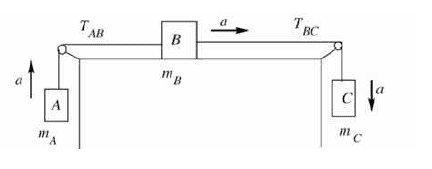
pic1.png
 
Physics news on Phys.org
The reason you have to do this is because you have chosen to keep a always positive. A consequence of this is that the force of gravity is positive for block A and negative for block C to make F=ma come out right.
Thats not how I would have done it. I would have chosen up is positive always, and the acceleration for A would be a, and the acceleration for block C would be -a.
 
willem2 said:
The reason you have to do this is because you have chosen to keep a always positive. A consequence of this is that the force of gravity is positive for block A and negative for block C to make F=ma come out right.
Thats not how I would have done it. I would have chosen up is positive always, and the acceleration for A would be a, and the acceleration for block C would be -a.

I agree! I recall doing it this way before, had forgotten all about it. Thank you :-)
 

Similar threads

  • · Replies 4 ·
Replies
4
Views
2K
Replies
3
Views
2K
  • · Replies 5 ·
Replies
5
Views
3K
  • · Replies 40 ·
2
Replies
40
Views
4K
  • · Replies 6 ·
Replies
6
Views
4K
  • · Replies 18 ·
Replies
18
Views
2K
  • · Replies 30 ·
2
Replies
30
Views
3K
Replies
6
Views
2K
  • · Replies 14 ·
Replies
14
Views
2K
  • · Replies 9 ·
Replies
9
Views
2K