Newton's second law -- rockets

Join the discussion
Ask a follow-up here, or get your own question answered by working scientists, mathematicians and engineers — people, not an autocomplete.
Real named experts · corrections over time · the nuance an AI answer skips
6 replies · 2K views
Woopa
Messages
20
Reaction score
4
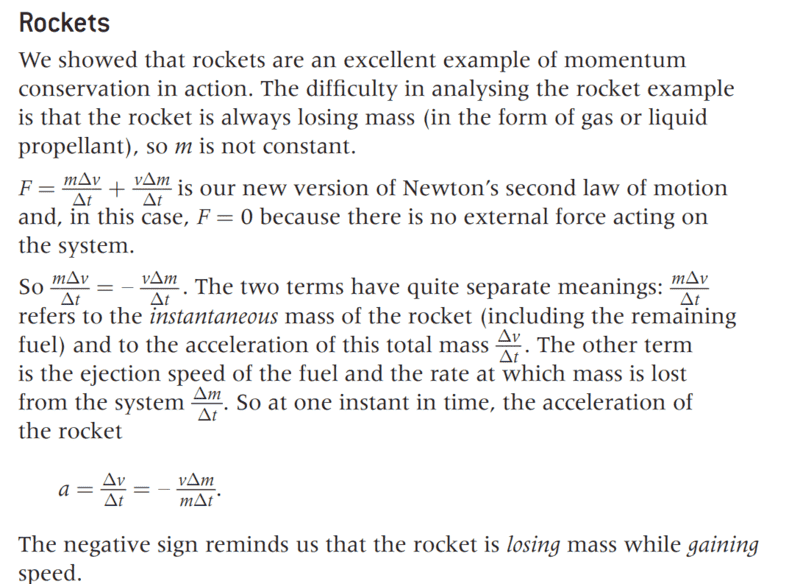
I am having difficulty understanding the information below. In the second line it states that F=0 as there is no external force on the system. However it later calculates acceleration of the rocket.

How can Force=0 if there is acceleration? (This is the first time I have encountered the product rule so this may be part of my misunderstanding)
1678945247034.png
 
Physics news on Phys.org
The keyword here is "system". By considering both the propellant (initial at rest inside the rocket) and the rocket itself to be part of the system and then say this system is isolated we are effectively saying that the net force between the mass inside and any mass outside the system is zero, leaving us to consider only forces between mass inside the system. This then means the momentum of the system is unchanged, or equivalently, if one part of the system, e.g. some of the propellant, accelerate one way then another part, e.g. the rocket plus its remaining propellant, has to accelerate in the opposite direction.
 
Reply
  • Like
Likes   Reactions: topsquark, Ibix, PeroK and 1 other person
Woopa said:
Note that the "new form" of Newton's second law given here is not valid in general. There are several threads on here analysing this question.

In fact it's not really Newton's second law, but an equation that is only valid in this specific case.

PS the author has confusingly used the same letter ##v## for the velocity of the rocket and the velocity of the expellant. A simpler way to look at this is to use conservation of momentum:
$$m_r\Delta v_r + \Delta m_e v_e = 0$$Where we need the assumption that ##\Delta m_e## is small compared to ##m_r##. Otherwise, we would need to be more explicit that the mass of the rocket is changing from ##m_r + m_e## to ##m_r## after the expellent is fired out.
 
Last edited:
Reply
  • Like
Likes   Reactions: Filip Larsen, vanhees71 and topsquark
PS if we are being harsh, then the author has made two mistakes which cancel out and contrive to get the right equation:

1) Wrongly stating Newton's second law as ##F = m\frac{\Delta v}{\Delta t} + v\frac{\Delta m}{\Delta t}##.

2) Mistakingly using the change in velocity of the rocket as ##\Delta v## and the velocity of the expellant as ##v## in this equation.
 
Reply
  • Like
Likes   Reactions: erobz, Ibix and vanhees71
Woopa said:
How can Force=0 if there is acceleration?
There is no acceleration. The rocket accelerates in one direction and the propellant accelerates in the opposite direction. The acceleration of the system (the system consisting of the rocket and the propellant) is zero.