Newton's Third Law for book on a table

Click For Summary

Homework Help Overview

This discussion revolves around understanding Newton's Third Law in the context of a book resting on a table. Participants are exploring the relationship between the forces acting on the book and the table, particularly focusing on the normal force and gravitational force.

Discussion Character

  • Conceptual clarification, Assumption checking

Approaches and Questions Raised

  • Participants are attempting to clarify why the normal force and weight of the book are not considered Newton's Third Law pairs. Some express confusion about how the book exerts a normal force on the table and question the nature of the forces involved.

Discussion Status

Multiple interpretations of the forces at play are being explored, with some participants providing insights into the definitions of action-reaction pairs. There is an ongoing exchange of ideas, with references to external resources for further clarification.

Contextual Notes

Some participants note that the discussion is influenced by external resources, such as Wikipedia, and emphasize the importance of understanding the definitions and relationships between different forces in this scenario.

String theory guy
Messages
26
Reaction score
4
Homework Statement
Statement is below.
Relevant Equations
Newton's Third Law
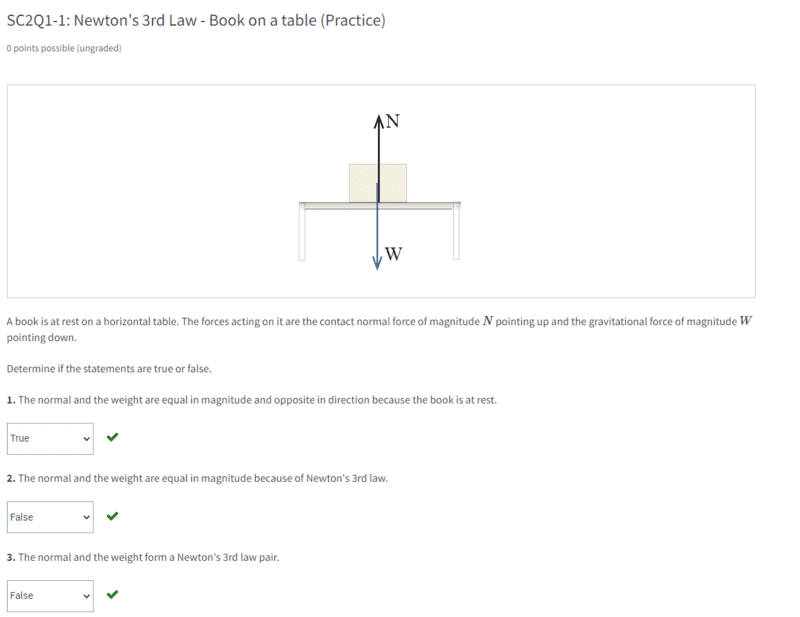
This problem is from MIT's module again.
1670989944624.png

I have a doubt about Newton's Third Law. How is the normal and weight of the book not Newton's 3rd Law pairs?

When the book is placed on the table, I imagine that the book's weight exerts a force on the table and the table exerts and equal and opposite force of the same magnitude and opposite direction. This force is called the normal force.
 
Physics news on Phys.org
The Wikipedia entry for "Newton's Third Law" literally gives the answer to that specific question.
 
  • Like
Likes   Reactions: String theory guy and topsquark
String theory guy said:
When the book is placed on the table, I imagine that the book's weight exerts a force on the table and the table exerts and equal and opposite force of the same magnitude and opposite direction. This force is called the normal force.
I'd write it out this way:
The book's weight, the force of the Earth's gravity acting on the book ##w_{BE}##, means that the book exerts a force on the table, ##N_{TB}##. Likewise, the table exerts an equal and oppositely directed force on the book, ##N_{BT}##. Third force law pairs are the same type of force, so one can't be a normal force and the other a weight, and they act between the two objects, Book and Table. So, the Third Law pairs are ##N_{BT}## and ##N_{TB}##.

The weight is the cause of the normal forces but is not the Third Law pair of either of them.

-Dan
 
  • Like
  • Love
Likes   Reactions: PeroK and String theory guy
The third law pairs are:
- The gravitational force from the Earth on the book and the gravitational force from the book on the Earth.
- The contact force from the table on the book and the contact force from the book on the table.

Third law pairs never affect the same object. The weight and the contact force on the book are equal and opposite because the book is in equilibrium, not because they are a third law pair. For example, if you add a force pushing down on the book, tilt or accelerate the table - they will not be the same any more. Third law pairs are always the force of A on B and the force of B on A.
 
  • Like
  • Informative
  • Love
Likes   Reactions: member 731016, berkeman, PeroK and 2 others
topsquark said:
I'd write it out this way:
The book's weight, the force of the Earth's gravity acting on the book ##w_{BE}##, means that the book exerts a force on the table, ##N_{TB}##. Likewise, the table exerts an equal and oppositely directed force on the book, ##N_{BT}##. Third force law pairs are the same type of force, so one can't be a normal force and the other a weight, and they act between the two objects, Book and Table. So, the Third Law pairs are ##N_{BT}## and ##N_{TB}##.

The weight is the cause of the normal forces but is not the Third Law pair of either of them.

-Dan
Thanks @topsquark. However, how dose the book exert a normal force onto the table? I don't understand why one can't be the weight and the other can't be the normal force from the table. The weight is equal to the normal force from the book onto the table.
 
  • Sad
Likes   Reactions: PeroK
String theory guy said:
Thanks @topsquark. However, how dose the book exert a normal force onto the table? I don't understand why one can't be the weight and the other can't be the normal force from the table. The weight is equal to the normal force from the book onto the table.
Every poster so far has answered that question already.
 
  • Like
  • Love
Likes   Reactions: topsquark and String theory guy
String theory guy said:
However, how dose the book exert a normal force onto the table?
Because if the table acts on the book with a force ##\vec F##, then the book acts on the table with a force ##-\vec F##. That is what Newton's third law says.
 
  • Like
  • Love
Likes   Reactions: topsquark and String theory guy
hmmm27 said:
The Wikipedia entry for "Newton's Third Law" literally gives the answer to that specific question.
In case the OP or anyone else is having trouble finding it, there is no (English) Wikipedia page for "Newton's Third Law", I believe @hmmm27 is referring to https://en.wikipedia.org/wiki/Newton's_laws_of_motion#Third.
 
  • Like
  • Love
Likes   Reactions: String theory guy, berkeman, topsquark and 1 other person
@String theory guy : Check this video out, it will help you resolve your misconception:
 
  • Like
  • Love
Likes   Reactions: topsquark and String theory guy

Similar threads

  • · Replies 25 ·
Replies
25
Views
2K
  • · Replies 12 ·
Replies
12
Views
3K
  • · Replies 13 ·
Replies
13
Views
1K
  • · Replies 2 ·
Replies
2
Views
14K
  • · Replies 2 ·
Replies
2
Views
912
  • · Replies 2 ·
Replies
2
Views
3K
  • · Replies 2 ·
Replies
2
Views
2K
Replies
5
Views
2K
Replies
5
Views
2K
Replies
13
Views
3K