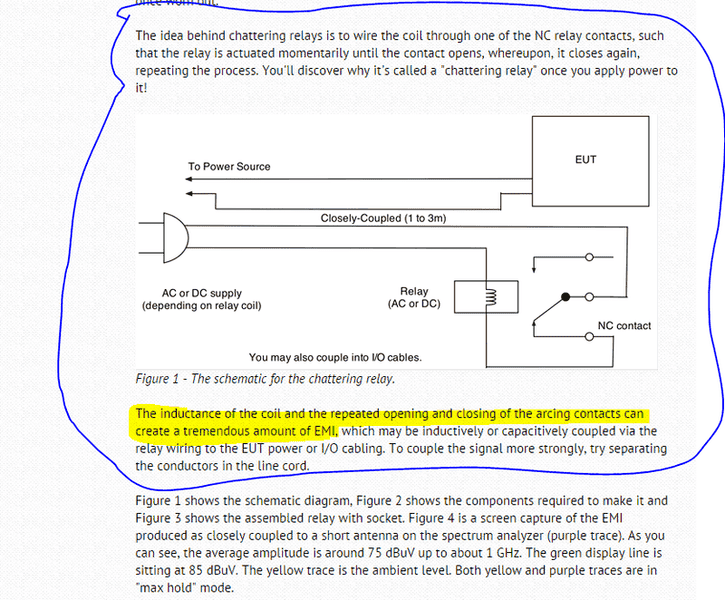
I believe the radiation occurs because when the contact starts to open, the inductance of the coil creates a forward EMF and this then causes the gap to break down again. This breakdown is very fast, and you may know that one of the early radio experimenters, Bose, obtained results using a spark gap at 40 GHz. So we may assume it breaks down in picoseconds. Any energy that is stored in the capacitance of the wires will then be converted into oscillatory energy at all frequencies at which the wires have a resonance. To obtain "good" radiation, I suggest connecting short antennas to each side of the spark gap, to form a dipole, or opening out the wiring each side of the contact to form a loop. Remember that the pulse in the coil itself will be quite slow.
I have used a buzzer of this type, using a little relay, as a source of RF for an impedance bridge, as a wavemeter and for measuring resonant frequencies of tuned circuits etc.