blueblast
Here is problem I quickly made up:
Suppose there is a ramp with a height of 6 meters and length of 12 meters. A block of 5 kg is pushed up to the top of the ramp with a constant velocity. The force of friction is 15 N.
Here's the confusion:
By using the non-conservative force work energy theorem, Work done by friction(Wf) = (KEf-KEi) + (PEf-PEi).
Since the block is pushed up at a constant velocity, the change in KE is zero. And since the block start from the ground, PEi is zero. So, Wf = PEf. Wf = friction * distance = 15 N * 12 meters = 180. So PEf = 180.
However, mgh says that potential energy is 5 kg * 6 meters * 9.8 m/s^2 =294.
Could someone please tell me where I am wrong? A diagram of the problem is attached just in case my words weren't clear.
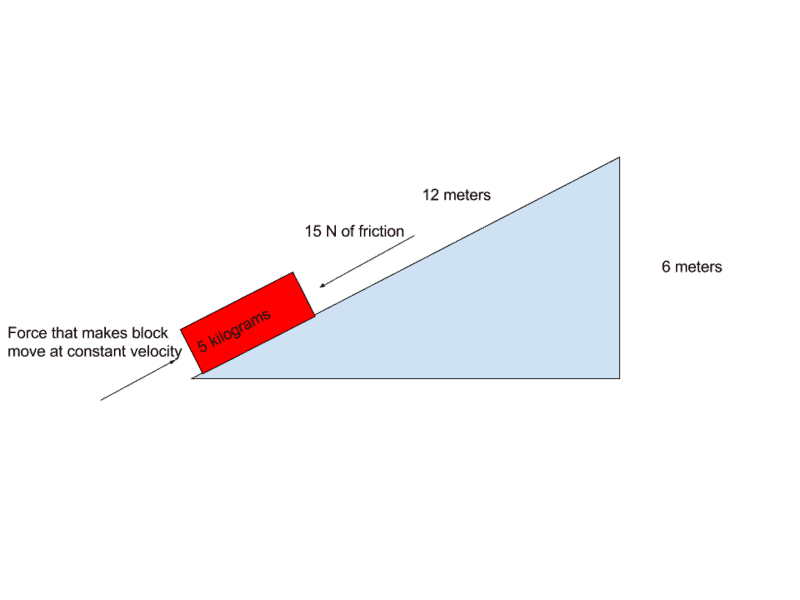
Suppose there is a ramp with a height of 6 meters and length of 12 meters. A block of 5 kg is pushed up to the top of the ramp with a constant velocity. The force of friction is 15 N.
Here's the confusion:
By using the non-conservative force work energy theorem, Work done by friction(Wf) = (KEf-KEi) + (PEf-PEi).
Since the block is pushed up at a constant velocity, the change in KE is zero. And since the block start from the ground, PEi is zero. So, Wf = PEf. Wf = friction * distance = 15 N * 12 meters = 180. So PEf = 180.
However, mgh says that potential energy is 5 kg * 6 meters * 9.8 m/s^2 =294.
Could someone please tell me where I am wrong? A diagram of the problem is attached just in case my words weren't clear.
Attachments
