Non-constant wave velocity in a ripple tank system

Click For Summary

Discussion Overview

The discussion revolves around the observation of non-constant wave velocity in a ripple tank system, specifically focusing on the behavior of circular waves generated by a ripple generator. Participants explore potential reasons for the observed phase velocity changes, including nonlinearity and dispersion effects.

Discussion Character

  • Exploratory
  • Technical explanation
  • Debate/contested

Main Points Raised

  • One participant notes that the phase velocity stabilizes around a constant value after 2.0 seconds but questions why it is initially much faster, suggesting possible nonlinearity introduced by the ripple generator.
  • Another participant speculates that the ripple generator may operate horizontally rather than vertically, which could influence the initial wave speed observed.
  • A different participant raises a point about energy distribution in radiated waves, suggesting that the initial high phase velocity may be due to the water blob moving with the dibber rather than forming a radiated wave.
  • This participant draws an analogy to radio transmitting antennas, discussing the concept of a reactive near field where energy is stored close to the source, which may relate to the observed phenomena in the ripple tank.

Areas of Agreement / Disagreement

Participants express differing views on the causes of the observed wave behavior, with no consensus reached on whether the effects are due to nonlinearity, dispersion, or energy storage mechanisms.

Contextual Notes

Participants mention the potential influence of the ripple generator's movement and the nature of wave propagation, but the discussion lacks clarity on specific definitions and assumptions regarding wave behavior in the ripple tank.

greypilgrim
Messages
583
Reaction score
44
Hi.

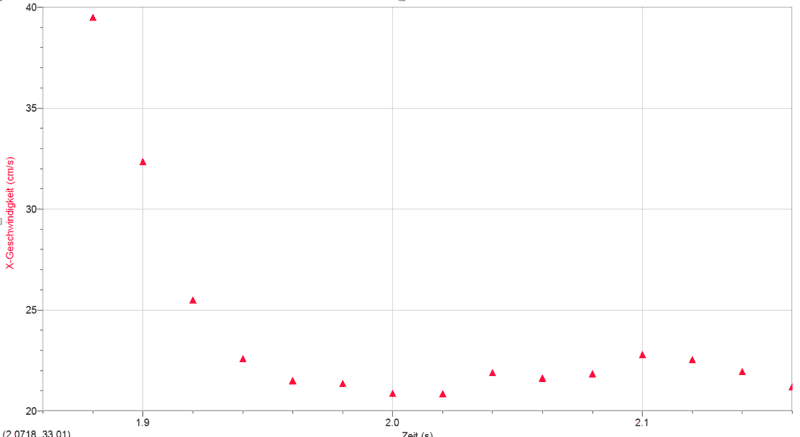
We tried to make some quantitative measurements with a Pasco ripple tank system, a video camera and software for video analysis. We generated circular waves and tracked the propagation of a crest, from which the software computed the phase velocity:
ATT00001.png


We used 5 Hz, 10 Hz and 20 Hz; unfortunately I'm not sure what the setting was for this particular measurement (they all look similar anyway).
The phase velocity seems to stabilize around a constant value (as the wave velocity should be according to linear wave theory) somewhere before 2.0 s, but why is it so much faster before that?
It seems that the ripple generator does more than just excite the waves by moving up and down, maybe it introduces a nonlinearity of some sort?

Or might this be a dispersive effect? Then again, why would there be dispersion if the frequency is constant?
 

Attachments

  • ATT00001.png
    ATT00001.png
    3.8 KB · Views: 642
Physics news on Phys.org
greypilgrim said:
Hi.

We tried to make some quantitative measurements with a Pasco ripple tank system

…It seems that the ripple generator does more than just excite the waves by moving up and down, maybe it introduces a nonlinearity of some sort?
Following the link you provided, I did not find any videos of the ripple generator in action, but from the photos it would seem that it works by moving horizontally, not vertically. Is that the case? If so, you may be seeing the waves start off at the whatever speed the generator is moving.
 
Can you please tell me the name of the X axis.
I presume the ripple tank uses a vertical "dibber" to make the waves.
 
For a radiated wave, I expect to see energy being carried away from the source.
If the phase velocity is high at the start, I read this that a blob of water initially tends to go up and down with the dibber, rather than forming a radiated wave.
The dibber drags a mass of water up and down with it. Only a part of this energy is radiated. Most of the energy is stored in the vibrating system, the voice coil etc, which now includes the mass of a blob of water.
A similar effect occurs with a radio transmitting antenna, where very close to it we see a lot of stored energy. The up and down displacement of your water
resembles the electric field of the antenna. Very close to the antenna we see a strong electric field which appears to have an outward phase velocity greater than light. This strange effect was first noticed by Hertz when he first made radio waves.
The region very close to the source, where we have a lot of stored energy, is called the reactive near field.
Do not confuse this reactive near field with another region in the ripple tank. Very close to a directional wave source, such as a vibrating bar, the waves travel away in a parallel beam. But eventually they spread out. These two zones are sometimes called the near and far radiation zones.
 
  • Like
Likes   Reactions: vanhees71

Similar threads

Replies
13
Views
3K
  • · Replies 1 ·
Replies
1
Views
2K
  • · Replies 13 ·
Replies
13
Views
3K
  • · Replies 21 ·
Replies
21
Views
3K
  • · Replies 8 ·
Replies
8
Views
2K
  • · Replies 50 ·
2
Replies
50
Views
20K
  • · Replies 5 ·
Replies
5
Views
4K
  • · Replies 1 ·
Replies
1
Views
3K
  • · Replies 43 ·
2
Replies
43
Views
6K
  • · Replies 23 ·
Replies
23
Views
5K