Non-intuitive velocity change for object with changing mass

  • Context: Graduate 
  • Thread starter Thread starter Dishsoap
  • Start date Start date
  • Tags Tags
    Change Mass Velocity
Click For Summary

Discussion Overview

The discussion revolves around the dynamics of an object with a changing mass under a constant force, specifically a cart experiencing a force while its mass decreases exponentially over time. Participants explore theoretical implications, potential experimental setups, and the mathematical modeling of the situation.

Discussion Character

  • Exploratory
  • Technical explanation
  • Debate/contested
  • Experimental/applied

Main Points Raised

  • One participant proposes a cart with a constant force and an exponentially decaying mass, leading to a non-intuitive velocity change, which they wish to test experimentally.
  • Another suggests using a circular air track in a vacuum chamber to model mass loss through water vaporization, but acknowledges challenges in measurement and design.
  • A participant questions the correctness of the initial equations, arguing that they assume all momentum is conserved in the remaining mass, which may not hold true in practice.
  • Concerns are raised about the implications of mass loss and momentum conservation, with some suggesting that the lost mass would have momentum in the direction of the object's motion, complicating the dynamics.
  • One participant asserts that the initial idea of the experiment may be flawed due to unrealistic assumptions about momentum transfer, suggesting that the resulting motion pattern may not be replicable without sophisticated controls.
  • Another participant proposes a modified mass function to avoid the issue of mass approaching zero, while also discussing the complexities of maintaining momentum conservation in the system.

Areas of Agreement / Disagreement

Participants express differing views on the validity of the proposed equations and the feasibility of the experimental setup. There is no consensus on the correctness of the initial model or the possibility of successfully demonstrating the effect experimentally.

Contextual Notes

Participants note limitations regarding the assumptions made in the equations, particularly concerning momentum conservation and the behavior of mass loss over time. The discussion highlights the complexity of accurately modeling the dynamics of a system with changing mass.

Dishsoap
Messages
1,016
Reaction score
308
Greetings, fellow PFers,

I have an interesting question which one of my professors raised, and I'm intrigued and would like to try it experimentally, though how to do so isn't clear to me.

Suppose a cart with a constant force on it (say 1N), and with a velocity v(0)=-10 and a mass that changes according to ##m(t)=e^{-t}##. That is, the cart is initially moving in a direction opposite the force. Therefore, the equation of motion gives

##F=\frac{d}{dt} m v = m \frac{dv}{dt} + v \frac{dm}{dt}##
or, solved with the method of integrating factors,
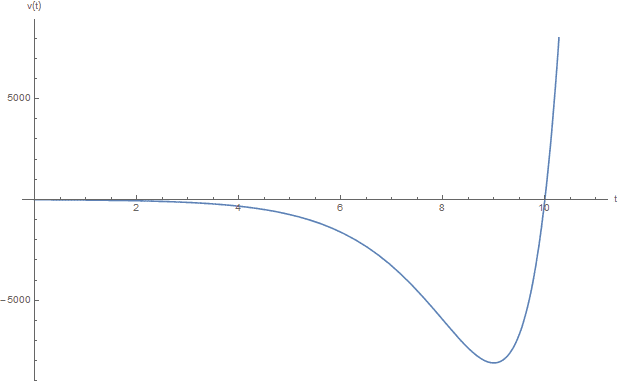
##v(t)=e^{t}(t-10)##

Which, to visualize, gives something like this:
SURd0YX.png


That is, the speed (not velocity) actually increases, before decreasing and the car eventually turning around.

This is intriguing and I would really like to see this experimentally, however the difficulty is avoiding "shooting off" the mass in such a way as to create recoil. Also, an exponentially decaying mass will be hard to realize, but I will frankly settle for any mass function which decreases monotonically. I have had a couple of ideas:
  1. A cart that gradually leaks water. However, the only way I can think to do this is to use the classic photogate/pulley system used for physics 1, which I think would not be accurate enough for this purpose.
  2. A Milikan oil drop experiment, but using some particle which undergoes alpha decay with a very short half-life.

Thoughts? Opinions? Sarcastic remarks?
 
Physics news on Phys.org
Interesting, instead of pulleys you could develop a circular air track, enclosed in a weak vacuum chamber with a modified rider holding water. You could then take advantage of the water to gaseous transformation to model the mass loss. Getting the escape to be a variable rate might be a challenge in design, and taking your measurements could be challenging.
 
Last edited:
Regarding a practical implementation: wouldn't the mass of a sublimating hemispherical block of dry ice decay exponentially?

Regarding the equations, I don't think the equation is necessarily correct. It assumes that all momentum is conserved in the remaining mass, which implies that the lost mass has zero momentum at the instant it detaches. It is that phenomenon that gives you your initially increasing speed, because the momentum is getting concentrated into a smaller and smaller mass.

In practice, it seems likely that, leaving aside the accelerating force, the body's momentum reduces in proportion to the loss of mass, because the detaching particles initially have the same velocity as the object, in the object's direction of motion. In that case the equation of motion is simpler: ##\frac{dv}{dt}=\frac{1}{m(t)}=e^t##. Hence ##v=v(0)+e^t## and displacement ##x=-10t+e^t##. In this case the speed decreases right from the beginning until it reaches zero, then heads off in the opposite direction exponentially.
 
  • Like
Likes   Reactions: FactChecker
Dishsoap said:
That is, the speed (not velocity) actually increases, before decreasing and the car eventually turning around.
Choose the reference frame where the cart is initially at rest. You have a force in positive direction, and want the cart to accelerate in the opposite direction? The only way to do this, is to shoot off mass forward from the cart, which will create thrust just like a rocket engine.

As andrewkirk shows, It will not work by just dropping the mass with zero relative horizontal velocity.
 
andrewkirk said:
It assumes that all momentum is conserved in the remaining mass, which implies that the lost mass has zero momentum at the instant it detaches.
It basically assumes a rocket engine, with variable expulsion speed, controlled such that the expelled gas is stationary in the frame where v(0)=-10. Due to the decaying mass flow, the negative rocket thrust is initially higher, then lower than the constant positive force.
 
  • Like
Likes   Reactions: Student100
Thank you all for your insight. So there is no real experiment in which I would be able to see this effect?
 
## m = e^{-t} ## means that after while the mass is basically zero, this is impossible a better suggestion will be ## m = m_0 + a*e^{-t}## where ##m_0## is the mass of the container and ##a## is the initial mass of the water, however as I've seen above momentum will not be conserved, but even though if a is very small you can assume that is conserved but the effect you've mentionned cannot be true, ## v = be^{t - ln(a +m_0e^t)} + \frac{Fe^t t}{a + me^t} ## which after a while will yield y = b + F*t/m, if you burn the container (which is a larger mass) momentum conservation will stop this from happening, :D Good luck and that was really interesting !
 
Dishsoap said:
So there is no real experiment in which I would be able to see this effect?
I presume that by This Effect you mean to refer to the pattern of movement shown in the graph. If so then yes there doesn't appear to be any such experiment without introducing very unnatural system controls such as computerised feedback. But that's because (I think) the graph is based on a mistake. I think that whoever thought up this situation wrote the equation that you solved without realising that it implied that all of the evaporating particles' momentum was magically transferred back to the unevaporated part of the object. I think they were probably just wondering what would be the equation of motion of an evaporating object, wrote that equation without realising that it implied that totally implausible assumption, then observed that it gave an interesting pattern of motion and wrongly concluded that the interesting pattern would be the real pattern of the simple experiment they imagined.

It's only because of the mistake that the pattern of motion is difficult to replicate. The initial idea was simple, and if pursued without the implausible assumption of momentum recapture, leads to an equation, shown in post #3, that should be easy enough to experimentally reproduce, but the mistake turned it into an equation of motion that is unrelated to the initial practical idea, and hence as hard to experimentally reproduce as any randomly chosen complicated function of time.

Having said that, even the original idea is not that easy to reproduce experimentally. I realized that my idea of a hemisphere of dry ice won't give the desired rate of mass loss because the proportional rate of shrinking will increase as it gets smaller, rather than remaining constant as required by ##m=e^{-t}## I think something a little more sophisticated would be needed. eg the dry ice could be in a container with an opening with a variable aperture. The size of the aperture could be controlled by a sliding shutter, whose position is related to the weight of the dry ice by some sort of spring and balance arrangement. The size of the aperture would determine the rate of evaporation. It shouldn't be too hard for a clever engineer to rig up, without needing to involve computer control.
 

Similar threads

  • · Replies 30 ·
2
Replies
30
Views
2K
  • · Replies 61 ·
3
Replies
61
Views
5K
  • · Replies 14 ·
Replies
14
Views
3K
  • · Replies 41 ·
2
Replies
41
Views
3K
  • · Replies 1 ·
Replies
1
Views
1K
  • · Replies 43 ·
2
Replies
43
Views
4K
  • · Replies 17 ·
Replies
17
Views
2K
  • · Replies 16 ·
Replies
16
Views
2K
  • · Replies 3 ·
Replies
3
Views
2K
  • · Replies 131 ·
5
Replies
131
Views
8K