Nonuniform Circular Motion of a steel table

Click For Summary

Homework Help Overview

The discussion revolves around a physics problem involving nonuniform circular motion of a steel block rotating on a steel table, with a focus on the forces acting on the block and the conditions under which the tube connecting it breaks. Participants are exploring the calculations related to tangential acceleration, angular velocity, and the time taken for the block to reach a certain speed.

Discussion Character

  • Exploratory, Conceptual clarification, Mathematical reasoning, Problem interpretation

Approaches and Questions Raised

  • Participants discuss calculations for tangential acceleration and angular velocity, with some questioning the interpretation of terms like "period" in the context of nonconstant angular velocity. There are inquiries about the method used to derive the total time and the relationship between final velocity and acceleration.

Discussion Status

The discussion is ongoing, with participants providing feedback on each other's calculations and clarifying misunderstandings. There is a recognition of errors in earlier calculations, and some participants are actively seeking further guidance on how to arrive at the correct total time and other parameters.

Contextual Notes

Participants are working under the constraints of homework rules, which may limit the information they can share or the methods they can use. There is an emphasis on understanding the relationships between the variables involved in the motion of the block.

pcmarine
Messages
6
Reaction score
0
A 600 g steel block rotates on a steel table while attached to a 1.20 m-long hollow tube. Compressed air fed through the tube and ejected from a nozzle on the back of the block exerts a thrust force of 4.30 N perpendicular to the tube. The maximum tension the tube can withstand without breaking is 60.0 N.

If the block starts from rest, how many revolutions does it make before the tube breaks?
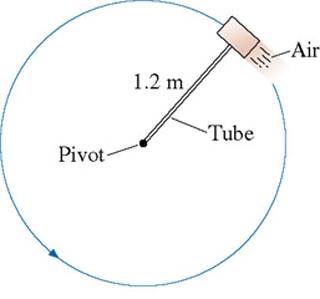
knight_Figure_07_55.jpg


I've done some calculations and have come up with:
Tangential Acceleration: 1.287 m/s^2
Omega: 9.13
Period: 8.513 seconds

plugged these numbers into Theta=((a)/(2*r))*(period)^2
and got 38.953 rads, or 61.19 revolutions... which was wrong :mad:
 
Physics news on Phys.org
pcmarine said:
A 600 g steel block rotates on a steel table while attached to a 1.20 m-long hollow tube. Compressed air fed through the tube and ejected from a nozzle on the back of the block exerts a thrust force of 4.30 N perpendicular to the tube. The maximum tension the tube can withstand without breaking is 60.0 N.

If the block starts from rest, how many revolutions does it make before the tube breaks?

knight_Figure_07_55.jpg


I've done some calculations and have come up with:
Tangential Acceleration: 1.287 m/s^2
Omega: 9.13
Period: 8.513 seconds

plugged these numbers into Theta=((a)/(2*r))*(period)^2
and got 38.953 rads, or 61.19 revolutions... which was wrong :mad:


I am assuming that you don't mean "period", you mean the total time it takes to reach the final omega?? (it does not make sense to talk about a period since the rotation is not at a constant omega). And I am guessing that you mean 6.119 revolutions.

Can you just show how you got your tangential acceleration?
 
Wow thanks, yeah you were right, it was actually a decimal over... 6.1 revolutions.
 
pcmarine said:
Wow thanks, yeah you were right, it was actually a decimal over... 6.1 revolutions.

So, do you have the right answer now?
 
yep, thanks
 
how the heck are you getting that time total of 8.513?
 
bump? Any help there?
 
Fierofiend said:
how the heck are you getting that time total of 8.513?
What do you think it should be?
 
No idea, tried for hours, couldn't come up with that answer. I figured it would be something with omega and accel, but nothing computes.
 
  • #10
Fierofiend said:
No idea, tried for hours, couldn't come up with that answer. I figured it would be something with omega and accel, but nothing computes.
Perhaps because that answer i wrong. It does have something to do with acceleration, and omega if you choose to use that. What did you try?
 
Last edited:
  • #11
my final velocity was 10.95 m/s and I tried to divide by my accel
 
  • #12
Fierofiend said:
my final velocity was 10.95 m/s and I tried to divide by my accel
Let's say that is correct. What did dividing by acceleration give you? Where do you go from there?
 

Similar threads

  • · Replies 3 ·
Replies
3
Views
3K
  • · Replies 8 ·
Replies
8
Views
2K
Replies
1
Views
3K
  • · Replies 5 ·
Replies
5
Views
4K
  • · Replies 3 ·
Replies
3
Views
4K
  • · Replies 1 ·
Replies
1
Views
7K
  • · Replies 8 ·
Replies
8
Views
3K
  • · Replies 4 ·
Replies
4
Views
4K
  • · Replies 2 ·
Replies
2
Views
8K
Replies
3
Views
2K