Obtaining position in a dipole field

Click For Summary
SUMMARY

The discussion centers on the challenges of determining the location of a magnet vector within a magnetic dipole field, specifically described by the equation B = (μ₀/4π)((3(m·r)r)/r⁵) - (m/r³). The participants clarify that it is not possible to uniquely identify the source location of a magnetic field given a specific magnetic field vector, due to the uniformity of the field along a circular ring coaxial with the dipole. The conversation emphasizes the constraints posed by the dipole strength and distance, which complicate the determination of the magnet vector's position.

PREREQUISITES
  • Understanding of magnetic dipole fields
  • Familiarity with vector calculus
  • Knowledge of spherical coordinates in electromagnetism
  • Proficiency in solving differential equations related to magnetic fields
NEXT STEPS
  • Study the properties of magnetic dipole fields in detail
  • Learn about the mathematical representation of magnetic fields in spherical coordinates
  • Explore the concept of azimuthal symmetry in magnetic fields
  • Investigate methods for solving magnetic field equations in various coordinate systems
USEFUL FOR

Physicists, electrical engineers, and students studying electromagnetism who are interested in the behavior of magnetic fields and dipole interactions.

IanBerkman
Messages
52
Reaction score
1
Hi all,

Consider one has a magnetic dipole, the field given by:

\begin{equation}
\vec{B} = \frac{\mu_0}{4\pi}\left(\frac{3(\vec{m}\cdot\vec{r})\vec{r}}{r^5}-\frac{\vec{m}}{r^3}\right)
\end{equation}

where we can take $$\vec{m} = m\hat{y}$$.

Let us say we have the a magnet vector which is theoretically somewhere in the dipole field. Is it possible to obtain the location where that magnet vector occurs?

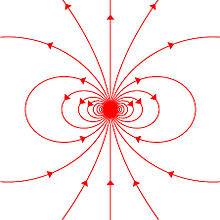
To simplify things a bit, I looked at the fieldlines of a dipole, sliced through the XY plane:
220px-Magnetic_dipole_moment.jpg


If we have a magnet vector of B = a[1,1,0], the vector would lie somewhere along the line y = 2x (just a really rough approximation to get my point across). The magnitude of the vector should correspond to two points on this line due to the symmetry. However, the dipole equation becomes

\begin{equation}
a[1,1,0]^\intercal = \frac{\mu_0m}{4\pi}\left(\frac{3y\vec{r}}{r^5}-\frac{\hat{y}}{r^3}\right)
\end{equation}

Which remains quite a tough equation to solve.

What am I missing in my line of reasoning?
 
Last edited:
Physics news on Phys.org
IanBerkman said:
Let us say we have the a magnet vector which is theoretically somewhere in the dipole field. Is it possible to obtain the location where that magnet vector occurs?
I'm not sure if I understand your question. Are you asking that when given ##\mathbf{B}## at some location in space, if it is possible to determine the source location?

If that is your question then the answer is no. This is because for a simple magnetic dipole, the magnetic field will be uniform along a circular ring coaxial with the dipole. The problem is also under constrained considering that the field strength is a function of the dipole strength and the distance; you have neither.
 
NFuller said:
I'm not sure if I understand your question. Are you asking that when given ##\mathbf{B}## at some location in space, if it is possible to determine the source location?

If that is your question then the answer is no. This is because for a simple magnetic dipole, the magnetic field will be uniform along a circular ring coaxial with the dipole. The problem is also under constrained considering that the field strength is a function of the dipole strength and the distance; you have neither.

The magnetic field magnitude would be uniform along the circular ring coaxial with the dipole. However, the magnetic field vectors would be different along the ring.

Let us consider the same magnetic dipole again in the y-direction, and we know the field at a certain position is of the form B=[1,1,0]. Since this field has no z-component, the answer should lie in the XY-plane instead of on a circular ring.

The dipole strength is known since m is given.
 
IanBerkman said:
However, the magnetic field vectors would be different along the ring.
The magnetic field of a dipole ##\mathbf{m}=m\hat{\mathbf{z}}## in spherical coordinates is
$$\mathbf{B}=\frac{\mu_{0}m}{4\pi r^{3}}\left(2\text{cos}(\theta)\hat{\mathbf{r}}+\text{sin}(\theta)\hat{\mathbf{\theta}}\right)$$
Notice that there is no ##\phi## dependence here so the magnetic field has azimuthal symmetry. Thus ##\mathbf{B}## is constant along a ring coaxial with the z-axis.
 

Similar threads

  • · Replies 6 ·
Replies
6
Views
1K
  • · Replies 1 ·
Replies
1
Views
1K
  • · Replies 25 ·
Replies
25
Views
2K
Replies
1
Views
2K
  • · Replies 11 ·
Replies
11
Views
1K
  • · Replies 1 ·
Replies
1
Views
2K
  • · Replies 4 ·
Replies
4
Views
3K
Replies
1
Views
2K
Replies
7
Views
2K
  • · Replies 28 ·
Replies
28
Views
1K