Ocean liner in bucket full of water

  • Thread starter Thread starter Himal kharel
  • Start date Start date
  • Tags Tags
    Ocean Water
Click For Summary
The discussion centers on the theoretical possibility of floating an ocean liner in a small bucket of water. It is established that a vessel floats by displacing a volume of water equal to its weight, which raises questions about the feasibility of such a scenario. Participants debate the necessity of sufficient water to create the required buoyant force, with some arguing that a thin film of water could exert enough pressure to support the vessel. However, others counter that without enough water to displace, the ship cannot float, emphasizing the importance of water retention in the bucket. Ultimately, the consensus leans towards the impossibility of floating a large vessel in an insufficient volume of water, despite theoretical arguments suggesting otherwise.
  • #91
This thread reminds me of the only question I missed one day on an exam, about 32 years ago:

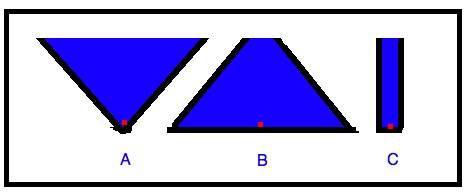
the_only_missed_question.jpg


Regarding the red dots above, labeled A, B, and C, which one experiences the the highest pressure?

A. ____
B. ____
C. ____
D. None of the above ____

I felt so stupid.

And if Dave answers "C!", because Om's geriatric shaking, placed it one pixel lower than A & B, I will come and kill him...
 
Physics news on Phys.org
  • #92
The ship would be floating on water in the same way as the load in your old wheelbarrow floats on oil.
(EDIT)
 
Last edited:
  • #93
dacruick said:
A "thin" film suggests that the water's thickness approaches zero, which means that the water will have negligible weight, and therefore there is no plausible way that the block could be floating.
With no part of the ship's hull being in direct contact with (say) the wet-dock walls, then what is supporting the ship's weight?
 
  • #94
NascentOxygen said:
The ship would be floating on water in the same way as your old wheelbarrow floats on oil.

Huh ?
 
  • #95
NascentOxygen said:
With no part of the ship's hull being in direct contact with (say) the wet-dock walls, then what is supporting the ship's weight?

That has been COMPLETELY discussed. Please read the thread.
 
  • #96
NascentOxygen said:
The ship would be floating on water in the same way as the load in your old wheelbarrow floats on oil.
(EDIT)

He's talking about the oiled bearings.

But I don't think that's applicable. It uses viscous properties, not bouyancy.
 
  • #97
NascentOxygen's comment was meant to point out that there are other places where a small amount of fluid supports a large force. The bearings (oil) supporting an automobile's piston rod is another.
 
  • #98
jmmccain said:
NascentOxygen's comment was meant to point out that there are other places where a small amount of fluid supports a large force. The bearings (oil) supporting an automobile's piston rod is another.
Yes but it is irrelevant.
 
  • #99
Is it?

A fluid supporting an aircraft carrrier and a piston is that different? In a general sense?

The idea may be horrid, but even the piston is floating.
 
  • #100
DaveC426913 said:
it is extremely hard to explain to someone who can't see it.
Anyone can see it clearly in the picture if he is willing to see it: in the bottom picture...
Borek said:
floating_ship.png
...in the bottom picture...
DaveC426913 said:
..skeptics not believing that a 100,000 tonne ocean liner can float on a bucket of water... It just doesn't scale down in a way that's incontrovertably convincing..

....you see "a bucket" of water supporting a liner. is that impossible?
now take the liner away and put back in the same place/volume the missing water.
...you see same "bucket" of water is supporting 100,000 tonne of water. is that impossible?
can we "scale up" to the Mariana Trench, or to the Atlantic Ocean? I suppose we can. Is this controvertible?
 
Last edited:
  • #101
This reminds me of the question:
There is a boat floating in a tub, the boat is full of stones. If you throw the stones out of the boat and they sink to the bottom of the tub, does the water level in the tub go up, down, or stay the same?
 
  • #102
mushinskull said:
There is a boat floating in a tub, the boat is full of stones. If you throw the stones out of the boat and they sink to the bottom of the tub, does the water level in the tub go up, down, or stay the same?

An amusing addendum, indeed!

When in the boat, the stone displaces its mass of water.

Once in the water, it displaces only its volume.

(Ultimately, its mass will be supported by the bottom, rather than by bouyancy.)

As it is more dense than water (because the condition is that it sinks), therefore less water will now be displace by the stone. The water level will sink, as the boat rises.
 
  • #103
cmb said:
An amusing addendum, indeed!

When in the boat, the stone displaces its mass of water.

Once in the water, it displaces only its volume.

(Ultimately, its mass will be supported by the bottom, rather than by bouyancy.)

As it is more dense than water (because the condition is that it sinks), therefore less water will now be displace by the stone. The water level will sink, as the boat rises.

Nicely solved.
 
  • #104


Dave,
I think even the mythbusters couldn't solve this, because volume comes into the equation! Buoyancy depends on the object displacing an equal volume of water, right. There is no way that you can compare the volume of an Ocean liner with the volume of water in a bucket !
 
  • #105


McQueen said:
Dave,
I think even the mythbusters couldn't solve this, because volume comes into the equation! Buoyancy depends on the object displacing an equal volume of water, right. There is no way that you can compare the volume of an Ocean liner with the volume of water in a bucket !
It's the volume of water displaced that matters. Not the amount of water.
 
  • #106


Doc,
I presume that there would have to be a certain volume of water to be dispaced in the first place, otherwise nothing makes sense.
 
  • #107


McQueen said:
Doc,
I presume that there would have to be a certain volume of water to be dispaced in the first place, otherwise nothing makes sense.
You assume wrong. The amount of water 'displaced' is a theoretical construct. That water need never have existed.

Example: Imagine a perfect bucket and something with exactly the same shape as the inside of the bucket just a tad smaller. If that something has a density just a bit less than water, how much water do you need to float it? A bucketful? Hardly. All you is a volume of water equal to the difference between the two volumes. Much less than a bucket. Yet, in the sense used here, the amount of water displaced will almost equal the volume of the bucket. Similarly, with the ocean liner: you won't need an amount of water equal to an ocean liner in order for it to displace that much water.

Sure, if you start with a full bucket, the water displaced will end up on the floor. But there's no reason to start with a full bucket. If you started with half a bucketful, you'd still 'displace' the same amount of water. When discussing things like Archimedes' principle, 'displaced' has a specific meaning.
 
  • #108
Why does pressure depend only on the height of the column?

If I have a cylindrical tank that gets narrower at the top and replace it with a cylindrical tank that is of uniform diameter of the same width that the first tank it at the bottom, and it is also as tall, it would take more water in it, but why doesn't the extra mass cause extra force at the bottom of the tank?

The height is the same, the area at the bottom is the same, but why doesn't the extra mass cause extra pressure?
 
  • #109
chingel said:
why doesn't the extra mass cause extra force at the bottom of the tank?

Because whatever restriction is in the way, limiting the aperture, it unloads the burden of the pressure above it. [wheras an aperture below it (if it expands again) re-applies the pressure back down on the water. The upper and lower parts of this aperture, that closes up then opens out again, must be in mechanical load-bearing contact to do this - else it'd leak!]
 
  • #110
cmb said:
Because whatever restriction is in the way, limiting the aperture, it unloads the burden of the pressure above it. [wheras an aperture below it (if it expands again) re-applies the pressure back down on the water. The upper and lower parts of this aperture, that closes up then opens out again, must be in mechanical load-bearing contact to do this - else it'd leak!]

But what if the aperture doesn't increase again, but rather is increasing all the way, as in the case of a cylinder getting narrower at the top?
 
  • #111
chingel said:
Why does pressure depend only on the height of the column?

If I have a cylindrical tank that gets narrower at the top and replace it with a cylindrical tank that is of uniform diameter of the same width that the first tank it at the bottom, and it is also as tall, it would take more water in it, but why doesn't the extra mass cause extra force at the bottom of the tank?

The height is the same, the area at the bottom is the same, but why doesn't the extra mass cause extra pressure?
In the case of the uniform diameter cylinder, the walls exert no downward force. Thus you can imagine that the pressure on the bottom is just the weight of the water divided by the area. But in the case of the tank that gets narrower at the top, the walls do exert a downward force. This adds to the weight of the water--just enough to give you the same pressure at the bottom, independent of how much water is in the tank.
 
  • #112
Doc Al said:
In the case of the uniform diameter cylinder, the walls exert no downward force. Thus you can imagine that the pressure on the bottom is just the weight of the water divided by the area. But in the case of the tank that gets narrower at the top, the walls do exert a downward force. This adds to the weight of the water--just enough to give you the same pressure at the bottom, independent of how much water is in the tank.

How do the walls exert a downward force?
 
  • #113
chingel said:
How do the walls exert a downward force?
Walls exert force perpendicular to their surface. If the diameter of the tank varies, that means the walls must curve in, and thus will exert a component of force downward.
 
  • #114
chingel said:
How do the walls exert a downward force?
Hi chingel. Maybe I could help explain what Doc Al is trying to say (not to put words in his mouth) but take a look at the picture OmCheeto posted:
the_only_missed_question.jpg

These three containers have the same pressure on the bottom where the red dot is because the height of the water in the containers is the same. In C, the pressure on the walls of the container results in a horizontal force, so the walls don't pull up or push down on the bottom of the container (other than the weight of the walls of course). However, in A, the pressure on the walls is again perpendicular to the wall and it has a vertical component of force. That force is downwards and is transmitted through the wall and into the bottom of the container. This is the downwards force Doc Al is referring to.

For the sake of better understanding, let's say A and C have the same area on the bottom of the container and let's neglect the weight of the container and just look at the force downwards due to water pressure. In C, it's simply the pressure on the bottom times the area of the bottom. The horizontal component of force on the walls can't contribute to the downward force. On A however, you could break it up into the force down on the bottom of the container (pressure times area of bottom) plus the additional downwards component of force due to pressure on the walls. The pressure is integrated over the area of the wall (PdA) to get the force, and that force is acting on the wall at some angle. The downward component of that force (the force being a vector) puts stress in the wall and that stress in the wall is what is transmitting the pressure force down to the bottom of the container so that it weighs more than C.

In B, there is also a force on the walls due to pressure, but this time it's actually pushing UP on the walls. That upwards force is transmitted through the walls and down to the bottom of the container. So although we might think the container force downwards is the pressure at the red dot times the area of the bottom of the container, there is also a force UP on the bottom of the container due to the pressure exerted on the walls. That upwards force due to the pressure on the walls (which is transmitted through the walls as stress) results in a force up on the bottom of the container so that the total force due to the walls and bottom of the container is exactly equal to the weight of the water (plus container).
 
  • #115
Excellent diagram!

And if there's any doubt that the walls of B are applying downward pressure on the water near the edges, imagine what would happen if we removed that pressure that the wall is exerting!
 

Attachments

  • tank.jpg
    tank.jpg
    6 KB · Views: 479
  • #117


Doc Al said:
You assume wrong. The amount of water 'displaced' is a theoretical construct. That water need never have existed.

Example:
I think a more direct example is a drydock. When you tow/sail a ship into a drydock, you can literally watch the water flow out of the drydock. But if you start with an empty drydock with a ship in it and open the gates, you fill it up to the same level to float the ship. The amount of water in the drydock when filled and with a ship in it is the same either way, regardless of if it started from empty or started with water and no ship.
 
Last edited:
  • #118
jmmccain said:
A fluid supporting an aircraft carrrier and a piston is that different? In a general sense?

It is different. The constant part of the force (i.e. the dead weight of the moving parts) is supported by the oil being under pressure. That's why engines have oil pumps. The dynamic part of the force is resisted because of the geometry of the situation. Suppose the bearing is 1 inch diameter and the oil film is 0.001 inches thick. To move the shaft 0.001 inches so it contacts the metal, you would have to "squidge" the oil through the 0.001 inch wide gap around half the circumference of the bearing (i.e a distance of about 1.5 inches).

When the engine is not running, the forces in the oil are too small to support the rotor. That's why, unless there is a failure (e.g. an oil leak, or the oil pump fails) most of the wear in engine bearings happens when the engine is started, before the oil film is doing its job, not when it is running.
 
  • #119
I've encountered a blip in my engineering idea.

Say our boat is a cube-esque block length 1m, width 1m, height 1.1m.
It weighs 1T, and so will float with .1m out of the water.

As a control, we float it in a calm pool and mark off where the waterline is, approximately .1m from the top.

And to prove it is indeed floating (this will become important later), we drop a 10kg cinder block on top. This causes the boat to sink into the pool by an additional 1cm, i.e. it is now floating a mere 9cm out of the water, our mark has sunk 1cm below the waterline. (The water level in the pool does not rise noticeably with the addition of 10kg.)

Agreed so far?

Now we want to demonstrate the exact same thing in our boat-hugging container. The container is 1.004m on a side, leaving a 2mm gap all around. It is as tall as we need it to be.

We drop the boat in and it floats to the exact same mark as above. So far so good.

Now for the pièce de resistance, we must prove that the boat is indeed floating above the bottom of the container (that it will rise and sink freely with only a change in weight).

We drop the 10kg cinder block on top and the boat sinks into the water by 1cm, just as before. In doing so, it displaces 10L of water.

But wait - the water level in the container does not rise a mere 1cm, as before, it rockets out of the gap and climbs much higher because the 10L of water that the boat is now displacing must squeeze into the 2mm gap all around. I get a ridiculous figure when I try to calculate how high the water level in the tank must rise in the tank to accommodate 10L of water in a 2mm gap.

10L of water, distributed in a 4m x 2mm area works out to a ridiculous height of 125cm. That is obviously stupid because it means a 10kg addition makes the boat-and-water-level rise up in the container by 1.25m.

Where is the flaw in my logic?
 
Last edited:
  • #120
DaveC426913 said:
I've encountered a blip in my engineering idea.

Say our boat is a cube-esque block length 1m, width 1m, height 1.1m.
It weighs 1T, and so will float with .1m out of the water.

As a control, we float it in a calm pool and mark off where the waterline is, approximately .1m from the top.

And to prove it is indeed floating (this will become important later), we drop a 10kg cinder block on top. This causes the boat to sink into the pool by an additional 1cm, i.e. it is now floating a mere 9cm out of the water, our mark has sunk 1cm below the waterline. (The water level in the pool does not rise noticeably with the addition of 10kg.)

Agreed so far?

Now we want to demonstrate the exact same thing in our boat-hugging container. The container is 1.004m on a side, leaving a 2mm gap all around. It is as tall as we need it to be.

We drop the boat in and it floats to the exact same mark as above. So far so good.

Now for the pièce de resistance, we must prove that the boat is indeed floating above the bottom of the container (that it will rise and sink freely with only a change in weight).

We drop the 10kg cinder block on top and the boat sinks into the water by 1cm, just as before.

But wait - the water level in the container does not rise a mere 1cm, as before, it rockets out of the gap and climbs much higher because the 10L of water that the boat is now displacing must squeeze into the 2mm gap all around. It get a ridiculous figure when I try to calculate how high the water level in the tank must rise in the tank to accommodate 10L of water in a 2mm gap.

10L of water, distributed in a 4m x 2mm area works out to a ridiculous height of 125cm. That is obviously stupid because it means a 10kg addition makes the boat-and-water-level rise up in the container by 1.25m.

Where is the flaw in my logic?

I think the block sinks 1 cm when it floats in veeeeeeery large container (a lake). In your example when the water level rises aprox 1 cm, the pressure grows to the amount we need to keep the 1ton+10 kG object floating.
 

Similar threads

Replies
10
Views
2K
  • · Replies 19 ·
Replies
19
Views
1K
  • · Replies 2 ·
Replies
2
Views
984
Replies
7
Views
2K
  • · Replies 2 ·
Replies
2
Views
1K
  • · Replies 12 ·
Replies
12
Views
3K
  • · Replies 39 ·
2
Replies
39
Views
8K
  • · Replies 6 ·
Replies
6
Views
2K
  • · Replies 32 ·
2
Replies
32
Views
14K
  • · Replies 35 ·
2
Replies
35
Views
6K