gnits
- 137
- 46
- Homework Statement
- Determination of the motion of a particle on the inner surface of a sphere
- Relevant Equations
- F = mv^2/r
Could anyone please help me out with the second part of this question:
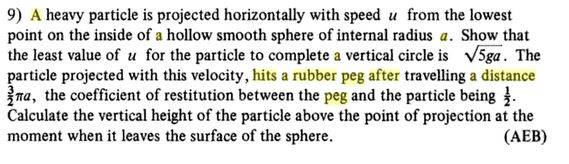
I've got the first part, u = √(5ga)
Here's my diagram for the second part:
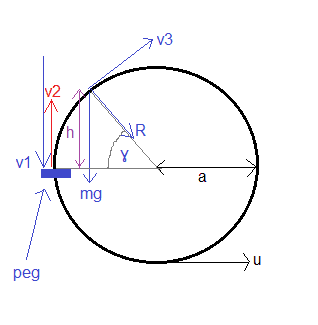
Distance traveled is from bottom of sphere to peg is 2πa/3 which means angle traveled is 2π/3.
So the particlee is going to travel 2π/3 radians and then hit the peg with velocity v1. It will rebound with velocity v2 after that will have a general position with velocity v3 and normal reaction R.
So, equating energy at start of motion at bottom of sphere with that at arrival at the peg we have:
½ m u^2 = ½ m v1^2 + mga
This rearranges to give:
v1 = √(u^2-2ga)
and as coefficient of restitution = ½ we then have:
v2 = ½ √(u^2-2ga)
So now, equate energy just after rebound with energy in general position to get:
½ m * ¼(u^2-2ga) = ½ m v3^2 + mga sin(ϒ)
This rearranges to give:
v3^2 = u^2/4 + ga/2 - 2ga sin(ϒ)
Now, centripetal force at general position is given by:
R + mg sin(ϒ) = m*v3^2/a
Substitute in for v3^2 from prior equation to get
R + mg sin(ϒ) = mu^2/4a + mg/2 - 2gma sin(ϒ)
Now we set R = 0 (this will be where the particle looses contact with the surface), then cancel through by m and substitute in that u = √(5ga) to get:
3g sin(ϒ) = 7g/4
This leads to sin(ϒ) = 7/12 = h / a and so
h = 7a/12 which would give an answer of 7a/12 + a = 19a/12
BUT the book asnwer is 5a/4
Thanks for any help,
Mitch.
I've got the first part, u = √(5ga)
Here's my diagram for the second part:
Distance traveled is from bottom of sphere to peg is 2πa/3 which means angle traveled is 2π/3.
So the particlee is going to travel 2π/3 radians and then hit the peg with velocity v1. It will rebound with velocity v2 after that will have a general position with velocity v3 and normal reaction R.
So, equating energy at start of motion at bottom of sphere with that at arrival at the peg we have:
½ m u^2 = ½ m v1^2 + mga
This rearranges to give:
v1 = √(u^2-2ga)
and as coefficient of restitution = ½ we then have:
v2 = ½ √(u^2-2ga)
So now, equate energy just after rebound with energy in general position to get:
½ m * ¼(u^2-2ga) = ½ m v3^2 + mga sin(ϒ)
This rearranges to give:
v3^2 = u^2/4 + ga/2 - 2ga sin(ϒ)
Now, centripetal force at general position is given by:
R + mg sin(ϒ) = m*v3^2/a
Substitute in for v3^2 from prior equation to get
R + mg sin(ϒ) = mu^2/4a + mg/2 - 2gma sin(ϒ)
Now we set R = 0 (this will be where the particle looses contact with the surface), then cancel through by m and substitute in that u = √(5ga) to get:
3g sin(ϒ) = 7g/4
This leads to sin(ϒ) = 7/12 = h / a and so
h = 7a/12 which would give an answer of 7a/12 + a = 19a/12
BUT the book asnwer is 5a/4
Thanks for any help,
Mitch.
Attachments


