One Dimensional Slab Heat Transfer Taylor Expansion in Glasstone

Click For Summary
SUMMARY

The discussion centers on the application of Taylor series expansion in the context of one-dimensional slab heat transfer as described in Sam Glasstone's 'Nuclear Reactor Engineering'. Participants clarify the incremental form of the Taylor series, specifically how the expression (dt/dx)_(x+dx) relates to net heat flow calculations. The derivation involves substituting Fourier's law into the net heat flow equation, leading to the heat equation. Key points include the distinction between total and partial differentials and the importance of neglecting higher-order terms in small increments.

PREREQUISITES
  • Understanding of Taylor series expansion
  • Familiarity with Fourier's law of heat conduction
  • Basic knowledge of differential equations
  • Concept of partial and total differentials
NEXT STEPS
  • Study the derivation of the heat equation from first principles
  • Explore advanced applications of Taylor series in engineering contexts
  • Learn about the implications of neglecting higher-order terms in series expansions
  • Investigate the relationship between heat transfer and differential equations
USEFUL FOR

Students and professionals in thermal engineering, physicists, and anyone involved in the analysis of heat transfer processes using mathematical modeling techniques.

terryphi
Messages
57
Reaction score
0
Hi There,

I came across the following passage in Sam Glasstone's 'Nuclear Reactor Engineering'

WqhHDFw.png


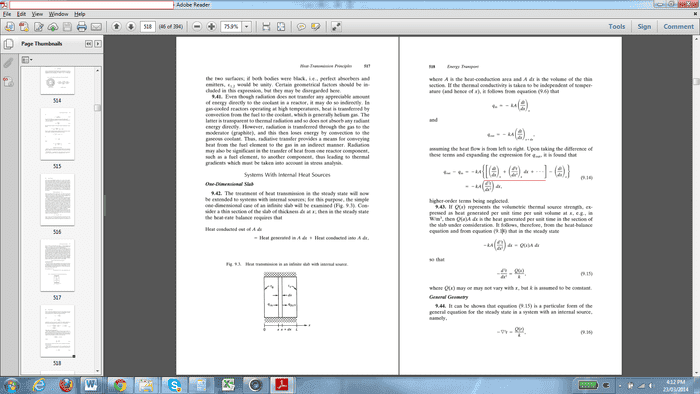
See where I underlined in red that taylor series expansion? I don't understand how (dt/dx)_(x+dx) is equal to that.

I know it's a Taylor series expansion, but where did the x+dx go?
 
Engineering news on Phys.org
I'm sorry you are not generating any responses at the moment. Is there any additional information you can share with us? Any new findings?
 
Well,

I know it's the incremental form of the Taylor series:
http://geophysics.ou.edu/solid_earth/readings/taylor/taylor.html

But I have no clue how to derive this incremental form.
 
Last edited by a moderator:
The differential is supposed to be small, so we can neglect higher order terms in the Taylor series expansion since squaring a small number will give you an even smaller number. So you have heat entering and exiting your differential control volume,

That is Net Heat Flow:

qx- qx+dx.

See the heat enters at position x and leaves at a position x + a very small amount (dx). Now if we do a Taylor series expansion

qx+dx= qx +(dqx/dx)*dx

Take this expression and substitute into the above expression for net heat flow.

qx-qx+dx=qx-qx+(dqx/dx)*dx

Then:
qx-qx+dx=(-dqx/dx)*dx

No you can't cancel those two dx terms because one is a partial differential and the other is total. The one in parentheses is the partial differential.

Now we can describe qx using Fourier's law

qx=-kA(dT/dx).

Substitute this into our above expression

-d/dx*(-k *dydz*dT/dx)*dx

Net heat flow in x direction is now

d/dx*(kdT/dx)*dxdydz

The area in the x direction is given by y times z, similarly in the y direction area will be given by x and z

If you do those equations for the y and z directions and then divide the whole equation by dxdydz you will obtain the heat equation.

I assume you were ok with the other terms in the heat equation. If not I'm happy to explain the derivation of those as well
 
terryphi,

I looks like a Taylor series expansion for the first derivative instead of the function itself.

The Taylor series expansion for function "f" about x = 0 is:

f(x) = f(0) + df/dx dx + 1/2 d2f/dx2 (dx)^2...

In this case, the function f is dT/dx; so all the derivative are one degree higher.

Greg
 

Similar threads

  • · Replies 3 ·
Replies
3
Views
1K
  • · Replies 3 ·
Replies
3
Views
1K
  • · Replies 3 ·
Replies
3
Views
2K
  • · Replies 9 ·
Replies
9
Views
2K
  • · Replies 5 ·
Replies
5
Views
3K
  • · Replies 8 ·
Replies
8
Views
1K
  • · Replies 2 ·
Replies
2
Views
2K
  • · Replies 1 ·
Replies
1
Views
2K
  • · Replies 2 ·
Replies
2
Views
1K
  • · Replies 4 ·
Replies
4
Views
2K