Op amp transfer function determination ()

Click For Summary
SUMMARY

The discussion focuses on determining the transfer function of an operational amplifier (op-amp) circuit configured as an active low pass filter. The relationship between the output voltage (Vout) and the input voltage (Vs) is defined by the equation Vout/Vs = -(Zf/Zs), where Zf represents the feedback impedance and Zs represents the source impedance. The user seeks clarification on incorporating a second input (V1) into the transfer function, emphasizing the need to derive two distinct transfer functions due to the presence of two input sources. The final goal is to express Vout as the difference between the two outputs derived from each input.

PREREQUISITES
  • Understanding of operational amplifier configurations
  • Familiarity with transfer functions in control systems
  • Knowledge of impedance calculations (Zf and Zs)
  • Basic concepts of active filters and their applications
NEXT STEPS
  • Study the derivation of transfer functions for op-amp circuits
  • Learn about feedback networks in active filter design
  • Explore the concept of complex impedance in AC circuits
  • Investigate the differences between inverting and non-inverting op-amp configurations
USEFUL FOR

Electrical engineers, students studying circuit design, and anyone involved in the analysis or design of op-amp based filtering circuits.

android25ua
Messages
1
Reaction score
0
OP warned about not using the homework template
Hey guys, need help with a problem here.

Sorry for the quality of the image.
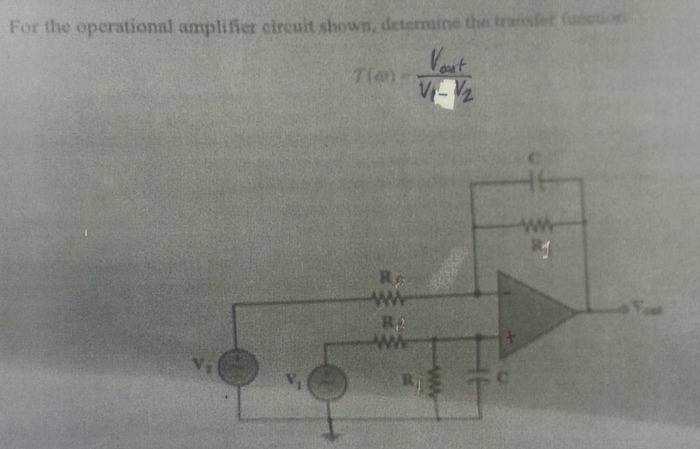
2q0r6tg.jpg


I understand that above the op-amp, is the active low pass filter. So if I were to figure that out with respect to V2 and Vout, it would just be

Vout/Vs = -(Zf/Zs)

where

Zf = (Rf/(1+jwCfRf))
Zs = Rs

But I don't understand how the bottom setup comes into the equation. I realize it must also be a filter and should be solved wrt V1.

And I am asked to find the transfer function Vout/V1-V2.

All help would be greatly appreciated.
 
Physics news on Phys.org
Because you have two input sources you can derive two different transfer functions (one inverting and the other one non-inverting).
And - as a second step - it should not be a problem to substract both functions Vout=Vout1-Vout2.
 

Similar threads

  • · Replies 4 ·
Replies
4
Views
3K
Replies
15
Views
3K
  • · Replies 5 ·
Replies
5
Views
5K
  • · Replies 5 ·
Replies
5
Views
2K
  • · Replies 11 ·
Replies
11
Views
4K
  • · Replies 4 ·
Replies
4
Views
2K
  • · Replies 9 ·
Replies
9
Views
2K
  • · Replies 16 ·
Replies
16
Views
4K
  • · Replies 13 ·
Replies
13
Views
2K
  • · Replies 9 ·
Replies
9
Views
2K