euphoricrhino
- 23
- 14
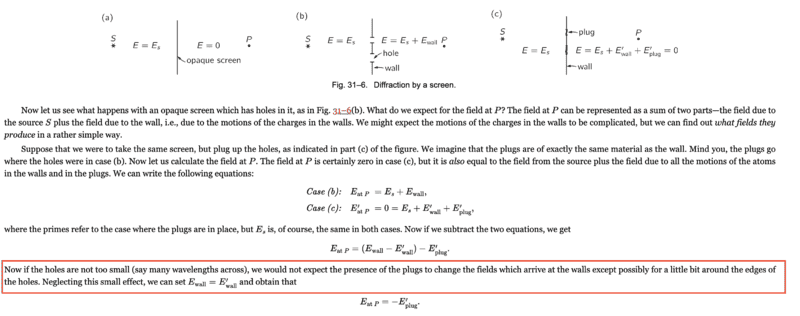
In Feynman lectures vol I, last part of chapter 31, there was this argument about electric field on the other side of the opaque wall with holes.
The argument is attached below. I'm having a hard time understanding the claim in the red box. In particular, I failed to see how "fields arrive at the wall" not being changed by the plugs can be an argument for Ewall=E'wall, which are the fields generated by the wall charges at point P.
This argument seems to say that the approximation in the claim works well with "big" holes (not holes with size comparable to the wavelength). And the result was also used in the previous chapter, where the hole is pretty much half of the infinite plane. I'm failing to see when the hole is this big, Ewall=E'wall can still hold.
Did I miss something obvious? Can someone please enlighten me?
Thanks!
The argument is attached below. I'm having a hard time understanding the claim in the red box. In particular, I failed to see how "fields arrive at the wall" not being changed by the plugs can be an argument for Ewall=E'wall, which are the fields generated by the wall charges at point P.
This argument seems to say that the approximation in the claim works well with "big" holes (not holes with size comparable to the wavelength). And the result was also used in the previous chapter, where the hole is pretty much half of the infinite plane. I'm failing to see when the hole is this big, Ewall=E'wall can still hold.
Did I miss something obvious? Can someone please enlighten me?
Thanks!