- 1,045
- 775
- TL;DR
- How can we get the average value around a point of an oscillating function that has an increasing envelope?
First some background, then the actual question...
Background:
(a) Very simple example: if we take ##Asin(x+ϕ)+0.1##, the average is obviously 0.1, which we can express as the integral over one period of the sine function. (assume that we know the period, but don't know the phase or other parameters of the function).
(b) More complicated example: Take ##x^2 sin(x+\phi) + 0.1##
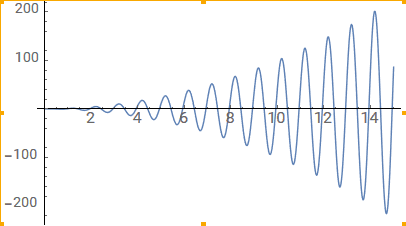 Here simple integration won't help, because the integral depends on where in the cycle we start from. If we integrate a positive half-cycle first and then a negative half-cycle, we get a negative result, and vice versa. To avoid favoring either the positive or negative half cycles, we can multiply our function by a window function:
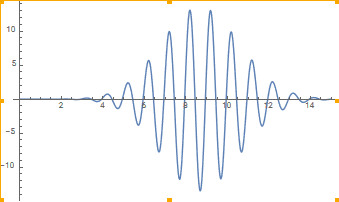 And now if we integrate over the window we can retrieve the bias (average) of 0.1.
Question:
Can we have a more rigorous way of recovering the "0.1" that gives the same result as the windowing method? Something that involves a smart way of integrating over one cycle (or a whole number of cycles) in different ways, then combining them and calibrating out the growth (envelope) function? -- But without actually knowing the envelope function explicitly?
Background:
(a) Very simple example: if we take ##Asin(x+ϕ)+0.1##, the average is obviously 0.1, which we can express as the integral over one period of the sine function. (assume that we know the period, but don't know the phase or other parameters of the function).
(b) More complicated example: Take ##x^2 sin(x+\phi) + 0.1##
Question:
Can we have a more rigorous way of recovering the "0.1" that gives the same result as the windowing method? Something that involves a smart way of integrating over one cycle (or a whole number of cycles) in different ways, then combining them and calibrating out the growth (envelope) function? -- But without actually knowing the envelope function explicitly?
Last edited: