Julez55
- 3
- 0
- TL;DR
- I'm designing a torpedo that is propelled by compressed air, essentially it is a rocket. The challenging part is the torpedo needs to have a speed low enough such that getting hit by it will not leave a bruise. I need to determine what to pressurize the vessel to. The vessel will be a 12g CO2 cannister filled with compressed air.
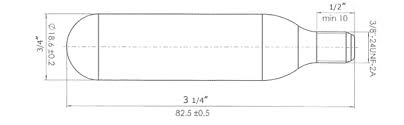
1. A CO2 canister with the following dimensions will be used.
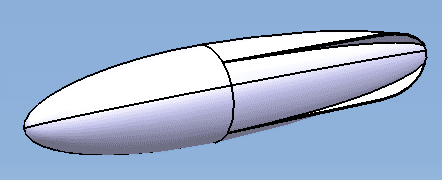
2. A shell was designed to house the CO2 canister, and the coefficient of drag was calculated to be 0.33
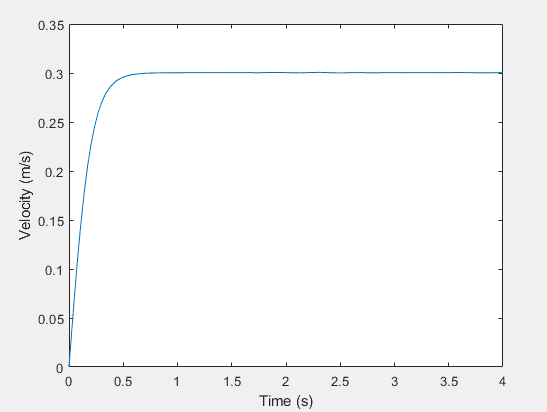
3. The constant thrust required to move the torpedo at approximately 1ft/s was found by using a free body diagram to generate an equation of motion for the torpedo: T(Po1) - D(ẋ) =mẍ, where D(ẋ) = =.5CdAẋ2. The ODE was solved in Matlab with variable thrust inputs. The thrust required to move the torpedo 1ft/s was determined to be a consntant .25N.
4. A Matlab code was generated to determine the Thrust as a function of A/A* using isentropic flow relations , where A* is the exit area of the CO2 cannister giving an exit velocity of M = 1.
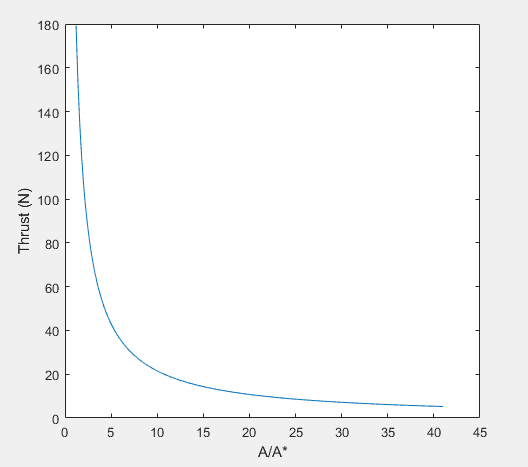
The figure of Trust versus the area ratio shows that thrust asymptotically approaches zero as the area ratio increases. For the configuration of the CO2 cannister A/A* = 4, and is therefore generating about 110 Newtons of thrust which is far too large.
My question is, is it possible with the given area ratio of the CO2 cannister to generate .25N of thrust? I feel like I hit a bit of a brick wall with my design, as I was planning to choke the flow.
A side question, as I had two professors tell me two different things. Let's say we have a choked flow with a constant A/A*, and P/P* = 2. One professor told me the Thrust will be constant as long as the Pressure ratio is above P/P*=2, yielding a constant massflow until the pressure ratio is below P/P*=2, this makes sense to me. The other professor told me if the pressure ratio is above P/P* = 2 the Thrust isn't constant and will have a mass flow as a function of time.
2. A shell was designed to house the CO2 canister, and the coefficient of drag was calculated to be 0.33
3. The constant thrust required to move the torpedo at approximately 1ft/s was found by using a free body diagram to generate an equation of motion for the torpedo: T(Po1) - D(ẋ) =mẍ, where D(ẋ) = =.5CdAẋ2. The ODE was solved in Matlab with variable thrust inputs. The thrust required to move the torpedo 1ft/s was determined to be a consntant .25N.
4. A Matlab code was generated to determine the Thrust as a function of A/A* using isentropic flow relations , where A* is the exit area of the CO2 cannister giving an exit velocity of M = 1.
The figure of Trust versus the area ratio shows that thrust asymptotically approaches zero as the area ratio increases. For the configuration of the CO2 cannister A/A* = 4, and is therefore generating about 110 Newtons of thrust which is far too large.
My question is, is it possible with the given area ratio of the CO2 cannister to generate .25N of thrust? I feel like I hit a bit of a brick wall with my design, as I was planning to choke the flow.
A side question, as I had two professors tell me two different things. Let's say we have a choked flow with a constant A/A*, and P/P* = 2. One professor told me the Thrust will be constant as long as the Pressure ratio is above P/P*=2, yielding a constant massflow until the pressure ratio is below P/P*=2, this makes sense to me. The other professor told me if the pressure ratio is above P/P* = 2 the Thrust isn't constant and will have a mass flow as a function of time.
