Understanding Orbital Geodesics in General Relativity

  • Context: High School 
  • Thread starter Thread starter Ziang
  • Start date Start date
  • Tags Tags
    Geodesics Orbits
Click For Summary
SUMMARY

The discussion centers on the interpretation of orbital geodesics in General Relativity (GR) as they relate to the motion of a missile orbiting Earth. Participants clarify that the missile's trajectory is a geodesic in 4-D spacetime, projecting onto 3-D space, and emphasize that the rotation of the missile does not affect the geodesic path of its center of mass. The conversation highlights the distinction between geodesic motion and the non-geodesic motion of the missile's components due to internal forces. Ultimately, the discussion concludes that both Newtonian mechanics and GR can describe the missile's motion, but the initial conditions dictate whether the missile rotates during its orbit.

PREREQUISITES
  • Understanding of General Relativity (GR) principles
  • Familiarity with geodesics in 4-D spacetime
  • Knowledge of Newtonian mechanics and orbital dynamics
  • Basic concepts of angular momentum and rotational motion
NEXT STEPS
  • Study the mathematical formulation of geodesics in General Relativity
  • Explore the differences between Newtonian and relativistic orbital mechanics
  • Investigate the effects of tidal forces on satellite orbits
  • Learn about the role of angular momentum in orbital dynamics
USEFUL FOR

Physicists, aerospace engineers, and students of gravitational physics seeking to deepen their understanding of orbital mechanics and the implications of General Relativity on motion in curved spacetime.

Ziang
Messages
66
Reaction score
0
In the following link,
https://en.wikipedia.org/wiki/Geodesics_in_general_relativity
they write:"the path of a planet orbiting around a star is the projection of a geodesic of the curved 4-D spacetime geometry around the star onto 3-D space."

Is there anything wrong with the following circular orbit of a missile around the Earth?
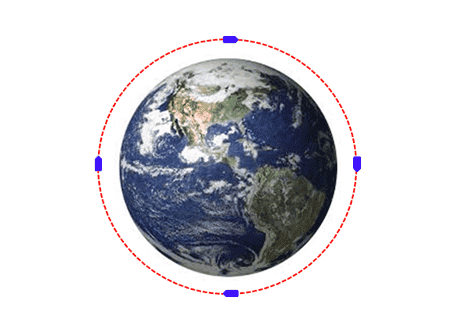
Newton_missle.png
 

Attachments

  • Newton_missle.png
    Newton_missle.png
    26.9 KB · Views: 883
Physics news on Phys.org
Not really. Why do you ask?
 
The path of a missile orbiting around the Earth is the projection of a geodesic of the curved 4-D spacetime geometry around the Earth onto 3-D space. Say the missile is orbiting on xy plane, forgetting about z and replacing z-axis by time, its geodesic draws a spiral in this (2+1)D space.
 
Let me show another circular orbit (orbit 2) as the following
newton_missle_2.png

Picture2: Orbit 2 of the missile

In the orbit 2 above, the main axis of the missile does not change its direction.

If the missile was fired horizontally only one time (at the top position to get the speed for a circular orbit), then you say orbit 1 (post#1) would be the orbit of the missile based on GR, Ibix?
 

Attachments

  • newton_missle_2.png
    newton_missle_2.png
    23.8 KB · Views: 839
The orbit is the trajectory of the center of mass of the object, so has nothing to do with the direction in which the nose of the missile points. Your two pictures both show the same circular orbit.

In one of the pictures, the missile is rotating once so the direction the nose points is changing over time, and in the other the missile is not rotating so the nose always points in the same direction.

None of this has anything to do with general relativity.
 
Ziang said:
If the missile was fired horizontally only one time (at the top position to get the speed for a circular orbit), then you say orbit 1 (post#1) would be the orbit of the missile based on GR, Ibix?
As Nugatory says, it depends on what initial rotation you specify.
 
Either picture is possible, depending on exactly how the missile is launched. I believe that the second picture is what you would get if you launched the missile from space at exactly the right altitude, with the initial velocity pointed along the direction of the orbit. Of course, that's not how circular orbits are actually obtained. Instead, you launch from Earth in a highly elliptical orbit, and then make corrections once it gets into place. The rotation of the missile afterward can be just about anything, depending on the corrections.
 
Just to add some irrelevant partially off topic detail, satellites usually need some sort of station keeping adjustments both to the orbit and the orientation. There are several schemes used. Small perturbations are caused by tidal force, solar wind, fuel sloshing around and so on. The Kepler satellite used reaction wheels (gyroscopes) to keep it accurately pointed. Failure in one or more of these wheels is why the mission was changed.
 
GR says orbits are geodesic lines which are "straight lines" in spacetime. In what geodesic line, picture 1 or 2, the missile turns its nose?
 
  • #10
Ziang said:
GR says orbits are geodesic lines which are "straight lines" in spacetime. In what geodesic line, picture 1 or 2, the missile turns its nose?

Answered here:

Nugatory said:
In one of the pictures, the missile is rotating once so the direction the nose points is changing over time, and in the other the missile is not rotating so the nose always points in the same direction.

None of this has anything to do with general relativity.
 
  • #11
Ziang said:
GR says orbits are geodesic lines which are "straight lines" in spacetime. In what geodesic line, picture 1 or 2, the missile turns its nose?

Geodesics describe the path of the center of mass of the missile. The rotation of the missile is not described by a geodesic. A geodesic is the path of a particle of neglible size and mass in the absence of non-gravitational forces. The various parts of the missile have forces acting on them--the mechanical forces that keep the rocket's shape constant. In the absence of non-gravitational forces, the rocket would not rotate; the various particles making up the rocket would go their separate ways.

For the center of mass, though, the non-gravitational forces cancel, so the motion is approximately a geodesic.
 
  • #12
Ziang said:
GR says orbits are geodesic lines which are "straight lines" in spacetime. In what geodesic line, picture 1 or 2, the missile turns its nose?

Your question can be framed as, in the frame of the missile what torques act on it? There may be very weak tidal torques for a non-spherical missile which is a gravitational effect.
 
  • #13
In the Newtonian mechanics' view, the orbit is a circle in 3D space, the missile does turn its nose in picture 1 and does not turn its nose in picture 2.
In GRs' view, in what picture the missile turns its nose in the geodesic line, a straight line in spacetime?
 
  • #14
Ziang said:
In the Newtonian mechanics' view, the orbit is a circle in 3D space, the missile does turn its nose in picture 1 and does not turn its nose in picture 2.
In GRs' view, in what picture the missile turns its nose in the geodesic line, a straight line in spacetime?

Near the Earth, GR is a minor correction to Newtonian gravity. Picture 2 is the way the missile would behave according to both.

In picture 1, the missile has a nonzero angular momentum about its center of mass. This is true in both Newtonian physics and GR.
 
  • #15
I would like to know in what picture the missile turns its nose in the geodesic line based on the GRs' view.
 
  • #16
Ziang said:
I would like to know in what picture the missile turns its nose in the geodesic line based on the GRs' view.
It depends on the initial conditions. Both pictures are valid. You've been told this several times.
 
  • #17
I know both are possible.

Ziang said:
In the Newtonian mechanics' view, the orbit is a circle in 3D space, the missile does turn its nose in picture 1 and does not turn its nose in picture 2.
Because GR's view is different from 3D space concept, I can say that based on GR's view the missile keeps rotating its nose during its inertial motion on its geodesic line in picture 2.
 
  • #18
Ziang said:
I would like to know in what picture the missile turns its nose in the geodesic line based on the GRs' view.
The nose does not necessarily follow a geodesic.
 
  • #19
Ziang said:
I know both are possible.

Because GR's view is different from 3D space concept, I can say that based on GR's view the missile keeps rotating its nose during its inertial motion on its geodesic line in picture 2.
As you have been told three or four times, that depends on initial conditions, both in Newtonian gravity and GR.
 
  • #20
Ziang said:
I would like to know in what picture the missile turns its nose in the geodesic line based on the GRs' view.

The missile is a bound object, so the motion of every point in it other than its center of mass will not be a geodesic. Only the motion of its center of mass will be a geodesic. The motion of every other point, including the nose, will be a non-geodesic path determined by the initial conditions (as has already been pointed out) plus the internal forces between the different parts of the missile.
 
  • #21
Ziang said:
In the Newtonian mechanics' view, the orbit is a circle in 3D space, the missile does turn its nose in picture 1 and does not turn its nose in picture 2.
That is not correct. In both Newtonian mechanics and GR, the nose remains pointed in the same direction unless you initially set things up so that the missile is rotating around its center of mass. Either way, the motion of the center of mass of the missile is the same.
In GRs' view, in what picture the missile turns its nose in the geodesic line, a straight line in spacetime?
Whether the missile's nose turns or not has nothing to do with differences between GR and special relativity. Neither says that the missile must turn or not turn. If the missile was rotating when it was injected into its orbit, it will keep on rotating as it orbits; if it wasn't rotating when it was injected into its orbit then it will keep on not rotating as it orbits.

One thing is worth mentioning: In your very first picture, the one in which the nose of the missile is always pointing in the direction the missile is travelling... That shows how things look when the missile started out pointing in the direction of travel and rotating about its its axis exactly once per orbital period.
 
  • #22
Ziang said:
I know both are possible.Because GR's view is different from 3D space concept, I can say that based on GR's view the missile keeps rotating its nose during its inertial motion on its geodesic line in picture 2.

Now let us take a look at the solar system,
The planets are definitely "favored" to orbit as shown in picture 2.
This "favorite" can be easy to explain with planets' spin motions based on Newtonian mechanics.
How can GR explain the planets "favor" to rotate their moving direction during their inertial motions on their geodesic lines?
 
  • #23
Ziang said:
The planets are definitely "favored" to orbit as shown in picture 2.

No, they aren't. Planetary rotation periods relative to their orbital periods vary all over the place. For example, the Earth looks nothing at all like picture 2, or picture 1 for that matter; it rotates with respect to the stars 366 times for each orbit around the sun. But the Earth is fairly normal compared to some other planets; for example, Venus rotates backwards (retrograde), and Uranus's axis of rotation lies close to the plane of its orbit, not anywhere near close to perpendicular to it.

At this point I am closing this thread since your original question in the OP has been answered, repeatedly, and you clearly do not understand the actual dynamics of the systems you are talking about.
 

Similar threads

  • · Replies 51 ·
2
Replies
51
Views
6K
  • · Replies 25 ·
Replies
25
Views
3K
  • · Replies 13 ·
Replies
13
Views
3K
Replies
82
Views
5K
  • · Replies 27 ·
Replies
27
Views
7K
Replies
29
Views
3K
  • · Replies 31 ·
2
Replies
31
Views
3K
  • · Replies 11 ·
Replies
11
Views
2K
  • · Replies 10 ·
Replies
10
Views
2K
  • · Replies 4 ·
Replies
4
Views
2K