Orthogonality Relationship for Legendre Polynomials

Click For Summary
SUMMARY

The discussion centers on the orthogonalization of the polynomial basis {1, x, x²} and its relationship to Legendre polynomials. The user successfully identified an orthogonal basis but failed to achieve orthonormality due to incorrect normalization. The integral $$\int_{-1}^1 dx (x^2 - 1/3)^2$$ was computed, yielding 8/45, but further normalization was necessary. The correct orthonormal polynomials for the interval [-1, 1] are given as ##p_0(x) = \pm\frac{1}{\sqrt{2}}## and ##p_1(x) = \pm\sqrt{\frac{3}{2}}x##, differing from the original monomials.

PREREQUISITES
  • Understanding of polynomial functions and their properties
  • Knowledge of orthogonality and orthonormality in function spaces
  • Familiarity with Legendre polynomials and their definitions
  • Ability to compute definite integrals, particularly over the interval [-1, 1]
NEXT STEPS
  • Learn about the normalization process for orthogonal polynomials
  • Study the properties and applications of Legendre polynomials
  • Explore the Gram-Schmidt process for orthogonalization of polynomial bases
  • Investigate the implications of orthonormal bases in functional analysis
USEFUL FOR

Mathematicians, physicists, and students studying polynomial approximation, orthogonal functions, and numerical methods in applied mathematics.

LCSphysicist
Messages
644
Reaction score
163
Homework Statement
I am trying to orthogonalize {1,x,x²}
Relevant Equations
Just the inner product of functions space.
Suppose p = a + bx + cx².
I am trying to orthogonalize the basis {1,x,x²}
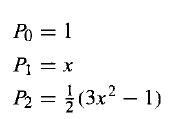
I finished finding {1,x,x²-(1/3)}, but this seems different from the second legendre polynomial.
1601451062834.png

What is the problem here? I thought could be the a problem about orthonormalization, but check and is not.
 
Physics news on Phys.org
Your basis is orthogonal but not orthonormal. You need to compute the normalization for your third basis function, i.e. $$\int_{-1}^1 dx (x^2 - 1/3)^2$$.
 
eys_physics said:
Your basis is orthogonal but not orthonormal. You need to compute the normalization for your third basis function, i.e. $$\int_{-1}^1 dx (x^2 - 1/3)^2$$.
Yeh, but as i said, i already do it. The integrate gives 8/45, taking the square and dividing by the module not get yet.
 
Vendo seu perfil, acho que daria pra te responder em portugues :D
 
Legendre polynomials are orthogonal but not orthonormal over the interval ##[-1,1]##. Thus, you shouldn't expect your orthonormal basis to be identical to the Legendre polynomials.

NB. If you are trying to construct and orthonormal set ##\{p_0,p_1,p_2\}## of polynomials over the interval ##[-1,1]## from the set ##\{1,x,x^2\}## of monomials. Then the first two are ##p_0(x) = \pm\frac{1}{\sqrt{2}}## and ##p_1(x) = \pm\sqrt{\frac{3}{2}}x## and not ##p_0(x) = 1## and ##p_1(x) = x##. As you can see, you have choice to make regarding the signs of ##p_0(x)## and ##p_1(x)##.
 
The Legendre polynomials are usually normalized such that ##P_n(1) = 1##.
 

Similar threads

  • · Replies 1 ·
Replies
1
Views
2K
  • · Replies 18 ·
Replies
18
Views
5K
  • · Replies 5 ·
Replies
5
Views
2K
  • · Replies 3 ·
Replies
3
Views
2K
  • · Replies 1 ·
Replies
1
Views
3K
  • · Replies 2 ·
Replies
2
Views
1K
  • · Replies 2 ·
Replies
2
Views
4K
  • · Replies 3 ·
Replies
3
Views
2K
  • · Replies 2 ·
Replies
2
Views
4K
  • · Replies 1 ·
Replies
1
Views
2K