Outlet adapter to mimic a car battery to power 12V devices

Click For Summary

Discussion Overview

The discussion revolves around the feasibility of using a 12V DC wall adapter to power a car RGB LED light indoors. Participants explore different wiring options, including the use of connectors and direct wiring, while considering the necessary amperage and polarity for the adapter.

Discussion Character

  • Exploratory
  • Technical explanation
  • Debate/contested

Main Points Raised

  • One participant questions whether they can replace the existing wiring with a 12V DC wall adapter and asks about the suitability of different wiring methods.
  • Another participant advises against wiring the adapter directly to the light, suggesting that using the provided connector is safer and maintains warranty validity.
  • Concerns are raised about the current requirements for the adapter, with suggestions to match the adapter's rating to the fuse provided.
  • A participant shares their experience using a battery to power similar devices and notes that wall adapters typically have lower power outputs compared to automotive solutions.
  • There is a suggestion to ensure the adapter can handle the light's power draw, with emphasis on using an adapter rated for the same or greater current than the fuse.

Areas of Agreement / Disagreement

Participants express differing opinions on the best approach to wiring the adapter, with some advocating for using the original connector while others suggest direct wiring may be acceptable. There is no consensus on the optimal method or the specific requirements for the wall adapter.

Contextual Notes

Participants note the importance of understanding the current requirements of the LED light and the limitations of wall adapters compared to automotive power sources. There is also a caution against working with mains voltage AC.

Who May Find This Useful

Individuals interested in DIY electronics, particularly those looking to adapt automotive lighting for indoor use or seeking advice on power supply options for low-voltage devices.

DagmaarUlereich
Messages
6
Reaction score
2
Sorry if this is a very simple question but i have been googling and looking around for a straight anwser but can seem to find a solid answere or draw a solid conclusion from information I've reached. So

I have a rgb led light for a car, the box says input 12vDC.
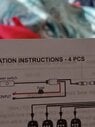
if I wanted to set these up indoors could I take the entire wire set up photo attached
( includes on off switch, a fuse, input leads and a male coupler that fits into the female coupling of the light controller)
and simply replace it with a 12vDc wall adapter with the appropriate sized coupler?

Also would it be possible or smarter/better to use any 12vDc wall adapter of the appropriate amperage & polarity and remove the coupler and just wire the adapter straight to the Power imput leads?

If either idea is suitable then what should the amperage and polarity of the wall adapter be?
Thank you for letting me post such a question.
And thanks to anyone who chimes in :)
 

Attachments

  • 16824329351372845485629935715409.jpg
    16824329351372845485629935715409.jpg
    30.1 KB · Views: 132
Engineering news on Phys.org
Welcome to PF.

DagmaarUlereich said:
Also would it be possible or smarter/better to use any 12vDc wall adapter of the appropriate amperage & polarity and remove the coupler and just wire the adapter straight to the Power imput leads?
Avoid wiring the 12VDC adapter directly to the light. It is easier to identify problems if you can unplug the circuit to test it. The warranty would be void if you wired it without the provided connector.

DagmaarUlereich said:
If either idea is suitable then what should the amperage and polarity of the wall adapter be?
Without more information on current requirement, I would suggest that the adaptor be rated for the same current as the fuse provided.
 
  • Like
Likes   Reactions: hutchphd and DagmaarUlereich
Baluncore said:
Welcome to PF.Avoid wiring the 12VDC adapter directly to the light. It is easier to identify problems if you can unplug the circuit to test it. The warranty would be void if you wired it without the provided connector.Without more information on current requirement, I would suggest that the adaptor be rated for the same current as the fuse provided.
Thank you very much for responding.
after reading this i Kinda have the strong urge to face palm myself for even asking, lolbvs I have a big doubts in my own working sense of electronics, so I hope to get over it soon as I gain more experience.
Thanks again !
 
DagmaarUlereich said:
I have a big doubts in my own working sense of electronics, so I hope to get over it soon as I gain more experience.
Stay away from mains voltage AC. You do not need to experience that.
 
  • Like
Likes   Reactions: russ_watters and DagmaarUlereich
Roger, copy that!
 
  • Like
Likes   Reactions: berkeman
I've done this with a big battery and it worked fine. You can go to an auto store and get the reverse socket to plug your light into.

The big question is how much power can your wall adapter output, and is it enough for your light? A cigarette lighter can usually output 150 watts, (12.5 amps at 12 volts) which is a lot more than most wall warts can deliver. As Baluncore says above, check what your light will actually draw and get something a bit bigger.
 
  • Like
Likes   Reactions: phinds
Baluncore said:
Without more information on current requirement, I would suggest that the adaptor be rated for the same current as the fuse provided.
Same or greater, not closest match.
 
  • Like
Likes   Reactions: DagmaarUlereich, Algr and phinds

Similar threads

  • · Replies 7 ·
Replies
7
Views
19K
  • · Replies 4 ·
Replies
4
Views
2K
  • · Replies 4 ·
Replies
4
Views
3K
  • · Replies 2 ·
Replies
2
Views
3K
  • · Replies 1 ·
Replies
1
Views
7K
  • · Replies 5 ·
Replies
5
Views
83K
  • · Replies 2 ·
Replies
2
Views
4K
  • · Replies 9 ·
Replies
9
Views
4K
  • · Replies 4 ·
Replies
4
Views
4K
  • · Replies 2 ·
Replies
2
Views
3K