Paradoxes of the Coulomb friction

  • Context: Graduate 
  • Thread starter Thread starter zwierz
  • Start date Start date
  • Tags Tags
    Coulomb Friction
Click For Summary

Discussion Overview

The discussion revolves around the paradoxes associated with Coulomb's law of friction, particularly in the context of a pendulum system mounted on a moving cart. Participants explore the implications of these paradoxes, including the conditions under which they arise and potential modifications to the system to resolve contradictions.

Discussion Character

  • Exploratory
  • Debate/contested
  • Technical explanation

Main Points Raised

  • Some participants reference Painleve's paradoxes, suggesting that applying Coulomb's law to rigid body systems can lead to contradictions.
  • One participant proposes a specific paradox involving a pendulum and a cart, concluding that if the coefficient of friction exceeds a certain threshold, the normal force becomes negative, implying an impossible scenario where the cart attracts the rod.
  • Another participant suggests that this paradox indicates the rod cannot either sink into or leave the cart, proposing that there are ways to achieve such a state.
  • There is a discussion about the direction of forces acting on the rod, with some participants questioning whether the force of friction rotates the rod clockwise or counterclockwise.
  • One participant compares the situation to a sprag clutch, noting that such mechanisms can allow free motion in one direction while resisting motion in the opposite direction.
  • Another participant suggests that if the friction is too high, the system will lock or break, indicating a practical limitation of the model.
  • Some participants propose alternative models, such as replacing the rod with a strong spring, which could eliminate the contradiction by allowing for compression and rotation without conflict.

Areas of Agreement / Disagreement

Participants express differing views on the implications of the paradox, with no consensus reached on the nature of the forces involved or the validity of the proposed modifications to the system.

Contextual Notes

The discussion highlights the complexity of applying Coulomb's law in dynamic systems and the potential for contradictions based on the chosen parameters, such as the coefficient of friction and the geometry of the setup. Unresolved assumptions about the behavior of the system under various conditions are evident.

zwierz
Messages
334
Reaction score
62
From Painleve we know that Coulomb's law of friction being applied to rigid bodies systems may produce contradictions. Painleve constructed several examples of such contradictions, so called Painleve's paradoxes, see [Painleve P. Leçons sur le frottement. P.: Hermann, 1895]. Those examples are somewhat complicated and contain big formulas.

I would like to propose a completely trivial paradox of Coulomb's friction.
fa2ec27c4008.png

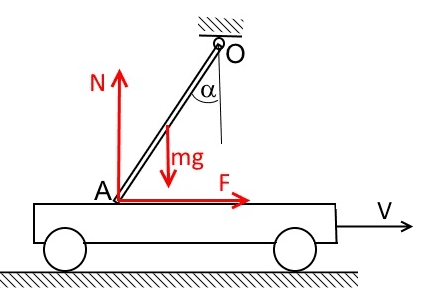
A cart moves from left to right on a horizontal road. Over the cart there is a pendulum with a fixed hing ##O## and a homogeneous rod ##OA## of mass ##m##. Rod's end ##A## rests on the cart such that the angle between the rod and the vertical is equal ##\alpha##.
Let ##N## be a normal reaction force that acts on the rod from the cart and ##F=\gamma N## be a force of friction applied to the rod; ##\gamma## is a coefficient of friction.
Applying the law of torques about the point ##O## we get
$$N=\frac{mg\sin\alpha}{2(\sin\alpha-\gamma\cos\alpha)}.$$ Thus if ##\tan\alpha<\gamma## then ##N<0## and the cart attracts the rod. That is impossible.
 
Physics news on Phys.org
zwierz said:
Thus if ##\tan\alpha<\gamma## then ##N<0## and the cart attracts the rod. That is impossible.
Why? It just means that the rod can neither sink into the cart nor leave the cart. I can think of possible ways to accomplish that.
 
  • Like
Likes   Reactions: Nidum
It means that the reaction N is directed downstairs and thus all the forces rotate the rod in the same direction (counterclockwise) but the rod remains at rest. Contradiction.
 
zwierz said:
all the forces rotate the rod in the same direction (counterclockwise)
Doesn't F rotate clockwise in this case?
 
Isn't this just a simplified linear version of a sprag clutch ?

With suitable geometry these mechanisms allow free motion in one direction and strongly retarded or stopped motion in opposite direction .
.
 
Dale said:
Doesn't F rotate clockwise in this case?
the force of friction acts in the opposite direction of relative velocity. The relative velocity is the same for both cases
 
zwierz said:
Thus if ##\tan\alpha<\gamma## then ##N<0## and the cart attracts the rod. That is impossible.
In reality this means: If friction is too high, the thing will lock or break.
 
Last edited:
we can also replace the rod with a very strong spring
 
zwierz said:
we can also replace the rod with a very strong spring
A spring will compress and rotate counter clockwise, so no contradiction.
 
  • #10
Sure, I just proposed one of the ways to change the model such that the contradiction vanishes.
In reality the rod will likely begin to jump
 

Similar threads

  • · Replies 18 ·
Replies
18
Views
3K
  • · Replies 125 ·
5
Replies
125
Views
20K
Replies
13
Views
5K
  • · Replies 20 ·
Replies
20
Views
11K
  • · Replies 28 ·
Replies
28
Views
7K
  • · Replies 16 ·
Replies
16
Views
7K
  • · Replies 175 ·
6
Replies
175
Views
28K
Replies
1
Views
2K
Replies
2
Views
19K
Replies
1
Views
7K