Parallel/Series DPDT With MOSFETs Help?

  • Thread starter Thread starter AaronS
  • Start date Start date
Click For Summary
The discussion revolves around wiring a DPDT switch with MOSFETs to manage high current levels for an electronic cigarette. The user seeks to create a system that allows toggling between series (8.4V, 30-40 amps) and parallel (4.2V, 30-40 amps) configurations. Concerns are raised about the limitations of small switches handling such loads, prompting the use of MOSFETs for better current management. Safety issues are highlighted, including the need for proper switching protocols to prevent shorts and ensure safe operation. The complexity of the circuit design is acknowledged, suggesting that simpler mechanical solutions might sometimes be more effective.
AaronS
Messages
31
Reaction score
1
Hi everyone, semi beginner here looking for a little help wiring this system. I am looking to use MOSFETs to handle higher current levels and a DPDT switch with toggle between on+off/series/parallel configuration. My idea for the wiring is here:
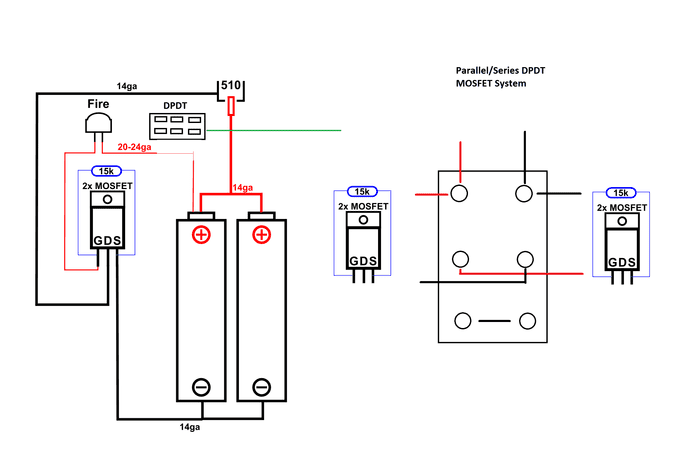
IR3YAyX.png

However I am not sure how to go about wiring the MOSFETs in with the DPDT, any help with a wiring diagram or education is greatly appreciated, here to both do and learn!
 
Engineering news on Phys.org
Can you explain what you are connecting in parallel and series? It it the batteries or a pair or loads? Why is a switch no good for this?

BoB
 
Im connecting them in parallel and series so the person can pick which type they would like to use. This is for a friends birthday present so the series option would be for 8.4v, 30-40 amps, the parallel option would be 4.2v 30-40 amps. Its an electronic cigarette/vape where the user can build a coil to a specific resistance in order to benefit from both options (lower for parallel vs higher resistance builds for series)

The DPDT switches I have found that are small enough to fit within the ~3x5x1 enclosure max out at 20 amps so I was looking to use MOSFETs to handle the current/load.
 
That circuit will be a lot more complicated than just hooking up some wires. Also with those kinds of loads on lithium ion batteries it can get real explody real fast if you don't know what you are doing.

BoB
 
Correct and he knows what he's doing in terms of controlling amp draw via resistance coils, my concern was using gates on MOSFETs to handle the amperage through the DPDT switch
 
  • Like
Likes Averagesupernova
Here is a circuit that you might consider for the job. I offer no guarantee. Any circuit will become explosive if you get it wrong.
Notes:
1. Mosfets have an intrinsic substrate diode, sometimes paralleled by a Schottky diode. The design must account for that ever-present diode in all situations.
2. Controls A and B select parallel or series operation. They should be changed while the batteries are disconnected. Never set A and B high = Vcc at the same time. Always tie B low = Vee when changing A.
3. M1 is a P-Channel mosfet, all other mosfets are N-channel.
4. R1 is the heater element.
5. Press the “fire” button to turn on the heater. Wear safety goggles during testing.
 

Attachments

  • Ser_Par_Switch.png
    Ser_Par_Switch.png
    4.4 KB · Views: 909
Baluncore said:
Here is a circuit that you might consider for the job. I offer no guarantee. Any circuit will become explosive if you get it wrong.
OK, by your schematics I could understand what the OP wants.
Just one remark: switches has an inherent protection against unwanted shorts, what's the distance between the poles.
FETs has nothing like that. There should be some kind of safety delay for switching between the states.
Even better if the 'stable' state is the 'all off', and any switching can be done only through that state.
 
Rive said:
There should be some kind of safety delay for switching between the states.
I considered pull-up and pull-down resistors to safe voltages, but then that current drain would be continuous. It will take a CMOS flip-flop and a couple of gates to build a latch capable of cleanly conditioning the switch, and so managing the A and B gate voltages safely. But designing that is another problem; working out how to minimise the investment in mosfets was enough of a problem.
 
I think some mechanical solution might be OK. One SPDT to control the FETs...

Maybe this is the case when the 'solution' is just more complicated than the original problem?
 
  • #10
Rive said:
I think some mechanical solution might be OK. One SPDT to control the FETs...
Can you control A and B safely with just a switch, without pull-up resistors that waste battery power ?
 
  • #11
Baluncore said:
Can you control A and B safely with just a switch, without pull-up resistors that waste battery power ?
If the control is a switch, then I think you would need just G-S resistors?
But it's possible that SPDT won't be enough...

Ps.: it would be good to know the expected current. If it's not out of the range what an average switch can handle, then I think the best solution for the problem is to forget it. It can be done with FETs, but it's not trivial. Sometimes the good old switches are just better.
 
  • #12
AaronS said:
... the series option would be for 8.4v, 30-40 amps, the parallel option would be 4.2v 30-40 amps. ...
Which is too much current for a small toggle switch.
 
  • #13
Baluncore said:
Which is too much current for a small toggle switch.
True. I missed that part about the current.

It's harder than I thought. Since there is no fixed voltages in the system and the poles are actually separated by default, it's hard to find an adequate gate drive voltage. Otherwise your schematics fits the bill (with some additional G-S resistors). One more issue. The 4.2V suggests that it's a Li-ion battery. Is the 40-50A fits with the maximal current of the battery? Lead-acid can supply some insane currents for limited time, but Li-ion is a bit sensitive for shorts.
 
  • #14
How about going hard series. Then add PWM to the "Fire" control. Instead of high/low/off you get anywhere in between. That is probably easier to make safe and needs only one FET.

Make sure that your control knob goes to 11. That one gets hotter.

BoB
 

Similar threads

  • · Replies 31 ·
2
Replies
31
Views
6K
  • · Replies 3 ·
Replies
3
Views
2K
  • · Replies 4 ·
Replies
4
Views
3K
  • · Replies 17 ·
Replies
17
Views
5K
Replies
24
Views
2K
Replies
10
Views
2K
  • · Replies 79 ·
3
Replies
79
Views
6K
  • · Replies 10 ·
Replies
10
Views
2K
Replies
12
Views
3K
  • · Replies 5 ·
Replies
5
Views
2K