Particle Dynamics Problem (kinematics)

Click For Summary
The discussion revolves around solving a particle dynamics problem using differential equations and initial conditions. The key focus is on determining the launch speed (v0) and the distance (S) from the provided diagram and given data. Participants emphasize the need to express the horizontal speed as a function of acceleration and time to calculate the launch speed accurately. The initial speed is confirmed to be zero, complicating the calculation of v0 just before the jump. Clarification on the problem's wording and the maximum time for the jump is also sought to ensure accurate calculations.
aligator11
Messages
10
Reaction score
0
Thread moved from the technical forums, so no Template is shown
Summary: Mechanics problem related with Calculus (differential equations)
244327

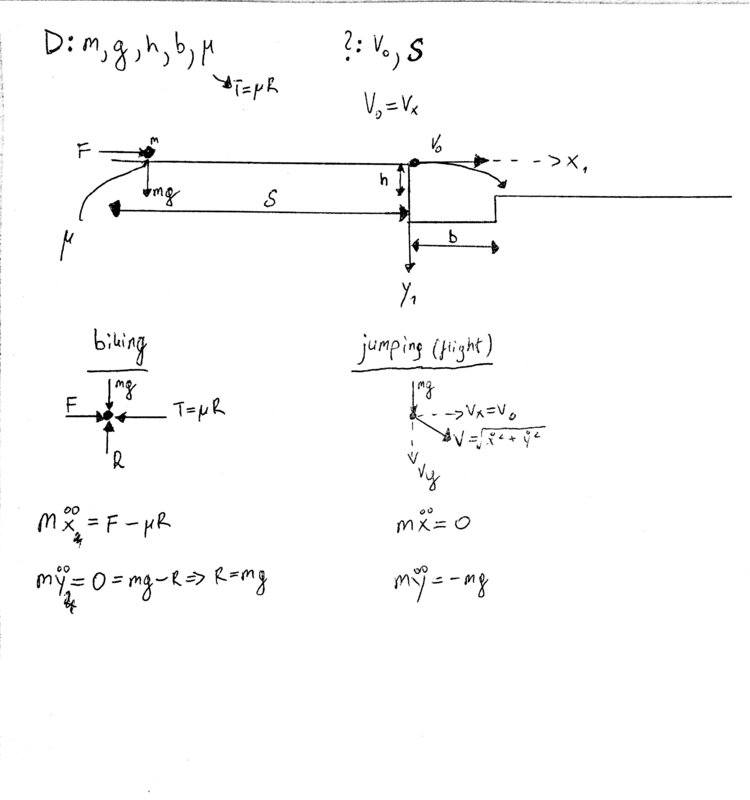
Hi everyone, I would like some help in that task, if anyone would be willing to help :) Namely I have a problem from particle dynamics. "D:" means given info... so, D: m,g,h,b, miu. We're looking for v0 and S as given on the diagram. We need to work out differential equation problems for that task and need to have initial conditions clearly stated.

Underneath the diagram you can see the forces I have already assigned onto the particle body diagrams.

Thanks for all the help I can get from you guys! :)
 
Physics news on Phys.org
Hi aligator11. Welcome to PF!

It would help if you would describe what you are trying to do. It would be just a projectile motion problem if all you wanted to determine is the launch speed. If you want to determine S as well, we would have to know its initial speed. Can you give us the exact wording?

v0 (launch speed) is determined by the projectile motion part of the problem. So that is the first thing you have to determine. Express distance fallen as a function of time. That gives you the time required to jump the horizontal distance. Work out launch speed from that.

Assuming the initial speed is 0 (it starts at rest), express horizontal speed, v, as a function of acceleration and time. Then express distance in terms of acceleration and time.

AM
 
Yes the starting speed (1st initial speed) at the beginning is 0 but we need to find v0, which is the initial speed just before the jump. So that would be problematic. I was trying to reorganize the data the best I could. In terms of the actual wording of the problem the only thing i got was the diagram I posted above, that's it. And of course the given data "D:..." and the components I have to find "?:...". Also we know that at the point where I have my coordinate system, v0=Vx so the horizontal component of velocity which we will probably use in regards with integration of the "jumping" part, system.
 
So what is the maximum time that the body has to make the jump? What happens if it takes longer than that?

AM
 
The book claims the answer is that all the magnitudes are the same because "the gravitational force on the penguin is the same". I'm having trouble understanding this. I thought the buoyant force was equal to the weight of the fluid displaced. Weight depends on mass which depends on density. Therefore, due to the differing densities the buoyant force will be different in each case? Is this incorrect?

Similar threads

  • · Replies 8 ·
Replies
8
Views
2K
Replies
2
Views
4K
  • · Replies 6 ·
Replies
6
Views
2K
  • · Replies 4 ·
Replies
4
Views
2K
  • · Replies 35 ·
2
Replies
35
Views
5K
  • · Replies 4 ·
Replies
4
Views
2K
Replies
8
Views
5K
Replies
4
Views
2K
  • · Replies 1 ·
Replies
1
Views
1K
  • · Replies 14 ·
Replies
14
Views
2K